Sunday, May 22, 2011

HIV/AIDS Activism: Lost in Translation

After dedicating two years of my life to the cause of sustainable development in the Republic of Mali, I came to loathe so-called "aid" projects which are unnecessarily expensive, relatively ineffective, and either achieve their intended goals at an obscenely high ratio of costs to benefits or they accomplish absolutely nothing at all. Perhaps the greatest potential for stupid, wasteful “aid” projects lies in the sub-field of HIV/AIDS education. Part of it is because HIV/AIDS is such a relatively trendy cause and there is simply such a volume of Western aid dollars allocated to HIV/AIDS projects that there is so much more potential for waste. Part of it is because HIV/AIDS is such an ideologically-loaded subject that Western do-gooders are wont to apply their own belief systems onto poor, unwitting Africans. And part of it is that benevolent do-gooders are so completely ignorant of their host country’s culture that when they try to intervene in matters of sexuality they are simply doomed to failure.

Imagine a couple of humanitarian aid professionals – one has a Masters in African Studies from Yale, another went to Princeton to get their Ph.D. in International Relations. A well-meaning NGO just raised $200,000 to send them to do something about AIDS in some poor West African country, say, Niger. So they are sitting around the air-conditioned boardroom of their NGO in the expatriate quarter of Niamey, brain-storming ways to raise the Nigerien people’s awareness about HIV transmission and prevention.

“What if we made a sign to raise awareness about HIV/AIDS?”

“Great idea! Let’s draw up a hundred of them and put them up along heavily-trafficked roads!”

So they will spend about $10,000 to hire a graphic designer in San Francisco who will email his design to a factory in Lyons which will manufacture a hundred or so signs for $20,000. And it will cost another $30,000 to ship the posts from Lyons to the port at Marseilles to the port at Lagos and overland to their NGO headquarters in Niamey. Another $15,000 will be lost to bribing the customs agents. And they will pay the local contractor some grossly inflated price, say, $25,000 to drive around the country, hammer posts in the ground and put up billboards along one lane-roads leading into various cities and towns in Niger.

So when everything is said and done, the perfectly benevolent NGO will have plopped down 100 billboards for a price of around $1,000 each to the grand total of $100,000. Take a hard look at this sign, scrutinize it for about a minute and try to understand why it is such a stupid, festering piece of garbage.

Every piece of information that could possibly be conveyed by this sign can only be understood by those who can read French. Officially, Niger is a Francophone country, there are indeed some people in this country who can speak French – a miniscule minority of teachers, doctors and police officers. But the overwhelming majority of the people only speak their native Hausa, Songraï, Peulh or Tamashek – it is not unfair to assume your typical market lady does not know any “White People Language” beyond “Bozu le Blanc sava sava byen”. Also, the vast majority of people in this country are absolutely illiterate; 71.3 percent of the population, according to the CIA World Factbook – and even that figure is padded by an extremely liberal definition of “literacy” which recognizes anyone who can scrawl their name as “literate”. To 9 out of 10 pedestrians who might be walking down the street in Niamey, that public service announcement might as well be written in ancient Greek.

Likewise, this billboard on the road to the Malian city of Koutiala is also a festering piece of garbage. Imagine you are an illiterate Minianka millet farmer riding your donkey cart to sell your goats at the Koutiala market – what useful lesson in disease prevention could you possibly gain from viewing this $1,000 sign?

This billboard was placed by the Christian NGO World Vision in my former home of Sanadougou. I will give them due credit for writing their public health message in Bambara – Mali’s vernacular lingua franca. It reads “Hey! Be careful, AIDS is here! There is no cure for it.”

Indeed, writing a public health message in Bambara is certainly more sensitive to the local culture compared to writing it in French. But this World Vision billboard is still fatally flawed by the fact that their message was written in any language at all; instead of writing their AIDS-prevention message in ancient Greek, they decided to write it in the equivalent of modern Greek.

To pass the time, I asked scores of my illiterate neighbors for their interpretations of this billboard on the road leading to town. Not a single person I asked was able to tell me that it had anything to do with HIV/AIDS. The closest thing to a logical response I ever heard was “don’t leave razor blades in your bed – they will cut you.”

Sometimes I wonder what part of “illiteracy ” these well-meaning Christian aid-givers don’t understand. To refer to someone as “illiterate” doesn’t me that they can’t fully appreciate the works of Proust; “illiterate” refers to an individual or a group of persons who cannot read or write anything at all. To refer to these cultures as “predominantly illiterate” is not at all a judgment of intelligence or character – it is simply a statement of fact. Likewise, one cannot mount an effective public health campaign in a country like Mali, Niger, Mauritania or Burkina Faso without taking into consideration that the vast majority of your intended audience in these countries is completely and utterly illiterate.

One time I met a World Vision missionary/humanitarian agent in Bamako and took issue with their billboard campaign. She accused me of “insulting the Malian people’s intelligence”; “I work with a number of local staff who are all very capable of reading and writing – one of my colleagues was educated at the Sorbonne and he can read English, French and German!”

This well-meaning church lady’s response was quite telling. When practitioners of “humanitarian aid” and “economic development” live in the expatriate Green Zones of their respective African capitols, they can manage to go months at a time interacting with only the extremely-Westernized, French- or even English-speaking, literate elite, completely sheltered from the social and economic realities of the other 99.999 percent of the population. Such an experience establishes an absurdly rose-tinted perspective of a country’s predominant living conditions – and it allows these naïve, bumbling do-gooders to waste all of their funds on projects which could only benefit the 0.001 percent of the indigenous population with whom they interact at official state functions and the American Club racquetball courts.

Here is another one of my favorite signs posted in the city of Koutiala. If you were a simple unlettered shepherd who speaks the hyper-literal Bambara language completely devoid of metaphor or simile, what would you interpret it to mean?

If I were an illiterate goat-herder, I would think that this billboard meant that AIDS is an anthropomorphic fire demon with a face and arms and legs. In a society where grown men are genuinely afraid of witches, warlocks, hairy field demons, mischievous forest demons and dwarf spirits with backwards feet, it makes perfect sense that benevolent Tubabs would seek to warn the Malian people about the anthropomorphic fire demons which have been wreaking havoc upon America. Likewise, I would interpret this billboard to mean that if this fire demon were to ever try to get into my house, I should push the door shut.

My all-time favorite HIV/AIDS public service announcement is the one line of billboards in Bamako which actually dares to show the image of a condom. Take a look at this public health campaign and try your best to imagine its unintended consequences.

Hardly any Malian men in Bamako ever buy condoms to wear while engaging in sexual intercourse, but – thanks to this fiasco of a public service announcement – when they do buy a condom they are likely to wear it on their two fingers. So they go to the brothel, they fuck a prostitute for 500 francs (~$1), they wear a 100 franc (~20¢) condom on their fingers, and – big surprise – they still contract HIV! So now if any of men or women ever get tested and discover that they are HIV+, they are going to go around telling everyone that either condoms don’t work or that it was the condom itself that transmitted HIV, and any lesson that the well-meaning NGOs might wish to convey will be thoroughly discredited in the public mind.

A ham-handed public health campaign like the infamous “finger bang” billboard is not merely ineffective in combating the transmission of HIV/AIDS – it actually makes the problem worse. Partly thanks to this train wreck of a public health campaign, many young men in Mali think that AIDS is just a hoax. Some have concluded that since people have followed the “finger condom” billboard’s instructions and contracted HIV, The White People are telling Black Africans to wear condoms because we want them to stop reproducing. Others think that AIDS is real, that it was concocted by the CIA to decimate the black population of Africa. Word on the street is that it’s the reservoir tip of the condom which contains the deadly virus; so some people actually buy condoms and cut off the very part of the prophylactic which makes it functional. Since these Western public health campaigns have crashed and burned so egregiously, it figures that polygamous young men resort to “traditional” i.e. witch doctor-prescribed methods like drinking snake oils, herbal teas and having unprotected sex with virgins.

So if these billboards are such absolutely ineffective pieces of garbage, why on Earth do humanitarian aid organizations waste their money on them? Part of the reason is surely that some of the individuals implementing these humanitarian aid campaigns simply don’t get it. But these professional aid-givers with their Ivy League graduate degrees are generally intelligent people – I can’t imagine that all of them are so dense that they don’t understand the folly of expressing public health messages with the written word in a thoroughly illiterate culture.

A more rational explanation for this embarrassing waste might be that Foreign Service Officers and professional development agents are often so lazy that they can’t be bothered to learn the local tribal language(s) of the culture they’re working in – the vernacular tongues without which they can’t possibly engage in any meaningful health education campaign. But they need to demonstrate to their superiors that they did something, anything constructive with their time in Namibia other than gallivanting around on the taxpayers’ dime. Constructing 100 undecipherable billboards – though they might be utterly useless for the Namibian people – at least makes for a solid bullet point on a professional aid-giver’s résumé.


But an even more rational explanation might lie in the political/economic interests of the rent-seeking aid agencies, private aid contractors and NGOs themselves. The unfortunate metric by which they all measure success is not the number of HIV infections averted or the number of Africans educated but the sheer volume of funds dispersed – the more money they spend, the more “successful” they can claim to be; e.g. “This year we spent $100,000 on a campaign to raise awareness about HIV/AIDS”. It doesn’t matter if that $100,000 was spent on a particularly ineffective awareness-raising campaign, or if it didn’t reap any positive health-related results. All that matters on the bottom line is how much money they spent, because the more funds they spend one year, they more funds they can justify raising from donor agencies, banks and private donors the next year.

So do I think that we – the vanguard of humanity who genuinely care about alleviating the disease and misery which defines life in so much of the world – should just give up on teaching Africans about HIV and AIDS? Not at all. I just think that we should stop throwing our money away on such unforgivably stupid wastes of finite resources as visual media which Westerners will never be able to produce for the consumption of peoples who do not understand our system of symbols and imagery, who cannot read our language, who cannot read any language at all – not even their own.

After spending two years living amongst the Minianka tribe in Mali, one lesson I came to understand is that though a literate culture remains alien to these people that have only begun to enjoy access to books, pens and paper, the Miniankas do have a rich and vibrant oral culture. This is a culture in which farmers will dispatch their child from one village to another to rely a simple message, in which virtually all business is transacted through oral contracts, the theology of the Qur’an is disseminated from the mouth of the imam to the ears of the faithful, and where griot troubadours transmit the tribal history from one generation to another through song. If you want to get a message across in the Minianka culture, the only appropriate medium for doing so is the spoken word.

Likewise, you can’t possibly hope to impart unto the Miniankas any useful lessons about health and hygiene unless you speak Minianka. This is one area in which I believe that the Peace Corps is leaps and bounds beyond any other development agencies and NGOs in the field because we are the only organization which bothers to learn the local tribal languages and live out in the field where we can practice them to fluency. I myself did not spend a whole lot of time disseminating seeds of knowledge about HIV/AIDS – I was much more preoccupied with the more ubiquitous scourges of diarrhea, giardia and dysentery. And it took me untold months of building up my language skills, sitting around the teapot chatting with the locals, gradually gaining their trust until I could convince anyone to take even the most modest steps to treat their drinking water.

Teaching the Miniankas about HIV/AIDS is a whole lot trickier because you have to have an exceptional command of the local tongue before you can gracefully converse with the locals about their most intimate relations. And even though my language skills might have been good enough by the end of my two years, I would have never become comfortable enough to talk to conservative Muslim Minianka women about their vaginas. The only people in Sanadougou with whom I could converse about matters of the nether-regions were the teenage-to-twenty-something boys who couldn’t stop asking me about penises, vaginas, and the various other instruments with which Americans engage in sexual relations.

“So Madu, how do Americans do it? Y’know, putting the penis into the vagina?” (Amadou demonstrates by inserting his index finger in and out of a curled fist)

“Well, in America the men have to always wear a condom on our penises before we engage in any sort of hanky-panky. You have to wear a condom every single time – unless, of course, you and your wife are married, you have a lucrative career, a good health insurance plan and enough funds in your savings account to have a baby.”

“But I do not want to wear a condom on my penis. It is not natural!”

“In America you would not have a choice. You must wear a condom on your penis every time you have sex. If you have sex with anyone and you don’t wear a condom – even just once - then everyone will think that you might have AIDS and no one will want to have sex with you ever again.”

“But I am a good Muslim! American women should trust me that I do not have AIDS.”

“Just about every American woman whom you will ever meet in Africa is here to work on HIV/AIDS projects. Hate to break it to you, Amadou, but you live in Africa. You are an African. If you have ever had sex without a condom, and you are open and honest with an American woman about your sexual history, then you have zero chance of ever having sex with her.”

“Hm… maybe I should start wearing condoms - that way I could convince an American woman to sleep with me!”

“That's awful, Amadou. I have just lost a lot of respect for you as a human being. But you know what? There's no such thing as a bad reason to start wear condoms!”

In such a fashion, development agencies and NGOs should make greater efforts to utilize the mass media potential of radio and television – media which are lapped up readily by even the most illiterate Minianka. This is a culture in which an entire village will sit around the car battery-powered TV set watching the soap commercials as raptly as their dubbed Telemundo soap operas. If there is ever to be a cost-effective means to encourage Africans to practice safe sex, it would be stop selling them prophylactics the way we sell them rheumatism ointment and arthritis palliatives and to start selling them prophylactics the way we sell them beer, soda and powdered milk – by insinuating that this product will help the consumer to get laid. After all, this is how Trojan and Durex market condoms in the developed West – it’s absolutely bizarre that the one product that should be sold with sex appeal isn’t marketed in Africa as a catalyst for more frequent and more enjoyable sex.

So if there is one thing that we Tubabs should be doing in Africa to halt the spread of HIV/AIDS, I would say it would be to start aggressively marketing condoms to Africans. USAID and the World Bank should start underwriting the filming of commercials with Akon, Jay-Z and the entire Ghanaian soccer team making culture-sensitive advertisements for these wonderfully cost-effective products, perhaps even buying advertising time on the various African radio TV stations. Such a marketing strategy might be aiming for the lowest common denominator, it might be completely bereft of science, and it might not be as intellectually sound as a bona fide public health announcement. And free market fundamentalists might shudder at public subsidies to benefit certain for-profit corportions. But in consequentialist terms I can’t help but think that it would be the most cost-effective strategy to encourage Africans to practice safe and hygienic sex.

Sunday, April 3, 2011

Do We Have a ‘Responsibility to Protect’ Civilians in Côte d’Ivoire?

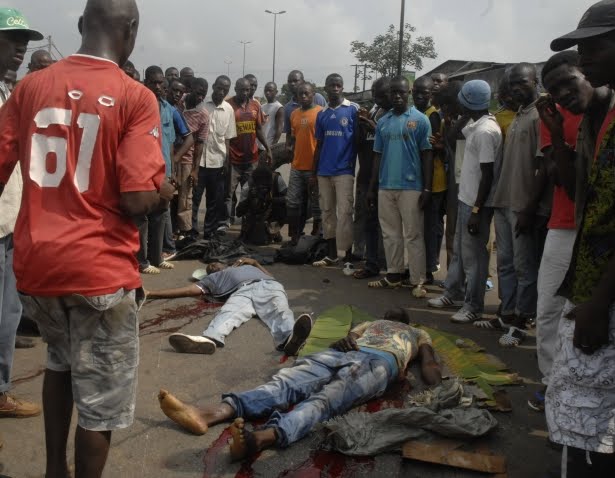
(WARNING: This blog post contains graphic images of war crimes. If you are upset by images of dead bodies then do not continue.)

A dictator stands in defiance of the will of his people. His security forces are shooting nonviolent demonstrators, and a full-fledged civil war has erupted between popular militias and regiments loyal to the incumbent regime. The civilian population is caught in the crosshairs, and the dictator’s paramilitary death squads and mercenaries have resorted to the indiscriminate slaughter of neighborhoods, cities and clans suspected of subversion. An entire nation sits precariously on the brink of genocide. Millions of civilian men, women and children have fled from the violence to become a long term caste of internally-displaced persons and war refugees, destabilizing every country in the region. The people can only pray for the international community to take a stand to protect them from annihilation.

I’m not talking about Libya, however, but another country whose fate might have even greater implications for the fate of African democracy: the Ivory Coast.


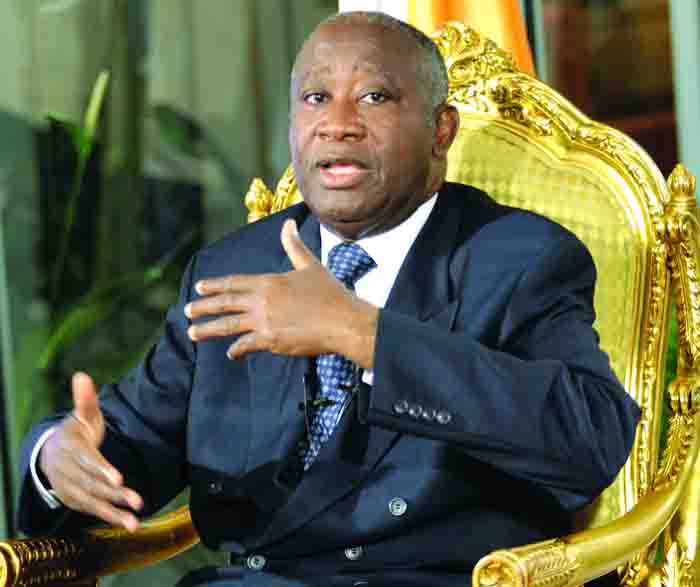
Any proponent of this democratic tide which has swept away dictatorships in North Africa should be equally if not more enthusiastic for the ouster of Laurent Gbagbo - the president/dictator of Côte d’Ivoire since 2000. When his term ended in 2005, Gbagbo simply declined to hold new elections and ensconced in the presidential palace for another five years as an unelected warlord. In Gbagbo we have not a long-standing monarch or military leader who is merely facing a sudden popular revolt, but a strongman who had stolen a position of authority by subverting his country’s inchoate democratic institutions.


Ivorian President Laurent Gbagbo agreed to hold a presidential election in November 2010. According to all objective observers, former Prime Minister and IMF economist Alassane Ouattara won with an unambiguous plurality of 54 percent of the vote. Nevertheless, the Gbagbo-appointed Constitutional Council declared “widespread fraud” in the pro-Ouattara northern provinces and rejected all of those districts’ ballots - disenfranchising enough voters to certify Gbagbo the winner with an alleged 51 percent of the vote. Gbagbo’s nullification of the Ivorian presidential election was the world’s greatest bastardization of the franchise in recent memory; fittingly, the incumbent nonsensically claiming victory in defiance of all objectively verifiable truth had campaigned on the slogan “We win or we win”.

Moreover, as President of Côte d’Ivoire Gbagbo provoked the Ivorian population into civil war, pitted his Christian-majority South against the Muslims of the North, incited xenophobic violence against French expatriates and immigrant workers from Burkina Faso, Guinea and Mali. Since the November election, ex-president Gbagbo widened the category of enemies of his quasi spiritual-nationalist-chauvinist regime and effectively declared war on the Ivorian civilian population which rejected him at the polls - a clear majority of the electorate. Ivorian soldiers and pro-Gbagbo youth gangs have terrorized tribes, clans, villages and neighborhoods as collective punishment for marking their ballots for Ouattara.


The moral cravenness of the Gbagbo regime was best exhibited this past March when the market women of the Abobo neighborhood in Abidjan demonstrated for an end to the fighting, carrying tree branches and chanting "We want peace".


Gbagbo’s forces mowed them down with machine guns, killing eight.

Despite the fact that they have declared allegiance to the rightful President Ouattara, lovers of liberty should hold little sympathy for Les Forces Nouvelles who are swiftly descending from their northern territories to conquer Gbagbo’s strongholds in the South. Les Forces Nouvelles are for the most part jackbooted thugs who likewise govern their territory through extortion, intimidation and outright theft.


Credible reports by Amnesty International and Human Rights Watch have documented an FN modus operandi of arbitrary detentions, torture, extrajudicial killings and sexual violence directed towards those tribes, clans and villages accused of loyalty towards the Gbagbo junta. Aid groups descending upon the western town of Duékué recently “liberated” by the FN have discovered mass graves and piles of bodies which may turn out to evince more than 1,000 individual war crimes.

The Ivorian civilian population needs protection from both factions in this gruesome war. The apathy of the international community in respect to the crisis in Côte d’Ivoire is disgraceful, especially considering the fact that the United Nations already has a peacekeeping force of 9,000 mostly French and Bangladeshi personnel in this country. UN peacekeepers have been stationed in Côte d’Ivoire since 2004, in fact. However, the UNOCI peacekeeping forces effectively only serve to stabilize the expatriate neighborhoods of Abidjan and the environs immediately surrounding Le Golf Hôtel where Ouattara’s government-in-internal-exile has stood under siege since November. Like the UN peacekeeping forces which could only stand their ground and watch as genocide unfolded in Rwanda and Sudan, the powers that be have apparently destined UNOCI to serve as a mere witness to the human slaughter in Côte d’Ivoire.

The United Nations Operation in Côte d’Ivoire (UNOCI) is authorized by Resolution 1528, which was passed unanimously in the Security Council back in 2004 and reauthorized and augmented in a series of subsequent resolutions. UNSCR 1528 which begat UNOCI is actually remarkably similar to UNSCR 1973 which brought us the present Operation Odyssey Dawn; each was ostensibly crafted on the liberal humanitarian and politically neutral rationale of maintaining a cease-fire and protecting civilians.

One major difference is that UNSCR 1973 authorized member states to enforce a no-fly zone to protect the Libyan rebels and civilians from assault by the Libyan Air Force; though the Gbagbo has used the Ivorian Air Force to pummel FN positions and civilian targets, and in 2004 even attacked the French air base in Bouaké (killing nine French soldiers and an American aid worker), the mandate for UNOCI has never included the enforcement a no-fly zone. Understandably so; most of the war crimes conducted by both sides in the Ivorian Civil War have been implemented by foot soldiers.

Another major difference – arguably more subtle but a more consequential difference nonetheless – is that UNSCR 1973 authorized member states to enforce the transport of arms in and out of Libya, and a significant portion of participants in Operation Odyssey Dawn have actively deployed their respective navies to hold up the blockade and starve Qaddafi of arms. UNSCR 1528 and its follow-up resolutions similarly exhorted member states to enforce an arms embargo on Côte d’Ivoire as well, but no one has seemed to notice. Even since the post-electoral revival of hostilities, UN investigators have been pursuing reports that guns, ammunition, perhaps even attack helicopters and aircraft may have been imported from Zimbabwe, Angola, even landlocked Belarus. Though some of the individual accusations may turn out to have be groundless – apparently the Belarussian helicopter sale had indeed been planned but never actually executed – the fact that Ivorian seaports and airports have been open to commercial traffic at all is testament to the fact that no relevant powers of the international community are earnestly committed to enforcing the arms embargo which is crucial to minimizing the extent of the Ivorian bloodbath.

Conversely, the UN-authorized operations in Libya are extremely dissimilar from UNOCI in that whereas Obama, Sarkozy, Cameron and every other power player has repeatedly insisted that Odyssey Dawn will not entail the deployment of ground troops, the multilateral campaign is being conducted exclusively by air and sea, the peacekeeping mission in Côte d’Ivoire consists almost exclusively of ground troops. UNOCI now consists of 9,024 uniformed personnel on the ground, including 7,578 troops, 176 military observers and 1,270 police – disproportionately Bangladeshi infantry and French gendarmes. Boots on the ground do not necessarily make the UN mission in Côte d’Ivoire any more effective; they have been by and large limited in their conduct to securing President Ouattara and his coterie at Le Golf Hôtel and only the most modest of civilian protection operations in Abidjan.

The crippling reserve exercised by UNOCI is likewise based on the exponentially greater risk of protecting civilians via ground troops; to date, 54 UN personnel have been killed in the line of duty in Côte d’Ivoire – more than the total death toll of US personnel in Bosnia, Kosovo, Colombia and Haiti combined. As the Obama administration is preoccupied with extricating our land forces from the quagmires in Iraq and Afghanistan, they are reasonably squeamish about committing to any sort of civilian protection operations that cannot be executed by B-2 stealth bombers or guided-missile destroyers.

It seems that the logistics of peacekeeping in Côte d’Ivoire might be daunting, even more so than our “kinetic military action” in Libya. Yet it seems that the moral logic of intervention is in both countries is indistinguishable. President Obama intones that action was necessitated by the specter of full-out massacre in Benghazi – an action which “would have reverberated across the region and stained the conscience of the world”. Indeed it would have. But are our consciences not stained by the massacres in Abobo and Duékué?

Obama argues that the United States has a strategic interest in preventing a massacre which “would have driven thousands of additional refugees across Libya’s borders, putting enormous trains on the peaceful – yet fragile – transitions in Egypt and Tunisia.” At last count, the UN High Commissioner of Refugees stated that at least 116,000 Ivorian refugees had already fled to neighboring Liberia, Ghana, Burkina Faso, Mali and Guinea – with more than 100,000 in Liberia alone. All of these countries are already suffering from some degree of political instability, anemic economies and intolerably high levels of unemployment; hence the situation we have now with multiple millions of internally displaced Ivorians who might very well pour over the borders bodes terribly ill for West Africa’s fragile democracies.

Obama contends that if the U.S. did not intervene in Libya, “The democratic impulses that are dawning across the region would be eclipsed by the darkest form of dictatorship, as repressive leaders concluded that violence is the best strategy to cling to power.” Though as Laurent Gbagbo defied the will of his people and nullified the election in which he lost, we demonstrated to the young democracies of Africa that we would respond to their power grabs with sharply-worded proclamations and economic sanctions that we would not bother to enforce. This year alone presidential elections are scheduled to be held in Liberia, Nigeria, Cameroon, Zimbabwe, and seven other countries on the continent; is the lesson of Ggbagbo to be learned by African incumbents that they should do well to stay in power by not holding elections at all?

Moreover, Obama maintained that intervention in Libya was necessary to uphold the credibility of the UN itself, that had we not acted “The writ of the United Nations Security Council would have been shown to be little more than empty words, crippling that institution’s future credibility to uphold global peace and security.” How does United Nations make itself credible when the Security Council calls for a cease-fire and does not enforce it? Or when the Security Council enacts an arms embargo on a war criminal regime – but not a single member state is willing to interdict cargo ships and planes bound for it? How can any institution be trusted to keep the peace in the African heartland when its peacekeeping mission cowers on the beaches of Abidjan?

In all fairness, the newly-christened Obama Doctrine is more nuanced than a mere postulate of normative ethics; the rubric for intervention laid out in the President’s “Responsibility to Act” speech is a complex calculus of moral imperatives and cold cost-benefit analysis. And he did state quite clearly: “It’s true that America cannot use our military wherever repression occurs”; i.e. sometimes despots will crush their people and the United States will do nothing because – however righteous intervention might be – we cannot afford to intervene, or we can but the fate of the country in question is not in our core national interests.

And likewise, it looks quite manifest that the international community is not going to take any substantive action to protect the Ivorian civilian population, that this civil war is probably going to end within a matter of hours as the Les Forces Nouvelles seize hold of the last military bases and police stations in Abidjan, the television station and the presidential palace, the last Gbagbo loyalists either defect, surrender or are summarily executed by the victors. Laurent Gbagbo himself will most likely come to an end with a bullet to the temple. And one can only imagine what sort of “revolutionary justice” the FN Jacobins might mete out to the neighborhoods, villages, and clans which voted for Gbagbo. This sort of African solution to an African problem will not put the lives of any U.S. troops on the line and it won’t cost taxpayers a dime; from our narrow self-interest, it might even be an efficient policy of isolationism. Though for the Ivorian people, on the other hand, it might mean tens of thousands of civilian deaths which could have been completely prevented had the international community made a serious stab at intervention.

As we bask in the self-righteousness of pre-empting humanitarian calamity in Libya, how do we sit content with the knowledge that civilians are being massacred at this very moment, that the United States could very well lead a multilateral coalition to protect the Ivorian civilian population – but we politely declined? How might our academies’ mightiest metaphysicists and international human rights lawyers conclude a moral “responsibility to protect” civilians in Libya – but not civilians in Côte d’Ivoire? What makes a real, actual massacre in Duékué any less atrocious than a hypothetical massacre in Benghazi? Is it the fact that Libyans are Caucasoid enough that they almost resemble Europeans – but Ivorians are much darker-skinned Others? Or is it that the Western economies cannot handle even a mild oil shortage – but we can cope with civil war in countries whose greatest export is the cocoa bean?

This author for one sympathizes greatly with the doctrine of a “responsibility to protect” which is evolving out of the legal framework of Odyssey Dawn, but a legal doctrine which aims to uphold the values of universal human rights either necessitates intervention to protect both peoples or neither. If the power elite espouse a “responsibility to protect” the people of Libya, but find no such obligation to intervene on behalf of the Ivorians, their reasoning must be predicated on some combination of apathy, hypocrisy, or the kind of cold-blooded economics in which human costs merit no consideration.

Sunday, March 20, 2011

The Elusive Aim for Regime Change in UNSCR 1973

Just as any thinking person cannot help but identify with the demonstrators for constitutionalism and parliamentary self-government everywhere throughout our Arab Spring, this lover of liberty empathizes with the Libyan rebels who wish to oust the bizarre, sadistic one-man revolution of Colonel Muammar el-Qaddafi. I would have preferred to have seen Qaddafi go relatively peacefully like Ben Ali and Mubarak, I would have preferred to see the Libyan insurrectionists overthrow their tyrannical regime with their own hands. Obviously neither of those scenarios were fated to be, and now apparently the only way to prevent the massacre of rebel forces and Libyan civilians by the Qaddafi loyalists is with some form of foreign military intervention.

The legal internationalist should have been opposed to unilateral U.S. intervention in Libya without a casus belli of self-defense, without authorization by the United Nations as it would have been a violation of international law. Likewise, I would have registered my doubts if France, Britain, or the Arab League were to intervene under such terms. However, now that the Security Council has just passed UNSCR 1973, concerns about illegal warfare should be largely assuaged. So long as the U.S. or any other foreign country wishes to intervene in Libya in accordance with the U.N. mandate, the matter of a no-fly zone is no longer a debate of de jure legality but one of normative politics and logistics. As the U.S. Air Force and Navy intervene, the objective rationalist should hope that they can get the job done with as few casualties and with as little cost as possible. The question remains though; what precisely does this job entail?

Now that the U.N. mission in Libya is a reality, cheerleaders of military intervention would be wise to temper their populist fervor by carefully reading the exact text of United Nations Security Council Resolution 1973. UNSCR 1973 is the follow-up to UNSCR 1970 passed on February 26th which

1) referred the situation in Libya to the International Criminal Court for investigations of war crimes, crimes against humanity and genocide;

2) instituted an embargo of arms transfers to Libya, Libyan arms exports, and the movement of mercenaries to fight in Libya;

3) imposed travel bans 17 Jamahiriyah figures and enacted asset freezes on Colonel Qaddafi and his sons;

4) called on U.N. members states to contribute humanitarian assistance to Libyan civilians.

As far as U.N. sanctions go, even the preliminary USCR 1970 was just about as strong as they come; it essentially revived the bulk of the U.N. sanctions imposed on Libya in UNSCR 748 (1992) and 883 (1993) in the wake of Tripoli’s sponsorship of the Lockerbie bombing and eventually eased from 1998 to 2003.

UNSCR 1973 tightens the screws on Qaddafi a bit further. The Resolution contains a range of operative clauses which authorize limited foreign intervention operations – with the politically neutral, strictly humanitarian objective of reducing civilian casualties. With 1973, the Security Council…

1. “Demands the immediate establishment of a cease-fire and a complete end to violence and all attacks against, and abuses of, civilians”...

2. Authorizes Member States “to take all necessary measures”… “to protect civilians and civilian populated areas under threat of attack in the Libyan Arab Jamahiriya, including Benghazi, while excluding a foreign occupation force of any form on any part of Libyan territory…”

6. “Decides to establish a ban on all flights in the airspace of the Libyan Arab Jamahiriya in order to protect civilians”... (i.e. flights with a military purpose, explicitly excepting flights with humanitarian passengers or cargo)

8. “Authorizes Member States… to take all necessary measures to enforce compliance with the ban on flights…”9. Calls upon Member States to provide assistance with the implementation of the no-fly zone and protection of civilian populations, including the use of air bases and airspace

13. Calls upon Member States “to ensure strict implementation of the arms embargo” established in UNSCR 1970 by inspecting vessels and aircraft in their seaports, airports and territorial waters bound to or from the Libyan Arab Jamahiriya

16. Calls upon Member States to take action to enforce UNSCR 1970’s ban on the import of mercenaries from their own respective populations or traveling through their territories bound for Libya

17 and 18. ...and to enforce the air embargo on the Libyan Arab Jamahiriyah
UNSCR 1973 calls for enforcement mechanisms of the arms embargo, mercenary embargo, air embargo and financial sanctions previously laid out in UNSCR 1970. UNSCR 1973 strengthens the Security Council’s prior ultimatums to Libya with demands for a cease-fire. And most dramatically, UNSCR 1973 includes a mandate for foreign military intervention, calling for U.N. Member States “take all necessary measures” “to protect civilians and civilian populated areas under threat of attack” and to enforce the no-fly zone. Period.

This resolution authorizes an agenda which should satisfy the self-ascribed humanitarian interventionists whose objective begins and ends at the prevention of civilian casualties. The no-fly zone applies to the Qaddafi loyalists as well as the Benghazi rebels alike – technically. But obviously it was intended to be enforced against the only faction in the Libyan Civil War which is employing Air Force bombers and heavy artillery against civilian populations. UNSCR 1973 was quite patently constructed for enforcement against only one side to the dispute, and it would be a fair bet to assume that there will be little to no incidence of coalition air strikes against Libyan rebels who might be in violation of the so-called cease-fire.

Though this Resolution might yet tilt the civil war in the rebels’ favor, let’s not get carried away to think that the Security Council has just authorized regime change in Tripoli. UNSCR 1973 does not authorize Member States to take action against Libyan military targets unrelated to the enforcement of a cease-fire, the implementation of the no-fly zone or the protection of civilians. It does not authorize France to bomb Libyan Army barracks full of soldiers engaged in calisthenics training. It does not authorize Britain to provide air cover for a rebel offensive on loyalist-held territory; it does not allow anyone to fight the Benghazi rebels’ civil war for them. Just as the George H.W. Bush administration refrained from marching onto Baghdad as such a move would have exceeded Operation Desert Storm’s narrow U.N. mandate to eject Iraqi forces from Kuwait, the coalition amassing to intervene in Libya cannot legally expand its objective to regime change in Tripoli.

Yet for some reason (perhaps these same Neoconservative interventionists’ dissatisfaction with the outcome of the first Gulf War) I don’t think that the present day Libya hawks would sit content with an endgame that leaves Colonel Qaddafi in power.

John McCain – one of the first major outspoken proponents of a no-fly zone – makes no bones about its final cause: “If you want Qaddafi to go, then one of the steps – among many – would be to establish a no-fly zone…”

Joe Lieberman conflates the objective of preventing civilian casualties with supporting the rebels and regime change:

“The president has made clear that Gadhafi’s got to go; he’s no longer the legitimate leader of Libya, and the question is what are we going to do to help make sure that Gadhafi goes as quickly as possible because the danger here is that this is going to become a bloody stalemate, a civil war, a bloody civil war...”
Iraq War architect Paul Wolfowitz calls for not just a no-fly zone in Libya, but for the U.S. to recognize the National Council in Benghazi as the legitimate government of Libya, providing the rebels with arms, supplies and direct military intervention:

Recognizing the new National Council would affect the psychology of both Gadhafi's cronies and his brave opponents. Ending the mixed signals sent by U.S. hesitation over recognition would end any possibility of rehabilitating Gadhafi if he wins. Absurd as that may sound to us—particularly after President Obama has declared that Gadhafi must go—this is probably the outcome that Gadhafi's cronies hope for, and that his opponents most fear.
David Frum – who wrote some of the Bush administration’s seminal speeches on regime change in Iraq and who himself laid the case for regime change in Iran and Syria – draws the argument for intervention directly to the need to oust the Libyan government:

“Gadhafi’s departure from power in other words is not just a requirement of humanity and decency. It’s not only justice to the people of Libya. It is also essential to American credibility and the stability of the Middle East region.”
My intent in harping upon this point is not to draw a straw man argument but to elucidate the U.S. Libya hawks’ intentions. It seems that there are two camps in this present discourse who have been clamoring for a no-fly zone. The first camp would be the liberal humanitarians who are concerned exclusively with the prevention of civilian casualties, who could be content with the Libyan rebels putting down their arms and the partition of Libya into a provisional rebel territory based in Benghazi and a Qaddafi rump state in Tripoli. The second faction for a no-fly zone is that of the Neoconservative hawks who embrace the language and purported objectives of the liberal humanitarians but make it clear that they do intend for the U.S. to take sides in this conflict, and that a no-fly zone is only the preliminary action that ought to be taken as part of a larger campaign to oust Qaddafi. This is notable because UNSCR 1973 explicitly only authorizes foreign military intervention to attain the goals of the liberal humanitarians, and the broader goals of regime change and democratization in the Arab world which the Neocons espouse – as desirable as they might be – go far beyond the scope of the U.N. mandate.

As for yours truly, I could not help but empathize with the Wolfowitz, McCain, et al.’s dream of establishing constitutional monarchies, republican and parliamentary regimes which derive their moral authority to lead from the popular will from Kabul to Baghdad to Tripoli. I agree with the liberal sentiment that the blossoming of democracy and free markets in repressed authoritarian societies should sow the seeds for peaceful change and political moderation, that the demise of states like Qaddafi’s nightmarish Jamahiriyah should lead to the stabilization of the region, undercut the appeal of Islamic fundamentalism and reduce the threat of anti-American terrorism in the long run. And by the way, regime change in Tarabulus is what a good plurality the Libyan people apparently want – it is certainly a desirable end. Regardless, there is no way to read the relevant documents of international law (namely the United Nations Charter, UNSCR 1970 and UNSCR 1973) and conclude that signatory U.N.O. Member States such as the U.S. can simply declare war on Libya and overthrow Colonel Qaddafi on a whim.

It would be perfectly plausible for the Obama administration to heed Wolfowitz’s advice and follow the lead of France and Portugal in recognizing the National Council in Benghazi as the legitimate government of Libya. Such a move would allow the administration to abide by myriad U.S. restrictions on military and economic aid to the Benghazi regime – though it would not make it any easier for the U.S. to exercise decisive force on Tripoli to bring a quick end to the Qaddafi regime. So long as the United Nations recognizes the Jamahiriyah as the legitimate government of Libya and Muammar el-Qaddafi as its legitimate ruler, the United Nations Charter stands in the way of a legal NATO-Arab League operation to subvert the Tripoli regime.

Though imagine if the following events – all perfectly plausible – were to precipitate in New York, Cairo and Benghazi over the course of this week:

1) After recommendation from the Security Council, the Arab League and the African Union member states were to sponsor a General Assembly resolution calling for the expulsion of the Great Socialist People’s Libyan Arab Jamahiriyah from the U.N.O. – which they can do according to Chapter II, Article 6 of the United Nations Charter. It passes.

2. Those same Arab League, African Union countries sponsor a second General Assembly resolution calling for the recognition of the National Council in Benghazi as the legitimate government of Libya. It too passes.

3) The newly-recognized Libyan government in Benghazi were to appoint a new Ambassador to the U.N. (perhaps Mohammad Shaghash, the Ambassador who recently defected from Tripoli)

There is something of a precedent for this. The Republic of China led by Chiang Kai-Shek joined the United Nations Organization as one of its founding members in 1945, the U.N. continued to recognize the R.O.C. governmentin Taiwan as the rightful representatives of all of China until 1971. By that time when the Chinese Civil War had been long settled in favor of Mao Tse-tung and his Red Army, the General Assembly passed Resolution 2758, which concluded:

"the representatives of the Government of the People's Republic of China are the only lawful representatives of China to the United Nations and that the People's Republic of China is one of the five permanent members of the Security Council,"
Furthemore, the General Assembly decided:

"to restore all its rights to the People's Republic of China and to recognize the representatives of its Government as the only legitimate representatives of China to the United Nations, and to expel forthwith the representatives of Chiang Kai-Shek from the place which they unlawfully occupy at the United Nations and in all the organizations related to it.”
UNGAR 2758 effectively stripped the R.O.C. from membership in the U.N.O. and transferred its General Assembly and permanent Security Council seats to the People’s Republic of China.

If the General Assembly were to expel the Great Socialist People’s Libyan Arab Jamahiriyah from the U.N.O. and replaced with representatives of the regime in Benghazi, as far as international law goes, we’d be talking about a whole new ballpark. If the provisional government in Benghazi is recognized by the U.N. as the legitimate government of all of Libya, Qaddafi’s armies would then be just another non-state militant group with no legal standing akin to the I.R.A., P.L.O., the Janjaweed, etc. which Tripoli propped up at one time in the past. Perhaps the Qaddafi-loyalist Libyan Army, Libyan Navy and Libyan Air Force could even be classified as terrorist organizations (as the U.S. now classifies the Iranian Revolutionary Guards) and thus any government aiding or abetting them financially or otherwise could be designated as a State Sponsor of Terrorism…

If – under such circumstances – the Libyan Ambassador to the U.N. were to call upon the aid of fellow Member States to come to his nation’s protection, there would be very little in the wide corpus of international law standing in our way to shower Benghazi with guns, ammunition, tanks and artillery. The legitimate Libyan government could call upon U.N., Arab League and African Union member-states to come to its aid against an existential threat just like Saudi Arabia and Kuwait did in 1990. A joint NATO-Arab League-African Union coalition could perfectly legally and with the fully nationalist legitimacy of the pan-Arabist, pan-Africanist regional organization defend the rightful Libyan government in Benghazi and help them to quash the “rebellion” in the Tripolitania.

Nevertheless, now that a truly multilateral military intervention in Libya has explicit Security Council authorization and de jure legality, this blogger is still concerned about the doctrinal repercussions. Yes we can intervene, but why ought we intervene in Libya? Is it because the international community has an obligation to strike against states in order to prevent gross human rights abuses and crimes against humanity? If that is the case, what makes the atrocities in Libya worthy of a U.N.-enforced no-fly zone – but not the atrocities in Darfur or the Gaza Strip? Let’s suppose that the people of Bahrain and Yemen were to call upon the U.N. to send peacekeeping forces to protect their nonviolent demonstrations from being massacred by their own totalitarian states – under what doctrine of protecting civilians must the U.N. intervene in Libya but not Bahrain and Yemen?

The established doctrines of military intervention might need some significant revision in the wake of newly-christened Operation Odyssey Dawn – especially if the Obama administration were to heed the advice of Wolfowitz, Lieberman, et al. and wholeheartedly take the side of the Benghazi rebels in the Libyan Civil War. The U.S. has conducted regime change under the ostensible rationales of containing thwart Communist aggression and preventing state-sponsored terrorist attacks. Though in this circumstance there isn’t the slightest pretense of intervening in order to prevent acts of aggression against American national security interests. G.A. Resolution 2785 only recognized the outcome of the Chinese Civil War 22 years after the fact. Is the United States now obligated to intervene in every single conflict between an undemocratic regime and a popular movement opposed to it and to always side with the latter? Is the Arab League, the African Union, NATO and United Nations? Or are we only obligated to take sides in civil wars against dictators like Qaddafi whom we have always disliked?

If the Obama administration were to invoke the international law of the United Nations Charter and the Universal Declaration of Human Rights, exert our political sway before the General Assembly and Security Council, exercise the power of the United States Armed Forces and our treaty alliances in order to replace Qaddafi’s dictatorship in Libya with some form of constitutional self-government, we would be entering a brave new doctrinal tomorrow. Would the United States be henceforth bound to some sort of Obama Doctrine which extends the Monroe Doctrine all the way to the Sahara Desert and establishes a universal doctrine for the United States to intervene on behalf of every popular movement in Africa and the Middle East? If we were to back the National Council in Benghazi to subvert Qaddafi’s dictatorship in Tripoli, we would be establishing a foreign policy more Wilsonian than anything Woodrow Wilson could have fantasized, a foreign policy which would interpret the promise of the Declaration of Independence as an affirmation of global human rights including a right to government by multiparty elections and the right of revolution against undemocratic regimes? Personally, I don’t think that sounds half bad…

However, if the Obama Doctrine formulated to justify intervention in Libya is going to have any moral bearing this precedent for intervention must be applicable to other comparable cases. If the impending humanitarian catastrophe in Benghazi is sufficient reason for the international community to take a forceful stand against the war criminal regime in Libya, then we must go through the Security Council to intervene on behalf of the people of Côte d’Ivoire, Zimbabwe, Guinea, the Congo, Sudan and Eritrea against their respective war criminal regimes. On the other hand, if the doctrinal precedent is meant to be “limited to the present circumstances”, inapplicable to any future cases because our interests are not threatened by these police states’ genocides and political massacres, then it would demonstrate that our principles of intervention are either nonexistent or false. Libya could only be a singularity designated for regime change if the capacity of unmitigated evil were limited to the persona of Muammar al-Qaddafi. If the millions of victims of Robert Mugabe, Laurent Gbagbo and Omar Hassan al-Bashir are deemed somehow less worthy of our intervention than the thousands of victims of Colonel Qaddafi, our inaction would prove ipse facto that the liberal case for intervention in Libya is just a humanitarian fig leaf for our discomforting, venal interests in the makeup of the Libyan regime; U.S. hegemony over North Africa and the petroleum which lies beneath her sands.

Sunday, March 6, 2011

The Most Fabulous Way to Stimulate the Economy

What would you say if I told you that New York State lawmakers could amend a certain legal regulation in a way that would stimulate additional consumer spending, foster more sales opportunities for small businesses and create thousands of new jobs? What if I told you that this policy would not add a dime to the deficit; in fact, all of the sales tax on the resultant commerce, additional income tax revenue and processing fees for these new contracts would actually help state and local governments balance their budgets? According to any credible economic analysis, this policy would only foster business growth so benign that it is almost inconceivable that it could lead to negative externalities in health, the environment, culture or anything at all.

What is this miracle policy of which I speak? What could possibly put some spring into the step of this dreary, moribund economy? Well, when people think of ways for the government to prime the pump, they usually imagine burly construction workers re-paving the highway. But we should also think of the police officer who got to keep his job thanks to the Recovery Act, the sailor who is bravely serving his country in the US Navy, and also the cowboy, the Native American and the motorcycling leather daddy…

This economic miracle policy I’m talking about, of course, is legalizing same-sex marriage. Nowadays even those with money to spare are so afraid of the market that they are just sitting on it in the bank; but if there’s ever a time to splurge, wouldn’t it be when your daughter has fallen madly in love with the perfect woman and you want to give her the wedding of her dreams? ...and if your son wanted to marry someone else’s son, wouldn’t you do the same? Some people have been waiting to be able to do this their entire lives.

In this time of economic crisis let’s forget for a moment about the Equal Protection Clause of the Fourteenth Amendment or the sexual ethics expounded by the Book of Leviticus and think about marriage solely in terms of dollars and cents. The average wedding in New York State costs around $32,000 – but in New York City where all goods and services are more expensive the figure is nearer to $37,000. However, the average wedding ceremony between two men or two women in New York State will most likely cost significantly less – circa $27,000 – largely due to the facts that 1) same-sex couples are less likely to receive support from their parents to pay for their weddings; and 2) same sex couples are more likely than opposite-sex couples to opt for no-frills City Hall marriages.

But even with the most conservative estimate that accepts continued social discrimination as a given, each and every additional marriage will nonetheless serve as a micro-level stimulus package. If the New York state legislature were to act this spring to modernize our discriminatory marriage laws, then the summer and autumn of 2011 could be punctuated by tens of thousands of additional weddings and a wave of additional commerce from Montauk to Buffalo.

At the very least, marriage equality would trim the budget deficit by adding revenues. For all of those couples who simply want to get it over with and get a City Hall marriage, in New York City it will cost them $35 for a marriage license payable to the Office of the City Clerk. Everyone who lives outside the five boroughs who wants to have a marriage certificate will have to make a credit card deduction, money order or write a $30 check payable to the New York State Department of Public Health, they will also have to pay for a $7.25 vendor processing fee, $15 for priority mail postage, and if they opt for next-day shipping the married couple would pay for an additional UPS fee of $12. With every marriage license issued, New York State would receive a bit more revenue to help mitigate our $10 billion budget shortfall.

Though it would be fair to say that a fair number of New York’s gays and lesbians and bisexuals and transsexuals would probably go for something more extravagant than a mere City Hall wedding… Seriously, if you’ve ever attended a Long Island bat mitzvah, just imagine how opulent Long Island gay marriages will be! Legalizing same-sex marriage will open the floodgates to the greatest, gayest shopping spree that New York has ever seen!


For starters, marriage usually starts with a proposal – and an engagement ring usually costs around $3,125. Jewelers will be so inundated with orders that there would be increased demand for every precious gem on the market – as well as the labor of goldsmiths, silversmiths and diamond cutters. Though the Hasidic diamond dealers of 47th Street might be amongst the most vociferous opponents of marriage equality, they would be amongst the greatest financial beneficiaries!

Then with time most of these same-sex fiancées are going to buy wedding bands and the jewelry industry would surge again (according to The Wedding Report, the average American wedding entails $3,631 of spending on jewelry for the day of the marriage ceremony).

For anything more elaborate, they are going to hire a wedding planner for $1,940…

Wedding announcements, invitations, reply cards and thank-you notes on personalized stationary will cost $1,117…

Your average marrying couple will spend $345 on hair styling, facials, makeup and spa treatment…

The best man or bridesmaid will throw down an average of $2,189 on the bachelor/bachelorette party…

The grooms will spend about $1,858 on their tuxedos…

Or the brides will spend $1,858 on their dresses…


…or the brides will spend $1,858 on their tuxedoes…

…or the grooms will spend about $1,858 on their dresses…

The sartorial possibilities are endless, and any permutation of bow-ties, tiaras, corsets and cummerbunds that the marrying couples, best men, bridesmaids and guests would buy would nevertheless serve as the greatest one-time boon to the high-end fashion industry that New York has ever seen!

Marrying couples typically spend around $2,036 on the ceremony itself; i.e. renting the location, hiring an officiate, paying for an aisle runner, a pillow box and a ketubah, etc…

They will spend an average of $1,276 on flowers and décor…

The big ticket item, however, is almost invariably the wedding reception – which costs an average of $11,863. Can you even imagine how many more job openings would be created for caterers, chefs, waitresses, busboys and bartenders?

More demand would be created for bakers as well, as the brides or grooms spend $469 on each wedding cake…

…$1,244 on limousine and chauffeurs…

… and of course a honeymoon, which usually rings up to a total of $5,027 (though chances are the bulk of this money would stimulate the economy of Puerto Rico or the Virgin Islands – not New York)

Subsequent growth in consumer spending would not be confined to the brides and grooms and their families. According to the Association of Bridal Consultants, married couples receive an average of 75 gifts and that the average amount of money spent on each wedding gift is $113. So for every time that a pair of men or a pair of women marry in New York, they will spur their guests to go out and spend approximately $8,475 on gifts that might have otherwise just sat in the bank and accumulated infinitesimal interest.

Out of town wedding guests are going to stay in New York hotels, and even if they are going to stay with friends for the weekend they are probably going to go out with their hosts to a restaurant on Friday night or at least stop at the liquor store and buy them a bottle of wine. No matter how you crunch the numbers, marriage equality is going to encourage people – and especially people from out of state – to go out and spend more of their money on New York goods and services.

Of course, we do not know exactly how many same-sex couples there are living together in New York because the 2010 Census which is still being tabulated was only the first census since Massachusetts’ landmark Goodridge decision in 2004, and this data only counts same-sex couples who are already legally married – thus providing an incomplete picture of how many same-sex couples there are who would be married if New York amended its family law code. So in the absence of more sound Census methodology the best we can do is refer to scientific estimates; according to a study by the Williams Institute, as of 2005 there were approximately 50,854 gay and lesbian couples living together in New York State.

However, that does not mean that legalizing same-sex marriage in New York State would necessarily result in exactly 50,854 weddings. Approximately 43 percent of those couples – 21,867 of them – have already married somewhere else. Since 2005 the population of same-sex couples has certainly risen. And there are of course a good number of couples who would prefer to marry in some other jurisdiction, to simply apply for a domestic partnership, or to not marry at all. The Office of the New York City Comptroller estimates that – based on the experience of Massachusetts – roughly 51 percent of the remaining nubile 28,987 couples would marry over the first three years after marriage equality has been achieved; in other words, around 14,783 New York resident couples would marry. After that initial surge, the rate of same-sex marriages would probably taper off significantly and eventually achieve something close to parity with the rate of opposite-sex marriages. According to the NYC Comptroller, resident weddings would generate almost $110 million in additional consumer spending over those first three years…

…and that’s only taking into consideration New York State residents; based on the experience of other states, the big money maker would be in out-of-state residents who would come from all across the country and all around the world to have their weddings in tolerant and accepting New York. The NYC Comptroller’s Office estimates that in the first three years of marriage equality, more than 56,000 couples would travel from out of state to marry in New York. Keep in mind that New York State law requires a minimum of 24 hours between the issuance of a marriage license and the performance of a wedding ceremony, so out-of-state residents would either have to make two day trips or (much more likely) stay overnight. Even the estimated 6,845 couples from mostly New Jersey, Pennsylvania and Connecticut who simply drive across the border for two day trips would bring in an additional $1 million. But those who come all the way from Florida, Texas, Japan or South Korea for destination weddings would spend almost $60 million, their guests would spend another $77 million on transportation, lodging, etc.

When you put it all together; New York residents, cross-border commuters and out of state same-sex marriage tourists would generate an additional $247 million in additional economic activity over the next three years – $175 million in New York City alone. We can only speculate as to how much long-term job creation this boom would generate; most likely, most of the additional business would probably be picked up by already-existing florists, bakers, DJs, etc. Though based on the experience of other states, the legalization of same-sex marriage would probably create a few thousand additional jobs mainly in the labor-intensive hospitality and catering businesses. But the sheer amount of consumer spending and job growth alone does not tell the whole story; for a more clear view of marriage equality’s effect on the public treasury we have to crunch those numbers a bit further.

When economists calculate the value of public policy they use the tool of cost-benefit analysis; and even the most liberal proponent of civil rights must concede that there are economic costs to granting marriage rights to gays and lesbians. Namely, firms that offer spousal and family benefits to their employees would be compelled to extend health care benefits to the spouses of their newly-married employees. The study by the Comptroller’s Office estimates that all of the same-sex married couples with one member working for a firm in New York State would cost their employers an additional $63 million in health insurance costs. However, this causes little reason to fear that businesses would flee to other states with discriminatory marriage laws in order to save on human resources; that $63 million in health benefits would be spread fairly evenly across more than 500,000 firms, unless a given business employs a disproportionate amount of nubile homosexuals then their burden would be comparatively negligible, and most small businesses would not be affected at all. In fact, most Fortune 500 companies located in New York – including Bank of America, Goldman Sachs, Morgan Stanley, American Express, Chase, MetLife, Citigroup, Bloomberg LP, Time Warner, Barnes & Noble, Eastman Kodak, to name a few – already offer health benefits to the same-sex domestic partners of their employees.

From the perspective of public finance, marriage equality would not generate any additional health care costs because New York State and City agencies are already required to offer health care benefits to the same-sex domestic partners of public employees. If anything, the public sector would actually save on means-tested programs because many newlywed couples’ combined income or assets would bring them above the income and asset thresholds for many social welfare programs; e.g. the Temporary Assistance for Needy Families and Safety Net Assistance programs, child care subsidies, earned income tax credits, etc. For a good number of people the legal act of marriage per se serves as a catalyst for movement from the class of welfare recipients to taxpaying contributors to the public treasury.

Following that same line of reasoning, marriage equality would in fact lead to a windfall in public revenues. Marriage licensing application fees – 50,458 applications for $35 in New York City and 32,012 applications for $40 elsewhere in New York State – would total $3 million in additional revenue. Sales taxes on all of the aforementioned wedding expenditures would add $4.3 million to City revenues and another $5.5 million to the State. With all the out of state destination weddings expected to be held in the five boroughs (i.e. Manhattan) the City would also collect an additional $767,000 in Hotel Occupancy Tax revenue. If the New York legislature changed the tax code so that same-sex married couples could file their tax returns jointly, so many couples would incur the so-called “marriage penalty” by moving to a higher income tax bracket that New York State would collect $2.1 million in additional income taxes. So it would be fair to assume that New York City would be able to balance its budget with $5.1 million and New York State would be able to plug its gaping deficit with $10.6 million in additional revenues over the next three years. Perhaps if homeownership rises for married same-sex couples, the government might even take in more revenue from property taxes and related real estate transaction-related taxes (though this is purely speculative); if this is the case, New York’s gaping deficit could be trimmed even further.

For a state to maintain discriminatory marriage laws is to practice fiscal insanity – they’re leaving money on the table. Though what we’re currently doing in New York is even more self-defeating; in 2004, then-Attorney General Eliot Spitzer responded to the flurry of gay marriages in Massachusetts, San Francisco and New Paltz by issuing a memorandum stating that New York – though we do not issue marriage licenses to same-sex couples – would give full faith and credit to the same-sex marriages issued by other jurisdictions. From the perspective of social justice, this might be a pragmatic step in the right direction, but from the perspective of economics it’s the worst policy imaginable as it assumes all of the costs but reaps very few of the benefits. Suppose there is a lesbian couple from Schenectady composed of a pharmacy worker and her unemployed wife and they decide to get married in Northampton; they might add to the health insurance costs borne by New York businesses, but all of the economic activity and tax revenue generated by their wedding would be enjoyed by the Commonwealth of Massachusetts. In other words, New York is exporting our gay marriage jobs to Massachusetts, Connecticut, Vermont, New Hampshire, Iowa, the District of Columbia, all ten provinces and three territories of Canada, Mexico City, Argentina, Spain, Portugal, the Netherlands, Belgium, Iceland, Norway, Sweden and South Africa.

Civil unions – another modest half-step towards social justice – are even more limited in their economic stimulus potential. In New Jersey, Illinois, Rhode Island, Delaware and Hawaii where the state issues civil union licenses to same-sex couples, businesses pay ever so slightly more in health insurance costs. But the wedding planners, hoteliers, caterers, florists and diamond cutters of these states have experienced only minimal business growth because hardly anyone throws down $37,000 to celebrate their daughter’s civil union – filing for domestic partnership feels as special as a trip to the DMV.

Likewise, it seems that the only way for a state to reach the maximum fiscal benefit is to establish complete and utter marriage equality under law. When the Comptroller’s Office did its cost-benefit analysis of legalizing same-sex marriages, they calculated that the government of New York State would come out of the red by collecting roughly $8 million in more taxes and saving $100 million on welfare programs, while the City would collect an additional $7 million in taxes and fees and have only negligible fluctuations in spending on anything at all. And though the health insurance costs and the benefits of additional sales will for the most part be paid by different firms, the private sector as a whole would grow on a net basis by $184 million throughout New York State with $142 million of that economic growth in the City.

Marriage equality should also make the New York economy more competitive in the long run by keeping our state among the forefront of social progress. Let’s say that the Acme Widget Company of Des Moines is planning on expanding to the East Coast and has to decide between two potential sites for their new bureau; one in Albany and the other in Hartford. The board of directors might reason that, ceteris paribus, it would be in their best interests to open the new bureau in Hartford because a lot of gay people would prefer to live in a state where they can raise a family, and Connecticut’s inclusive marriage laws might help them to attract a more competitive pool of employees. The most well-dressed, highly productive members of the labor force want to live and work in a state where the law treats them as first-class citizens – why wouldn’t we do everything we can to make them want to live and do business in New York?

The fact of the matter is that gay families are great for the economy; they’re hip, they’re ahead of so many market trends, they are more likely to have two incomes and less likely to have children – and when they do have kids, it kind of has to be the result of a thoroughly-planned, well-thought decision. Families headed by same-sex couples are more likely to pay taxes for schools and less likely to have kids to send to them - but when they do, wouldn't you imagine they would be the most meticulous parents?

To put it more blunty, it is in the direct financial interest of every state, county and municipal government with revenues dependent upon property taxes to attract families with two moms and two dads, because when gay people move into a neighborhood the value of real estate rises. If you’ve ever been to Hudson, New York, you would see before your eyes how an influx of gay antiques dealers, innkeepers and restaurateurs took a rusting, depressed Upstate town and gave it a makeover into a relatively-booming Mecca for weekenders and gentlewomen farmers!


So when the the New York State Senate takes up the same-sex marriage bill, do they really want to take this opportunity to uphold our state's long proud history of welcoming immigrants of all cultures, stripes and hues, upholding the rights of refugees who fled violence and repression... and, by the way, effortlessly improve the state's fiscal standing?

Or will they reject it out of some combination of bigotry, malice or cowardice?
After almost every state in the region has steadily progressed towards marriage equality, do they want New York to be the state that balked under pressure from the Paladino Republicans and the "Christian values" wing of the Dixiecrats? What Grinch of a statesman wakes up, puts on a suite and tie, and stands up before the body public to say "Actually, I object to these tens of thousands of New Yorkers from wedding"? If lawmakers in Albany won't welcome their sisters and brothers in the very state that invented Liberation, they’re going to settle down in Massachusetts or Connecticut and take their money with them.


Unfortunately, the numbers don’t evince that legalizing same-sex marriage could be the silver bullet which singlehandedly digs this state us out of this deep recession; to do that, we might have to end the war in Afghanistan, curb the cost of health care by establishing a public option, invest $800 billion into modernizing our energy infrastructure, shift the tax burden from the wages of the working class to the estates, trusts and dividends of the super-rich, found a market for carbon permits, abolish mandatory minimum sentencing and legalize marijuana…

Nevertheless, even if legalizing same-sex marriage would only promise to increase the New York state private sector by roughly $184 million in additional commerce, cut the state deficit by $108 million and create roughly 2,000 additional full-time jobs, that sounds to me like a substantial first step towards economic recovery. Legalizing same-sex marriage might not be more than a modest reform, it might not be the superlatively most comprehensive strategy to vitalize business growth – but you must admit that it would certainly be the most fabulous way to stimulate the economy.

Saturday, March 5, 2011

In India, More Women Demand Toilets Before Marriage

Here's an absolutely wonderful article in The Washington Post explaining how the development of water sanitation infrastructure goes hand in hand with social development, namely the empowerment of women.

Moreover, this article hammers home a point that I really struggled to convey to my young male Malian friends: Improving your toilet improves your chance of gettin laid! If you don't have a quality toilet and septic tank, ain't no girl gonna be into you!

Maybe one day I could even disseminate similar sentiments about greywater recycling, urine separating and composting toilets amongst my American brethren... (insh'allah)

Thursday, March 3, 2011

Zac Mason on Eco Brooklyn and Riverkeeper!

Dear loyal readers,

I have recently been hired by this really awesome green builder/renovator called Eco Brooklyn – which is why I have not been writing a whole lot of extensive blog posts as of late. I have been busy waking up before dawn salvaging construction materials, transporting them to various sites around Brooklyn, Queens and Harlem; digging out a basement, mixing mortar, cement and rammed earth, hauling rocks and bricks and other extremely heavy labors. Commuting to do construction work is kicking my ass; however, I’m learning a whole lot about green tech with hands-on experience. Moreover, it has been discovered that I can also be an asset to this team by blogging extensively about green construction technologies and practices!

Hopefully some of the time I will be able to write about tech matters and local policy, be allowed to use those postings directly on this blog as well. And Riverkeeper is also interested in me doing some blogging for them too… That doesn’t mean that Zacstravaganza is going soft – no sirree – rather, look forward to Zacstravaganza becoming hardcore environmental and straight up New York – from the Croton Watershed and the Hudson River to the NYC sewer system and the Gowanus Canal!

So check out my soapbox on Eco Brooklyn and Riverkeeper’s respective blogs – I will at least be cross-linking all updates over here if not rebroadcasting them verbatim on Zacstravaganza. My first post for the former is on how Eco Brooklyn minimizes its carbon footprint compared to competing New York contractors by using exclusively salvaged cement and other post-consumer construction materials!