Showing posts with label human rights. Show all posts

Saturday, October 29, 2011

How Committed is America to Fighting the Lord's Resistance Army?


Does the United States have a strategic interest in the stability of Uganda, South Sudan, the Central African Republic and the Democratic Republic of the Congo? If so, is our national security interest in this region compelling enough to justify U.S. military intervention to eliminate the Lord’s Resistance Army? Are the American people committed enough to the outcome of this conflict to justify the deployment of an already-overstretched military, the allocation of scarce resources in a time of budget austerity, and potential American casualties?

One would hope so, because the United States Africa Command (AFRICOM) is now committed to a new campaign to aid the governments of Uganda, South Sudan, the Central African Republic and the Democratic Republic of the Congo in their long, painful effort to eliminate the Lord’s Resistance Army which has terrorized their countryside, killed at least 12,000, abducted as many as 75,000 and displaced up to 2 million civilians. President Obama justified this operation in an October 14th letter to the Speaker of the House and President Pro Tempore of the Senate.
On October 12, the initial team of U.S. military personnel with appropriate combat equipment deployed to Uganda. During the next month, additional forces will deploy, including a second combat-equipped team and associated headquarters, communications, and logistics personnel. The total number of U.S. military personnel deploying for this mission is approximately 100. These forces will act as advisors to partner forces that have the goal of removing from the battlefield Joseph Kony and other senior leadership of the LRA. Our forces will provide information, advice, and assistance to select partner nation forces. Subject to the approval of each respective host nation, elements of these U.S. forces will deploy into Uganda, South Sudan, the Central African Republic, and the Democratic Republic of the Congo. The support provided by U.S. forces will enhance regional efforts against the LRA. However, although the U.S. forces are combat equipped, they will only be providing information, advice, and assistance to partner nation forces, and they will not themselves engage LRA forces unless necessary for self defense. All appropriate precautions have been taken to ensure the safety of U.S. military personnel during their deployment.

One can almost imagine that on the morning of October 15th, staffers at every single one of our nation’s Congressional offices and news outlets crashed the server of Wikipedia when they entered the same search terms in unison: “What is the Lord's Resistance Army?” …

Unlike Operation Odyssey Dawn in Libya, the political discourse has seen no constitutionalist argument against Obama administration’s deployment of military advisers to Uganda because, well, there really is none. Yes, you read that correctly – the military intervention against the more obscure warlord in Central Africa whom no one has ever talked about, which Congress did not debate, is perfectly constitutionally fine. You see, back in May of 2010, Congress passed the Lord's Resistance Army Disarmament and Northern Uganda Recovery Act of 2009; this law declared as official Congressional policy:
“To support stabilization and lasting peace in northern Uganda and areas affected by the Lord’s Resistance Army through development of a regional strategy to support multilateral efforts to successfully protect civilians and eliminate the threat posed by the Lord's Resistance Army and to authorize funds for humanitarian relief and reconstruction, reconciliation, and transitional justice, and for other purposes.”
Buried somewhere in this tangle of euphemism and understatement was the by-the-way authorization for the President to use military means to achieve this grand objective, so subtle that even the most discerning reader of Congressional resolutions might not have caught it. The prime mover behind the LRA Disarmament Act, the Senate’s erstwhile progressive icon Russell Feingold, was quite explicit in his intent; “supporting viable and legitimate efforts to disarm and demobilize the LRA is exactly the kind of thing in which AFRICOM should be engaged.”

If you might be scratching your head in puzzlement, don’t feel alone. This matter of war and peace, the weightiest of subjects that a democratic government might address, was simply slipped under the rug. On May 10, 2010, the Senate passed Feingold’s resolution with unanimous consent, and two days later the House of Representatives passed it by a voice vote – a procedural measure by which representatives’ positions are not even tabulated. At a time when the world was fixated on the heroic efforts needed to address the oil spill in the Gulf Coast and the earthquake in Haiti, apparently the most liberal of bleeding hearts in journalism did not consider as newsworthy the fact that Congress authorized the President to engage in military action against the Lord’s Resistance Army. At most it was buried in a one paragraph blurb on page A24

There never was an earnest debate on this issue at all. Congress treated a resolution authorizing the use of military force as essentially just another symbolic resolution to rename a post office or congratulate the St. Louis Cardinals on their World Series championship. The Beltway media followed suite.

This blogger remains undecided as to whether or not President Obama did the right thing by sending 100 military advisers to Uganda. I am ashamed to admit that I do not know as much as I should know about a security issue facing four of Africa’s 55 countries in which I have never lived, which I have only read about, and on which I know nothing more than anyone else who follows BBC Africa.

However, I do have a very strong opinion on the fact that President Obama’s recent decision to send troops to Uganda has demonstrated the American people’s and the American political class’ complete and utter disregard for anything happening in Africa. Not only are we as a nation ignorant about African affairs, but we are not very interested in educating ourselves about them. The now patently-offensive term – “The Dark Continent” – unfortunately remains an apt moniker for how a continent home to 1 billion of the world’s population remains a black hole to which American thought rarely penetrates and from which some of the world’s greatest tragedies and triumphs of the human spirit never escape to see the light of day. One could retort that maybe it takes a military intervention to stimulate demand for journalistic assignments, research grants and course enrollment. After all, it was not until we invaded Afghanistan that most Americans could be bothered to care about the plight of women in Kandahar, it wasn’t until American boys were stationed in Iraq that any noticeable iota of Americans cared to learn the difference between Sunnis and Shi’ites. Maybe, one argues, now that we have troops in Uganda, Congressmen and military academicians might finally take note of this long-ignored part of the world.

The obligatory Congressional hearing on the U.S. deployment to Uganda demonstrated no such thing.

“What is the strategic interest of the United States in doing this?” asked Gerry Connolly (D-Virg.), “I mean, there are lots of unpleasant people in the world. There are lots of insurgencies and terrorist movements in the world. The United States obviously cannot try to dethrone every one of them.”

Rep. Jeff Duncan (R-S.C.) dismissed the LRA – which has killed at least 12,000, abducted as many as 75,000 and displaced in the environs of 2 million people – as “not a sophisticated insurgency” because they have not used high-tech weaponry.

Rep. Dana Rohrabacher (R-Cali.) and Rep. Jean Schmidt (R-Ohio) utilized the hearings as a soapbox to decry government spending and the federal deficit.

Representatives Connolly, Duncan, Rohrabacher and Schmidt should receive steak knives for at least bothering to show up to the discussion. Most Republican candidates running to be the Leader of the Free World have not even issued press releases on the subject.

Stunningly, the most prominent voice in American politics to give U.S. intervention in Uganda anything resembling due air time was Rush Limbaugh. In a radio segment titled “Obama Invades Uganda, Targets Christians”, Limbaugh somehow managed to take the side of the Lord’s Resistance Army as a proxy in the Global War between Christian Civilization and Islamic Barbarism.
[The] Lord’s Resistance Army are Christians. It means God… They are fighting the Muslims in Sudan. And Obama has sent troops, United States troops, to remove them from the battlefield, which means kill them. So that’s a new war, a hundred troops to wipe out Christians in Sudan, Uganda.
One of the most powerful mouthpieces on the Right demonstrated that he was willing to opine and bloviate on an issue as seminal as war and peace without having even taken the time to so much as Google: “Lord’s Resistance Army” or leaf through the World Almanac. And think about how many countless Republican voters and legislators take their cues from Limbaugh. This is how the American political class formulates its Africa policies.

I would hope that the American people, media and political class take this issue a bit more seriously. Sure, there are now only 100 military advisers in Uganda – just few dozen less than there will be in Iraq by New Year’s Day. Sure, they constitute a relative few, and they are only serving in an advisory role – for now. But the American tradition of intervention in faraway lands has proven time and time again to be particularly susceptible to a thing called “mission creep”; we are a people who generally prefer escalating our mission to accepting defeat.

As much as Obama, Feingold, et al. are right to acknowledge the importance of African stability to global security and the potential of AFRICOM, I am concerned that the generally dovish Democrats so blithely justified this mission on security grounds. This mission in Central Africa does not appear to have much if anything to do with the vital interests of the United States or our allies. It is unclear whether this mission has clearly defined political and military objectives, or whether the U.S. military even has the capacity to defeat a guerrilla insurgency in the midst of the remote jungles and savannas of the Ugandan, South Sudanese, Congolese and Central African Republican interior. It remains hazy just how committed the U.S. military establishment is to defeating the Lord’s Resistance Army. Most importantly, there does not appear to be that much wholehearted support of U.S. public opinion. If U.S. military intervention in Central Africa were to escalate to a combat role, it wouldn’t pass the requirements of the Weinberger Doctrine.

I am concerned that the general ignorance of all things African is not limited to Republican isolationists. But for a few policy analysts in the State Department, the vast majority of the most genuinely-committed, TOMS Shoes-wearing do-gooders must concede general ignorance of the politics of the Lord’s Resistance Army. Yes, I’m sure you’ve read plenty of newsletters from Amnesty International and Human Rights Watch – I get those emails too. Nevertheless, I would beg the “Save the World” camp to maintain a healthy level of skepticism before marching to the trumpets of the just war. It was only months ago that the outgoing Secretary of Defense Robert Gates told a class of West Point cadets, “any future defense secretary who advises the president to again send a big American land army into Asia or into the Middle East or Africa should ‘have his head examined.’”

Does the U.S. misson to defeat the Lord's Resistance Army fulfill the rigors of the Responsibility to Protect Doctrine? Is the humanitarian crisis in Uganda as imminently catastrophic as the situation in Benghazi might have been had NATO not enforced a no-fly zone? Why is the humananitarian crisis in Uganda worthy of U.S. intervention when the humanitarian crises in Darfur, Abyei, Côte d’Ivoire, Zimbabwe, et al., are not? President Obama has not adequately explained to the American people why this mission is necessary and consistent with U.S. foreign policy. An open letter to the Speaker of the House and the Presiden Pro Tempore of the Senate hardly suffices.

Just because a certain faction in an African conflict is systematically violating the human rights of civilians does not meant that the opposing faction in that conflict is genuinely interested in upholding those civilians’ human rights. Just because the Ugandan government is fighting the Lord’s Resistance Army does not mean that the Ugandan government is worthy of U.S. military aid. Strongman Yoweri Musevini, who has ensconced himself in power for 25 years, has within the past months rigged his “re-election” and clamped down on pro-democracy demonstrators with teargas and water cannons. There is a strong human rights-based argument that the U.S. should curtail military aid to the Ugandan government – not increase it. Don't even get me started on the “Democratic Republic” of the Congo

Moreover, just because the Lord’s Resistance Army might be one of the most evil, despicable terrorist groups in the modern world does not mean that deploying U.S. commandos to Uganda is necessarily going to make things any better. Fair arbiters of U.S. foreign policy should remain wary of military intervention even when it is done for purely humanitarian reasons – or rather, especially when it is done for purely humanitarian reasons.

For now I’m willing to give President Obama the benefit of a doubt, there is still a chance that this mission might just save a whole lot of people from a brutal warlord and his minions. But it remains the duty all Americans to take this opportunity to study more about the reasons why our troops are now in Uganda, ostensibly South Sudan, the Democratic Republic of the Congo and the Central African Republic. The new U.S. military mission might do a lot of good for people in Africa, God willing it should be a great success. But when we are willing to send troops to far-flung corners of the world in complete ignorance, without earnest inquiry and debate, there is only reason to be concerned about the state of democracy in America.

Tuesday, May 31, 2011

Help Fight Human Trafficking in Nepal!

Partly thanks to Stieg Larsson’s Millennium trilogy, the Liam Neeson flick Taken and the insightful columns of Nicholas Kristof, Western audiences are finally waking up to the harsh realities of human trafficking and the modern day slave trade. In the United States of America where (at least in the Union states) our sense of political values and social justice are largely inherited from ante bellum Abolitionism, many citizens whose consciousnesses have been expanded to this present evil are eager to learn what they can do to help. Unfortunately, the worst of the worst of this problem is confined to the domestic slave markets of Africa and Asia and thus it is daunting for stateside abolitionists to get involved. However, two of my activist friends are organizing to do some real promising work to fight human trafficking in Nepal – and they would appreciate your help.


The first of these modern day abolitionists is my old pal Dan Linden from Katonah, New York. Dan is perhaps the most unlikely of activists – he is a classical Spanish guitarist by training, a music instructor by trade, and he has spent the past few years teaching Nepalese schoolchildren about scales and chords. Nevertheless, the blatantly visible commerce in sex slaves in his adopted Nepal has so horrified Mr. Linden that he has been roused into action as a matter of conscience. In his own words:

Nepalese girls, as young as six and at a rate of about fifteen a day, are drugged and taken to India by people they know and trust, or are lured my false promises of job opportunities there. It is estimated that there are 200,000 sex slaves in the Kamathipura district of Mumbai alone, living in horrific conditions in what are known as “the cages.” Upon arrival, those who refuse will be raped, brutally beaten or burned with cigarettes or even threatened to be buried alive until they break. They will then begin a routine of forced sex with as many as forty customers a day. The younger girls may be forced to live most of their childhoods under a bed until they are old enough to be desirable to customers.

While in Nepal I was pleased to observe firsthand as a woman from Maiti Nepal boarded the bus I was on and questioned passengers, deciphering whether one of the girls on board might be a victim. Maiti Nepal is an organization founded by Anuradha Koirala which works on many fronts to fight sex trafficking including raising awareness in the villages most at risk of losing their daughters, intercepting traffickers and those being trafficked on bus routes, and providing health care, a home and career opportunities for those who have been rescued.

In an effort to support Maiti Nepal’s courageous efforts, Dan is hosting a fundraiser on June 14 at 6 PM at the Katonah Village Library in Katonah, NY. There will be a viewing of the film The Day My God Died followed by a discussion with the Massachusetts non-profit organization Friends of Maiti Nepal, who work in partnership with Ms. Koirala. For more information, or if you would like to make a donation online, please visit Maiti Nepal or Friends of Maiti Nepal.

Other abolitionists are working to combat human trafficking via more non-traditional methods. My lovely cousin Anya Cherneff has spent the past five years studying for her Masters at the University of Denver’s Josef Korbel School of International Studies and campaigning against human trafficking. Understanding that slavery is fundamentally the symptom of underdeveloped economies and sheer desperation, Anya decided to try a new demand-side angle to the problem; If so many women and men find themselves in bad “jobs” because they are forced to take risky offers to survive, why not create an alternative for them—a space for choice?

Anya’s fiancée Bennett Cohen has been implementing fossil fuel use reduction strategies and studying natural resource management for the past five years. After years of working to affect change in the developed world he had an idea: why not get it right the first time with community-scale renewable energy projects in the developing world?

So Anya and Bennett decided to join forces and combine their passions to promote gender equality and clean energy in marginalized communities. They set off for Asia in search of inspiration and understanding. They met with organizations in Nepal, Laos, Cambodia and Thailand running community development projects, setting up social enterprises, micro-financing, fighting against sex trafficking, and bringing renewable power to marginalized communities. Everywhere they went people were interested in using renewable power in their communities and creating more jobs at home to reduce the need for migration and improve women’s social position. And so they are launching Empower Generation —an initiative to advance community sustainability and gender equality through the promotion of renewable energy technology, micro-enterprise and natural resource management.

For their first project, Anya and Bennett are trying to help out a Nepalese woman named Sita Adhikari who wants to set up a biogas system construction and maintenance company . The biogas systems will use locally available organic wastes – i.e. human and livestock fecal matter – to produce methane gas for energy supply. Empower Generation's current fundraiser provides the start-up capital for Sita's biogas business. To learn more, check out their blog and help contribute to the loan that Sita needs to start her biogas business! produce methane gas for energy supply.

I've already received some criticism for this post along the lines of "Hey Zac, I thought you had drank the Ayn Rand bug juice and you're totally against foreign aid. But now you're making a pitch for us to make donations?" I'm very sorry if my scribblings of criticism of foreign aid have given anyone that impression.

I'm not a critic of all aid projects - I'm just a critic of bad aid projects which don't work, because they discredit and denigrate those aid projects which do have greater potential for actually making a difference. I think that the philanthropically-minded amongst us should certainly act according to our hearts and donate our time, resources, and yes, sometimes even some of our expendable income to such projects. But before you cut a check to anyone, it's absolutely necessary to do a thorough job of researching the cause and the means by which Charity X, Y or Z aims to remedy the problem.

I think that Dan, Anya and Bennett's activism is worthwhile not just because they are my friends, relatives and soon-to-be relatives. Believe me, I have turned down many, many prior requests from good friends to utilize this blog as a soapbox because it takes a lot to win the Zac Mason Seal of Approval. Maiti Nepal is an established human rights organization that is working on the ground in that country to fight human trafficking, and from what I've read, I only have reason to believe that they are spending their donations in relatively cost-effective, sound avenues. And though Empower Generation has yet to become a household name, that is because this initiative is brand new and just about to take off. I think that Anya and Bennett are brilliant young activists with the human rights know-how and the technical prowess to establish an organization that provides actual market-based solutions to the fundamentally economic problem of human trafficking. Like with any fledgling enterprise, there is of course an element of risk to investing in something new - but I trust these individuals so much that I must conclude that investing in Empower Generation is a risk worth taking.

Sunday, April 3, 2011

Do We Have a ‘Responsibility to Protect’ Civilians in Côte d’Ivoire?

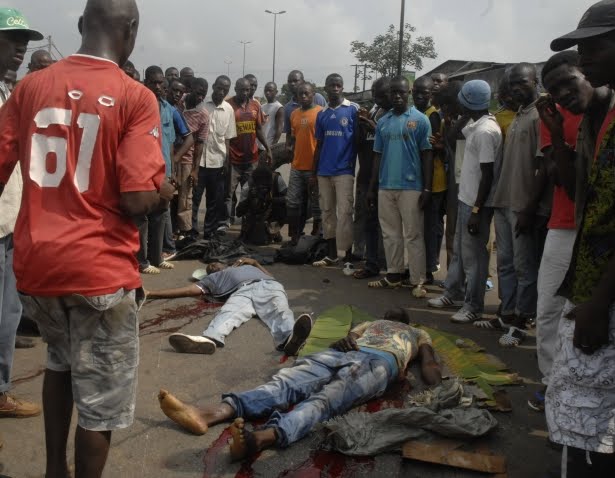
(WARNING: This blog post contains graphic images of war crimes. If you are upset by images of dead bodies then do not continue.)

A dictator stands in defiance of the will of his people. His security forces are shooting nonviolent demonstrators, and a full-fledged civil war has erupted between popular militias and regiments loyal to the incumbent regime. The civilian population is caught in the crosshairs, and the dictator’s paramilitary death squads and mercenaries have resorted to the indiscriminate slaughter of neighborhoods, cities and clans suspected of subversion. An entire nation sits precariously on the brink of genocide. Millions of civilian men, women and children have fled from the violence to become a long term caste of internally-displaced persons and war refugees, destabilizing every country in the region. The people can only pray for the international community to take a stand to protect them from annihilation.

I’m not talking about Libya, however, but another country whose fate might have even greater implications for the fate of African democracy: the Ivory Coast.


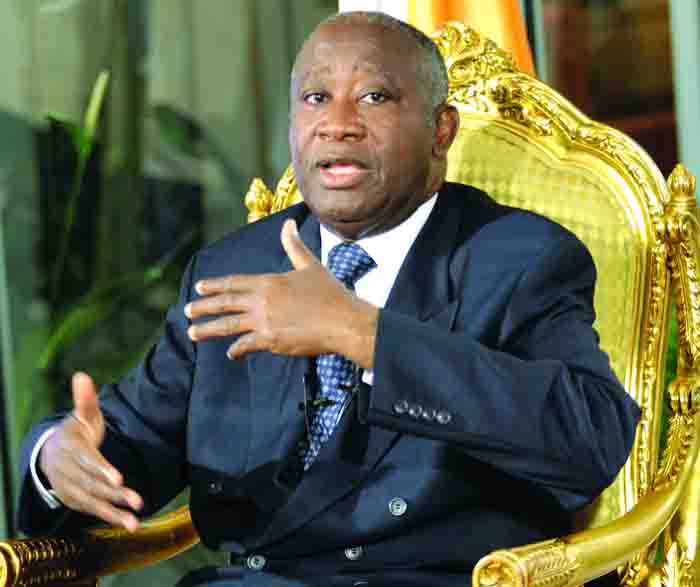
Any proponent of this democratic tide which has swept away dictatorships in North Africa should be equally if not more enthusiastic for the ouster of Laurent Gbagbo - the president/dictator of Côte d’Ivoire since 2000. When his term ended in 2005, Gbagbo simply declined to hold new elections and ensconced in the presidential palace for another five years as an unelected warlord. In Gbagbo we have not a long-standing monarch or military leader who is merely facing a sudden popular revolt, but a strongman who had stolen a position of authority by subverting his country’s inchoate democratic institutions.


Ivorian President Laurent Gbagbo agreed to hold a presidential election in November 2010. According to all objective observers, former Prime Minister and IMF economist Alassane Ouattara won with an unambiguous plurality of 54 percent of the vote. Nevertheless, the Gbagbo-appointed Constitutional Council declared “widespread fraud” in the pro-Ouattara northern provinces and rejected all of those districts’ ballots - disenfranchising enough voters to certify Gbagbo the winner with an alleged 51 percent of the vote. Gbagbo’s nullification of the Ivorian presidential election was the world’s greatest bastardization of the franchise in recent memory; fittingly, the incumbent nonsensically claiming victory in defiance of all objectively verifiable truth had campaigned on the slogan “We win or we win”.

Moreover, as President of Côte d’Ivoire Gbagbo provoked the Ivorian population into civil war, pitted his Christian-majority South against the Muslims of the North, incited xenophobic violence against French expatriates and immigrant workers from Burkina Faso, Guinea and Mali. Since the November election, ex-president Gbagbo widened the category of enemies of his quasi spiritual-nationalist-chauvinist regime and effectively declared war on the Ivorian civilian population which rejected him at the polls - a clear majority of the electorate. Ivorian soldiers and pro-Gbagbo youth gangs have terrorized tribes, clans, villages and neighborhoods as collective punishment for marking their ballots for Ouattara.


The moral cravenness of the Gbagbo regime was best exhibited this past March when the market women of the Abobo neighborhood in Abidjan demonstrated for an end to the fighting, carrying tree branches and chanting "We want peace".


Gbagbo’s forces mowed them down with machine guns, killing eight.

Despite the fact that they have declared allegiance to the rightful President Ouattara, lovers of liberty should hold little sympathy for Les Forces Nouvelles who are swiftly descending from their northern territories to conquer Gbagbo’s strongholds in the South. Les Forces Nouvelles are for the most part jackbooted thugs who likewise govern their territory through extortion, intimidation and outright theft.


Credible reports by Amnesty International and Human Rights Watch have documented an FN modus operandi of arbitrary detentions, torture, extrajudicial killings and sexual violence directed towards those tribes, clans and villages accused of loyalty towards the Gbagbo junta. Aid groups descending upon the western town of Duékué recently “liberated” by the FN have discovered mass graves and piles of bodies which may turn out to evince more than 1,000 individual war crimes.

The Ivorian civilian population needs protection from both factions in this gruesome war. The apathy of the international community in respect to the crisis in Côte d’Ivoire is disgraceful, especially considering the fact that the United Nations already has a peacekeeping force of 9,000 mostly French and Bangladeshi personnel in this country. UN peacekeepers have been stationed in Côte d’Ivoire since 2004, in fact. However, the UNOCI peacekeeping forces effectively only serve to stabilize the expatriate neighborhoods of Abidjan and the environs immediately surrounding Le Golf Hôtel where Ouattara’s government-in-internal-exile has stood under siege since November. Like the UN peacekeeping forces which could only stand their ground and watch as genocide unfolded in Rwanda and Sudan, the powers that be have apparently destined UNOCI to serve as a mere witness to the human slaughter in Côte d’Ivoire.

The United Nations Operation in Côte d’Ivoire (UNOCI) is authorized by Resolution 1528, which was passed unanimously in the Security Council back in 2004 and reauthorized and augmented in a series of subsequent resolutions. UNSCR 1528 which begat UNOCI is actually remarkably similar to UNSCR 1973 which brought us the present Operation Odyssey Dawn; each was ostensibly crafted on the liberal humanitarian and politically neutral rationale of maintaining a cease-fire and protecting civilians.

One major difference is that UNSCR 1973 authorized member states to enforce a no-fly zone to protect the Libyan rebels and civilians from assault by the Libyan Air Force; though the Gbagbo has used the Ivorian Air Force to pummel FN positions and civilian targets, and in 2004 even attacked the French air base in Bouaké (killing nine French soldiers and an American aid worker), the mandate for UNOCI has never included the enforcement a no-fly zone. Understandably so; most of the war crimes conducted by both sides in the Ivorian Civil War have been implemented by foot soldiers.

Another major difference – arguably more subtle but a more consequential difference nonetheless – is that UNSCR 1973 authorized member states to enforce the transport of arms in and out of Libya, and a significant portion of participants in Operation Odyssey Dawn have actively deployed their respective navies to hold up the blockade and starve Qaddafi of arms. UNSCR 1528 and its follow-up resolutions similarly exhorted member states to enforce an arms embargo on Côte d’Ivoire as well, but no one has seemed to notice. Even since the post-electoral revival of hostilities, UN investigators have been pursuing reports that guns, ammunition, perhaps even attack helicopters and aircraft may have been imported from Zimbabwe, Angola, even landlocked Belarus. Though some of the individual accusations may turn out to have be groundless – apparently the Belarussian helicopter sale had indeed been planned but never actually executed – the fact that Ivorian seaports and airports have been open to commercial traffic at all is testament to the fact that no relevant powers of the international community are earnestly committed to enforcing the arms embargo which is crucial to minimizing the extent of the Ivorian bloodbath.

Conversely, the UN-authorized operations in Libya are extremely dissimilar from UNOCI in that whereas Obama, Sarkozy, Cameron and every other power player has repeatedly insisted that Odyssey Dawn will not entail the deployment of ground troops, the multilateral campaign is being conducted exclusively by air and sea, the peacekeeping mission in Côte d’Ivoire consists almost exclusively of ground troops. UNOCI now consists of 9,024 uniformed personnel on the ground, including 7,578 troops, 176 military observers and 1,270 police – disproportionately Bangladeshi infantry and French gendarmes. Boots on the ground do not necessarily make the UN mission in Côte d’Ivoire any more effective; they have been by and large limited in their conduct to securing President Ouattara and his coterie at Le Golf Hôtel and only the most modest of civilian protection operations in Abidjan.

The crippling reserve exercised by UNOCI is likewise based on the exponentially greater risk of protecting civilians via ground troops; to date, 54 UN personnel have been killed in the line of duty in Côte d’Ivoire – more than the total death toll of US personnel in Bosnia, Kosovo, Colombia and Haiti combined. As the Obama administration is preoccupied with extricating our land forces from the quagmires in Iraq and Afghanistan, they are reasonably squeamish about committing to any sort of civilian protection operations that cannot be executed by B-2 stealth bombers or guided-missile destroyers.

It seems that the logistics of peacekeeping in Côte d’Ivoire might be daunting, even more so than our “kinetic military action” in Libya. Yet it seems that the moral logic of intervention is in both countries is indistinguishable. President Obama intones that action was necessitated by the specter of full-out massacre in Benghazi – an action which “would have reverberated across the region and stained the conscience of the world”. Indeed it would have. But are our consciences not stained by the massacres in Abobo and Duékué?

Obama argues that the United States has a strategic interest in preventing a massacre which “would have driven thousands of additional refugees across Libya’s borders, putting enormous trains on the peaceful – yet fragile – transitions in Egypt and Tunisia.” At last count, the UN High Commissioner of Refugees stated that at least 116,000 Ivorian refugees had already fled to neighboring Liberia, Ghana, Burkina Faso, Mali and Guinea – with more than 100,000 in Liberia alone. All of these countries are already suffering from some degree of political instability, anemic economies and intolerably high levels of unemployment; hence the situation we have now with multiple millions of internally displaced Ivorians who might very well pour over the borders bodes terribly ill for West Africa’s fragile democracies.

Obama contends that if the U.S. did not intervene in Libya, “The democratic impulses that are dawning across the region would be eclipsed by the darkest form of dictatorship, as repressive leaders concluded that violence is the best strategy to cling to power.” Though as Laurent Gbagbo defied the will of his people and nullified the election in which he lost, we demonstrated to the young democracies of Africa that we would respond to their power grabs with sharply-worded proclamations and economic sanctions that we would not bother to enforce. This year alone presidential elections are scheduled to be held in Liberia, Nigeria, Cameroon, Zimbabwe, and seven other countries on the continent; is the lesson of Ggbagbo to be learned by African incumbents that they should do well to stay in power by not holding elections at all?

Moreover, Obama maintained that intervention in Libya was necessary to uphold the credibility of the UN itself, that had we not acted “The writ of the United Nations Security Council would have been shown to be little more than empty words, crippling that institution’s future credibility to uphold global peace and security.” How does United Nations make itself credible when the Security Council calls for a cease-fire and does not enforce it? Or when the Security Council enacts an arms embargo on a war criminal regime – but not a single member state is willing to interdict cargo ships and planes bound for it? How can any institution be trusted to keep the peace in the African heartland when its peacekeeping mission cowers on the beaches of Abidjan?

In all fairness, the newly-christened Obama Doctrine is more nuanced than a mere postulate of normative ethics; the rubric for intervention laid out in the President’s “Responsibility to Act” speech is a complex calculus of moral imperatives and cold cost-benefit analysis. And he did state quite clearly: “It’s true that America cannot use our military wherever repression occurs”; i.e. sometimes despots will crush their people and the United States will do nothing because – however righteous intervention might be – we cannot afford to intervene, or we can but the fate of the country in question is not in our core national interests.

And likewise, it looks quite manifest that the international community is not going to take any substantive action to protect the Ivorian civilian population, that this civil war is probably going to end within a matter of hours as the Les Forces Nouvelles seize hold of the last military bases and police stations in Abidjan, the television station and the presidential palace, the last Gbagbo loyalists either defect, surrender or are summarily executed by the victors. Laurent Gbagbo himself will most likely come to an end with a bullet to the temple. And one can only imagine what sort of “revolutionary justice” the FN Jacobins might mete out to the neighborhoods, villages, and clans which voted for Gbagbo. This sort of African solution to an African problem will not put the lives of any U.S. troops on the line and it won’t cost taxpayers a dime; from our narrow self-interest, it might even be an efficient policy of isolationism. Though for the Ivorian people, on the other hand, it might mean tens of thousands of civilian deaths which could have been completely prevented had the international community made a serious stab at intervention.

As we bask in the self-righteousness of pre-empting humanitarian calamity in Libya, how do we sit content with the knowledge that civilians are being massacred at this very moment, that the United States could very well lead a multilateral coalition to protect the Ivorian civilian population – but we politely declined? How might our academies’ mightiest metaphysicists and international human rights lawyers conclude a moral “responsibility to protect” civilians in Libya – but not civilians in Côte d’Ivoire? What makes a real, actual massacre in Duékué any less atrocious than a hypothetical massacre in Benghazi? Is it the fact that Libyans are Caucasoid enough that they almost resemble Europeans – but Ivorians are much darker-skinned Others? Or is it that the Western economies cannot handle even a mild oil shortage – but we can cope with civil war in countries whose greatest export is the cocoa bean?

This author for one sympathizes greatly with the doctrine of a “responsibility to protect” which is evolving out of the legal framework of Odyssey Dawn, but a legal doctrine which aims to uphold the values of universal human rights either necessitates intervention to protect both peoples or neither. If the power elite espouse a “responsibility to protect” the people of Libya, but find no such obligation to intervene on behalf of the Ivorians, their reasoning must be predicated on some combination of apathy, hypocrisy, or the kind of cold-blooded economics in which human costs merit no consideration.

Sunday, March 20, 2011

The Elusive Aim for Regime Change in UNSCR 1973

Just as any thinking person cannot help but identify with the demonstrators for constitutionalism and parliamentary self-government everywhere throughout our Arab Spring, this lover of liberty empathizes with the Libyan rebels who wish to oust the bizarre, sadistic one-man revolution of Colonel Muammar el-Qaddafi. I would have preferred to have seen Qaddafi go relatively peacefully like Ben Ali and Mubarak, I would have preferred to see the Libyan insurrectionists overthrow their tyrannical regime with their own hands. Obviously neither of those scenarios were fated to be, and now apparently the only way to prevent the massacre of rebel forces and Libyan civilians by the Qaddafi loyalists is with some form of foreign military intervention.

The legal internationalist should have been opposed to unilateral U.S. intervention in Libya without a casus belli of self-defense, without authorization by the United Nations as it would have been a violation of international law. Likewise, I would have registered my doubts if France, Britain, or the Arab League were to intervene under such terms. However, now that the Security Council has just passed UNSCR 1973, concerns about illegal warfare should be largely assuaged. So long as the U.S. or any other foreign country wishes to intervene in Libya in accordance with the U.N. mandate, the matter of a no-fly zone is no longer a debate of de jure legality but one of normative politics and logistics. As the U.S. Air Force and Navy intervene, the objective rationalist should hope that they can get the job done with as few casualties and with as little cost as possible. The question remains though; what precisely does this job entail?

Now that the U.N. mission in Libya is a reality, cheerleaders of military intervention would be wise to temper their populist fervor by carefully reading the exact text of United Nations Security Council Resolution 1973. UNSCR 1973 is the follow-up to UNSCR 1970 passed on February 26th which

1) referred the situation in Libya to the International Criminal Court for investigations of war crimes, crimes against humanity and genocide;

2) instituted an embargo of arms transfers to Libya, Libyan arms exports, and the movement of mercenaries to fight in Libya;

3) imposed travel bans 17 Jamahiriyah figures and enacted asset freezes on Colonel Qaddafi and his sons;

4) called on U.N. members states to contribute humanitarian assistance to Libyan civilians.

As far as U.N. sanctions go, even the preliminary USCR 1970 was just about as strong as they come; it essentially revived the bulk of the U.N. sanctions imposed on Libya in UNSCR 748 (1992) and 883 (1993) in the wake of Tripoli’s sponsorship of the Lockerbie bombing and eventually eased from 1998 to 2003.

UNSCR 1973 tightens the screws on Qaddafi a bit further. The Resolution contains a range of operative clauses which authorize limited foreign intervention operations – with the politically neutral, strictly humanitarian objective of reducing civilian casualties. With 1973, the Security Council…

1. “Demands the immediate establishment of a cease-fire and a complete end to violence and all attacks against, and abuses of, civilians”...

2. Authorizes Member States “to take all necessary measures”… “to protect civilians and civilian populated areas under threat of attack in the Libyan Arab Jamahiriya, including Benghazi, while excluding a foreign occupation force of any form on any part of Libyan territory…”

6. “Decides to establish a ban on all flights in the airspace of the Libyan Arab Jamahiriya in order to protect civilians”... (i.e. flights with a military purpose, explicitly excepting flights with humanitarian passengers or cargo)

8. “Authorizes Member States… to take all necessary measures to enforce compliance with the ban on flights…”9. Calls upon Member States to provide assistance with the implementation of the no-fly zone and protection of civilian populations, including the use of air bases and airspace

13. Calls upon Member States “to ensure strict implementation of the arms embargo” established in UNSCR 1970 by inspecting vessels and aircraft in their seaports, airports and territorial waters bound to or from the Libyan Arab Jamahiriya

16. Calls upon Member States to take action to enforce UNSCR 1970’s ban on the import of mercenaries from their own respective populations or traveling through their territories bound for Libya

17 and 18. ...and to enforce the air embargo on the Libyan Arab Jamahiriyah
UNSCR 1973 calls for enforcement mechanisms of the arms embargo, mercenary embargo, air embargo and financial sanctions previously laid out in UNSCR 1970. UNSCR 1973 strengthens the Security Council’s prior ultimatums to Libya with demands for a cease-fire. And most dramatically, UNSCR 1973 includes a mandate for foreign military intervention, calling for U.N. Member States “take all necessary measures” “to protect civilians and civilian populated areas under threat of attack” and to enforce the no-fly zone. Period.

This resolution authorizes an agenda which should satisfy the self-ascribed humanitarian interventionists whose objective begins and ends at the prevention of civilian casualties. The no-fly zone applies to the Qaddafi loyalists as well as the Benghazi rebels alike – technically. But obviously it was intended to be enforced against the only faction in the Libyan Civil War which is employing Air Force bombers and heavy artillery against civilian populations. UNSCR 1973 was quite patently constructed for enforcement against only one side to the dispute, and it would be a fair bet to assume that there will be little to no incidence of coalition air strikes against Libyan rebels who might be in violation of the so-called cease-fire.

Though this Resolution might yet tilt the civil war in the rebels’ favor, let’s not get carried away to think that the Security Council has just authorized regime change in Tripoli. UNSCR 1973 does not authorize Member States to take action against Libyan military targets unrelated to the enforcement of a cease-fire, the implementation of the no-fly zone or the protection of civilians. It does not authorize France to bomb Libyan Army barracks full of soldiers engaged in calisthenics training. It does not authorize Britain to provide air cover for a rebel offensive on loyalist-held territory; it does not allow anyone to fight the Benghazi rebels’ civil war for them. Just as the George H.W. Bush administration refrained from marching onto Baghdad as such a move would have exceeded Operation Desert Storm’s narrow U.N. mandate to eject Iraqi forces from Kuwait, the coalition amassing to intervene in Libya cannot legally expand its objective to regime change in Tripoli.

Yet for some reason (perhaps these same Neoconservative interventionists’ dissatisfaction with the outcome of the first Gulf War) I don’t think that the present day Libya hawks would sit content with an endgame that leaves Colonel Qaddafi in power.

John McCain – one of the first major outspoken proponents of a no-fly zone – makes no bones about its final cause: “If you want Qaddafi to go, then one of the steps – among many – would be to establish a no-fly zone…”

Joe Lieberman conflates the objective of preventing civilian casualties with supporting the rebels and regime change:

“The president has made clear that Gadhafi’s got to go; he’s no longer the legitimate leader of Libya, and the question is what are we going to do to help make sure that Gadhafi goes as quickly as possible because the danger here is that this is going to become a bloody stalemate, a civil war, a bloody civil war...”
Iraq War architect Paul Wolfowitz calls for not just a no-fly zone in Libya, but for the U.S. to recognize the National Council in Benghazi as the legitimate government of Libya, providing the rebels with arms, supplies and direct military intervention:

Recognizing the new National Council would affect the psychology of both Gadhafi's cronies and his brave opponents. Ending the mixed signals sent by U.S. hesitation over recognition would end any possibility of rehabilitating Gadhafi if he wins. Absurd as that may sound to us—particularly after President Obama has declared that Gadhafi must go—this is probably the outcome that Gadhafi's cronies hope for, and that his opponents most fear.
David Frum – who wrote some of the Bush administration’s seminal speeches on regime change in Iraq and who himself laid the case for regime change in Iran and Syria – draws the argument for intervention directly to the need to oust the Libyan government:

“Gadhafi’s departure from power in other words is not just a requirement of humanity and decency. It’s not only justice to the people of Libya. It is also essential to American credibility and the stability of the Middle East region.”
My intent in harping upon this point is not to draw a straw man argument but to elucidate the U.S. Libya hawks’ intentions. It seems that there are two camps in this present discourse who have been clamoring for a no-fly zone. The first camp would be the liberal humanitarians who are concerned exclusively with the prevention of civilian casualties, who could be content with the Libyan rebels putting down their arms and the partition of Libya into a provisional rebel territory based in Benghazi and a Qaddafi rump state in Tripoli. The second faction for a no-fly zone is that of the Neoconservative hawks who embrace the language and purported objectives of the liberal humanitarians but make it clear that they do intend for the U.S. to take sides in this conflict, and that a no-fly zone is only the preliminary action that ought to be taken as part of a larger campaign to oust Qaddafi. This is notable because UNSCR 1973 explicitly only authorizes foreign military intervention to attain the goals of the liberal humanitarians, and the broader goals of regime change and democratization in the Arab world which the Neocons espouse – as desirable as they might be – go far beyond the scope of the U.N. mandate.

As for yours truly, I could not help but empathize with the Wolfowitz, McCain, et al.’s dream of establishing constitutional monarchies, republican and parliamentary regimes which derive their moral authority to lead from the popular will from Kabul to Baghdad to Tripoli. I agree with the liberal sentiment that the blossoming of democracy and free markets in repressed authoritarian societies should sow the seeds for peaceful change and political moderation, that the demise of states like Qaddafi’s nightmarish Jamahiriyah should lead to the stabilization of the region, undercut the appeal of Islamic fundamentalism and reduce the threat of anti-American terrorism in the long run. And by the way, regime change in Tarabulus is what a good plurality the Libyan people apparently want – it is certainly a desirable end. Regardless, there is no way to read the relevant documents of international law (namely the United Nations Charter, UNSCR 1970 and UNSCR 1973) and conclude that signatory U.N.O. Member States such as the U.S. can simply declare war on Libya and overthrow Colonel Qaddafi on a whim.

It would be perfectly plausible for the Obama administration to heed Wolfowitz’s advice and follow the lead of France and Portugal in recognizing the National Council in Benghazi as the legitimate government of Libya. Such a move would allow the administration to abide by myriad U.S. restrictions on military and economic aid to the Benghazi regime – though it would not make it any easier for the U.S. to exercise decisive force on Tripoli to bring a quick end to the Qaddafi regime. So long as the United Nations recognizes the Jamahiriyah as the legitimate government of Libya and Muammar el-Qaddafi as its legitimate ruler, the United Nations Charter stands in the way of a legal NATO-Arab League operation to subvert the Tripoli regime.

Though imagine if the following events – all perfectly plausible – were to precipitate in New York, Cairo and Benghazi over the course of this week:

1) After recommendation from the Security Council, the Arab League and the African Union member states were to sponsor a General Assembly resolution calling for the expulsion of the Great Socialist People’s Libyan Arab Jamahiriyah from the U.N.O. – which they can do according to Chapter II, Article 6 of the United Nations Charter. It passes.

2. Those same Arab League, African Union countries sponsor a second General Assembly resolution calling for the recognition of the National Council in Benghazi as the legitimate government of Libya. It too passes.

3) The newly-recognized Libyan government in Benghazi were to appoint a new Ambassador to the U.N. (perhaps Mohammad Shaghash, the Ambassador who recently defected from Tripoli)

There is something of a precedent for this. The Republic of China led by Chiang Kai-Shek joined the United Nations Organization as one of its founding members in 1945, the U.N. continued to recognize the R.O.C. governmentin Taiwan as the rightful representatives of all of China until 1971. By that time when the Chinese Civil War had been long settled in favor of Mao Tse-tung and his Red Army, the General Assembly passed Resolution 2758, which concluded:

"the representatives of the Government of the People's Republic of China are the only lawful representatives of China to the United Nations and that the People's Republic of China is one of the five permanent members of the Security Council,"
Furthemore, the General Assembly decided:

"to restore all its rights to the People's Republic of China and to recognize the representatives of its Government as the only legitimate representatives of China to the United Nations, and to expel forthwith the representatives of Chiang Kai-Shek from the place which they unlawfully occupy at the United Nations and in all the organizations related to it.”
UNGAR 2758 effectively stripped the R.O.C. from membership in the U.N.O. and transferred its General Assembly and permanent Security Council seats to the People’s Republic of China.

If the General Assembly were to expel the Great Socialist People’s Libyan Arab Jamahiriyah from the U.N.O. and replaced with representatives of the regime in Benghazi, as far as international law goes, we’d be talking about a whole new ballpark. If the provisional government in Benghazi is recognized by the U.N. as the legitimate government of all of Libya, Qaddafi’s armies would then be just another non-state militant group with no legal standing akin to the I.R.A., P.L.O., the Janjaweed, etc. which Tripoli propped up at one time in the past. Perhaps the Qaddafi-loyalist Libyan Army, Libyan Navy and Libyan Air Force could even be classified as terrorist organizations (as the U.S. now classifies the Iranian Revolutionary Guards) and thus any government aiding or abetting them financially or otherwise could be designated as a State Sponsor of Terrorism…

If – under such circumstances – the Libyan Ambassador to the U.N. were to call upon the aid of fellow Member States to come to his nation’s protection, there would be very little in the wide corpus of international law standing in our way to shower Benghazi with guns, ammunition, tanks and artillery. The legitimate Libyan government could call upon U.N., Arab League and African Union member-states to come to its aid against an existential threat just like Saudi Arabia and Kuwait did in 1990. A joint NATO-Arab League-African Union coalition could perfectly legally and with the fully nationalist legitimacy of the pan-Arabist, pan-Africanist regional organization defend the rightful Libyan government in Benghazi and help them to quash the “rebellion” in the Tripolitania.

Nevertheless, now that a truly multilateral military intervention in Libya has explicit Security Council authorization and de jure legality, this blogger is still concerned about the doctrinal repercussions. Yes we can intervene, but why ought we intervene in Libya? Is it because the international community has an obligation to strike against states in order to prevent gross human rights abuses and crimes against humanity? If that is the case, what makes the atrocities in Libya worthy of a U.N.-enforced no-fly zone – but not the atrocities in Darfur or the Gaza Strip? Let’s suppose that the people of Bahrain and Yemen were to call upon the U.N. to send peacekeeping forces to protect their nonviolent demonstrations from being massacred by their own totalitarian states – under what doctrine of protecting civilians must the U.N. intervene in Libya but not Bahrain and Yemen?

The established doctrines of military intervention might need some significant revision in the wake of newly-christened Operation Odyssey Dawn – especially if the Obama administration were to heed the advice of Wolfowitz, Lieberman, et al. and wholeheartedly take the side of the Benghazi rebels in the Libyan Civil War. The U.S. has conducted regime change under the ostensible rationales of containing thwart Communist aggression and preventing state-sponsored terrorist attacks. Though in this circumstance there isn’t the slightest pretense of intervening in order to prevent acts of aggression against American national security interests. G.A. Resolution 2785 only recognized the outcome of the Chinese Civil War 22 years after the fact. Is the United States now obligated to intervene in every single conflict between an undemocratic regime and a popular movement opposed to it and to always side with the latter? Is the Arab League, the African Union, NATO and United Nations? Or are we only obligated to take sides in civil wars against dictators like Qaddafi whom we have always disliked?

If the Obama administration were to invoke the international law of the United Nations Charter and the Universal Declaration of Human Rights, exert our political sway before the General Assembly and Security Council, exercise the power of the United States Armed Forces and our treaty alliances in order to replace Qaddafi’s dictatorship in Libya with some form of constitutional self-government, we would be entering a brave new doctrinal tomorrow. Would the United States be henceforth bound to some sort of Obama Doctrine which extends the Monroe Doctrine all the way to the Sahara Desert and establishes a universal doctrine for the United States to intervene on behalf of every popular movement in Africa and the Middle East? If we were to back the National Council in Benghazi to subvert Qaddafi’s dictatorship in Tripoli, we would be establishing a foreign policy more Wilsonian than anything Woodrow Wilson could have fantasized, a foreign policy which would interpret the promise of the Declaration of Independence as an affirmation of global human rights including a right to government by multiparty elections and the right of revolution against undemocratic regimes? Personally, I don’t think that sounds half bad…

However, if the Obama Doctrine formulated to justify intervention in Libya is going to have any moral bearing this precedent for intervention must be applicable to other comparable cases. If the impending humanitarian catastrophe in Benghazi is sufficient reason for the international community to take a forceful stand against the war criminal regime in Libya, then we must go through the Security Council to intervene on behalf of the people of Côte d’Ivoire, Zimbabwe, Guinea, the Congo, Sudan and Eritrea against their respective war criminal regimes. On the other hand, if the doctrinal precedent is meant to be “limited to the present circumstances”, inapplicable to any future cases because our interests are not threatened by these police states’ genocides and political massacres, then it would demonstrate that our principles of intervention are either nonexistent or false. Libya could only be a singularity designated for regime change if the capacity of unmitigated evil were limited to the persona of Muammar al-Qaddafi. If the millions of victims of Robert Mugabe, Laurent Gbagbo and Omar Hassan al-Bashir are deemed somehow less worthy of our intervention than the thousands of victims of Colonel Qaddafi, our inaction would prove ipse facto that the liberal case for intervention in Libya is just a humanitarian fig leaf for our discomforting, venal interests in the makeup of the Libyan regime; U.S. hegemony over North Africa and the petroleum which lies beneath her sands.

Thursday, October 14, 2010

Who Speaks for America's Jews?


(Click HERE for musical accompaniment)

Deprived for much-too-long of borscht-flavored intellectual ferment, I sojourned to Temple Beth El in Stamford, Connecticut to hear a debate between Alan Dershowitz and Jeremy Ben-Ami provocatively titled “Who Speaks for America’s Jews?” (both men would like to tell you that the answer to the question is “me”). I came with high hopes for this debate between two heavyweights in the Yiddish League of verbal sparring; I assumed that given the speakers’ expertise I might have heard a vigorous discussion of American Jewish activism in relation to the U.S.-brokered peace talks between Netanyahu and Abu Mazen.

For those who are unfamiliar with the speakers, Jeremy Ben-Ami is the Executive Director of J Street – self-described as “the political home for pro-Israel, pro-peace Americans”. He is an American Jew descended from some of the first settlers in Tel Aviv, whose father founded a number of American Zionist organizations and who has himself lived a substantial part of his life in Israel. Now as the head of J Street, Jeremy Ben-Ami is asserting himself as the face of American Jewry dedicated to a two-state solution to the Israeli-Palestinian conflict in order to guarantee “Israel’s survival as the national home of the Jewish people and as a vibrant democracy.”

Many more of you probably know Alan Dershowitz – the Harvard Law professor who has made a name for himself as an advocate for the State of Israel. Dershowitz’s background as a constitutional liberal makes him an estimable defender, because he vows support for a two-state solution and opposes the Israeli settlement of the West Bank. His argument is that he opposes the singling out of Israel for human rights violations – which he interprets as the product of anti-Semitic prejudice. And likewise, the author of such titles as The Case for Israel, The Case for Peace and The Case Against Israel’s Enemies has spent the better part of the past decade serving as the go-to destroyer of Jimmy Carter, Noam Chomsky, Norman Finkelstein, John Mearsheimer and Stephen Walt, the Board of Directors of Hampshire College and anyone else who might criticize Israeli policies in the Occupied Territories – including the new group J Street.

I had come to this debate thinking that Jeremy Ben-Ami and Alan Dershowitz would make a thorough discussion of American Jewish activism in relation to U.S.-Israeli relations, Israeli policy towards the Palestinian issue, the Iranian nuclear program, Lebanon and Syria and the rest of the Arab world – ostensibly, the reasons why one should be interested in who speaks for American Jews. Unfortunately, the vanities of both Dershowitz and Ben-Ami allowed for no such thing – and what could have been a substantive debate on policy descended into a petty catfight between two prima donnas.

Hardly more than a few softball questions into the debate, Dershowitz veered the discourse to file a personal grievance against J Street; in one advertisement, they displayed Dershowitz’s face alongside those of Sarah Palin, Rush Limbaugh and other prominent opponents of present negotiaions for two-state solution in a group that J Street calls “The Chorus of ‘No’”.

“How dare you lump me together with two people with whom I have nothing in common? You owe me an apology!”

Ben-Ami tried his best to mitigate the apoplectic Dershowitz but could not; “The reason why you appear in “The Chorus of No” is because this is the way you choose to advocate for Israel. As soon as there is something that you interpret in a way you don’t like, the person is immediately ‘anti-Israel’…”

“I think we have to talk about George Soros... George Soros has publicly said he is not a Zionist, he doesn’t want to have anything to do with Zionism, he thinks that Israel causes anti-Semitism, he has compared Israel to Nazism, you have denied that he funded you…”

“As soon as there is a question on the table, you throw out the name ‘George Soros!...”

“…You are a cover for many people who are virulently anti-Israel!”

In such a manner, Dershowitz and Ben-Ami plotzed and kvetched about bupkes for at least the first 40 minutes of the “debate”. It was not until 50 minutes into the “debate” that the discourse turned to actually substantive matters when the moderator asked Jeremy Ben-Ami, “What exactly is it that troubles you about Israel’s human rights record?”

“Have you been to the old market in Hebron?” Ben-Ami asked, and even invited the Stamford rabbi to come with him some time. "It is impossible to be a Jew and not feel shame at the way in which Palestinian people are treated in the center of Hebron… Down the middle of the street runs a barrier; on one side Palestinians are allowed to walk, on the other side Jews are allowed to walk…”

This is precisely the moment when Jeremy Ben-Ami was lobbed a softball down the center and he could have hit it out of the park. He could have leaped upon this opportunity and declared the unequivocal injustice of one nation ruling another under the yoke of military occupation, the fundamental wrongness of any nation annexing the territory of another won in battle as the spoils of war, he could have illustrated the barbarism of Israeli settlers evicting Palestinians from their rightful land by gunpoint and killing those who refuse. He could have eloquently depicted the humiliation of Palestinians whose day-to-day movement is frustrated by cumbersome checkpoints, he could have explained how the economy of Gaza has all but collapsed since Israel laid siege to the city with a stifling embargo and cut off electricity and fuel and deprived a city of a million people of basic functioning water and sanitation treatment facilities. He could have cited reports from groups like Amnesty International and Rabbis for Human Rights documenting the bulldozing of entire apartment complexes, the use of white phosphorus in populated neighborhoods, the IDF’s use of human shields in the 2008-2009 Gaza invasion, etc… But no, Ben-Ami bunted; the most troubling thing he could think of was the layout of the market in Hebron – implying the A-word that alienates much of an audience like the one at Temple Beth El.

Even the purportedly-neutral moderator pounced, “I’ve seen human rights violations that are so extreme in what they do to human beings and how human beings end up dead, maimed and dead… whether it’s in Sudan or Sri Lanka… I don’t understand why of all the things you want to give me as an example of why it’s troubling… I don’t doubt that it would be troubling, but troubling is not what I’m looking for from you!”

Dershowitz seized the opportunity to make the relativist argument: “No country in modern history has had a better record with human rights under comparable threats than the nation of Israel!” he proclaimed, “not the United States – which detained 110,000 Japanese-American civilians during the Second World War, which has killed civilians in drone attacks, which has had much greater human rights violations in administrative detentions in Guantánamo; not Great Britain – with its fights in Northern Ireland, its fights in Kenya; not France – with its problems in Algeria…”

Then Dershowitz laid his trademark “gotcha!” trap: “Jeremy Ben-Ami, I want you to name a country with a better human rights record – that has been more criticized for its human rights record than Israel.”

“I’m struggling to think of another country in the world right now that is occupying another people…”

“China!”

“… that is preventing them from exporting any goods…”

“China – Tibet! Kurdistan! And I can go on! Fourteen or fifteen countries – most of which nobody has ever heard of because the UN doesn’t spend any time on them!”

The central problem with Dershowitz’s strategy of defaming critics of Israeli policy – illustrated here – is that the crux of his case tends to employ a mixture of the straw man argument and ad hominem attack. When someone like Jeremy Ben-Ami so much as criticizes a specific Israeli policy, Dershowitz makes pains to avoid addressing that grievance and quickly changes the topic of conversation to the criticizer’s own shortcomings;

"Iran/Syria/China/Burma/Sudan/Zimbabwe/Kyrgyzstan is violating human rights. Why aren't you criticizing their human rights record?"

His opponent freezes, can only stammer some weak-kneed excuse: “Well… my organization doesn’t have an official position on the situation in Zimbabwe, so I really don’t know …”

“So, even though Iran/Syria/China/Burma/Sudan/Zimbabwe/Kyrgyzstan is committing gross human rights abuses, you remain silent! You only criticize human rights abuses when they are made by Israel!” Dershowitz thunders, “Therefore, your judgment is tainted with anti-Israel bias! Therefore you are an anti-Semite! You are a Jew and yet you are an anti-Semite and therefore you are a self-hating Jew! Therefore, anything you might say about Israel’s human rights record is an anti-Israel, anti-Semitic, blood lie against yourself!” Dershowitz’s Jewish audience pockets the line of reasoning, proceeds to view his opponent as Mahmoud Ahmadinejad in a yamulke for the rest of the debate and thereby dismisses anything of merit that he might have to say.

Indeed, Alan Dershowitz has a valid point to make when he rejects criticisms of Israel’s human rights record made by regimes that are themselves gross violators of human rights with a long history of anti-Israel and anti-Semitic bias; e.g. the governments of Saudi Arabia, Iran or the UN Human Rights Committee when it was chaired by the delegation from Libya. He is right when he demands that human rights organizations within the United Nations umbrella, Amnesty International, Human Rights Watch, etc. be evenhanded and not single out Israel for vilification while remaining silent about the Egyptian and Jordanian governments’ and Hamas’ crimes against the Palestinians, Syria and Hezbollah’s disregard for the human rights of Lebanese civilians. He is right to criticize Hamas and Hezbollah's terrorist attacks against Israeli civilians as violations of Israelis' human rights - and thereby he is right to criticize the governments of Iran, Syria, Sudan and Venezuela for sponsoring these terrorist groups. But that doesn’t mean that Dershowitz is right in shouting down anyone who dares to criticize Israel’s human rights record.

The central plank of Dershowitz’s destruction of Ben-Ami – “You can’t name one country in a situation comparable with Israel’s with a better human rights policy” – is a terrible defense of Israel’s occupation of the West Bank and siege of the Gaza Strip. What it amounts to is more or less “So Israel might be flagrantly violating international law in its occupation and colonization of another nation’s sovereign territory… but you can't criticize Israel so long as they are not the superlative worst offender of human rights!" or "Hey, at least it’s not genocide!” Is that really the kind of logic that American Jews want to employ when defending Israel? Shouldn’t people who write books with titles like The Case for Moral Clarity be arguing that the State of Israel have a human rights record not just better than that of blood-stained Asiatic autocracies and African juntas but so immaculate that it is beyond the reproach of fair criticism?

That argument for moral clarity, actually, was what Jeremy Ben-Ami was trying to make before Alan Dershowitz shouted him down.

“The occupation of the West Bank and the way in which the Palestinian people have been treated for 42 years is very, very troubling. I’m not putting it on a scale with the genocide that took place in Rwanda, I’m not putting it on a scale with what happened in Sri Lanka… What I am worried about in the Jewish community is that we’re too self-satisfied that we’re not as bad as Sri Lanka, we’re not as bad as Rwanda – that’s not good enough. We should be treating people according to the values that we were brought up under, the values that we expect other people to treat us with, and if we were treated in Hebron the way that Palestinian people are treated by Israelis, we would be deeply troubled as well.”

“There is a standard of morality, a standard of ethics, a standard of behavior that I was raised to believe is fundamental to what it means to be Jewish. I don’t care where my standard falls vis-à-vis the Kurds, I don’t care where my standard falls vis-à-vis the Chinese. What I believe is that the country that is the nation-state of my people should be behaving and upholding the standards of my people.”

Nevertheless, one would think that Alan Dershowitz handily won this “debate” judging by the reactions of the largely elderly Jewish audience. By keeping his vocabulary within the secular language of human rights and constitutionalism and democracy he was able to swat away Ben-Ami’s criticisms with nary a word that might discomfit a liberal, college-educated audience. He was able to excuse Israeli mistakes with such bombast that it seemed that in making these mistakes Israel was in fact righteous and that it was her accusers who were at fault for the very act of making the accusations. And when he made his applause lines the audience dutifully applauded – even if you disagree with everything the man says, you have to admit that Dershowitz is a masterful rhetorician. Having seen Dershowitz do his song-and-dance routine in person, it is clear why Benjamin Netanyahu invited him to serve as Israel’s Ambassador to the United Nations.

But on the substance of the “debate”, I feel that Dershowitz really didn’t make much in terms of an argument – he didn’t really defend Israel’s policies in regards to the occupation, the settlements and its human rights record as much as he criticized Mr. Ben-Ami’ criticisms of them. I left Temple Beth El disappointed that the bulk of Dershowitz’s shtick was to undermine the credibility of his opponent by associating him with some outrageous thing that George Soros might have said out of context this one time, to showcase the fact that Ben-Ami never publicly denounced this or that left-wing anti-Zionist and to thereby put those outrageous words in Ben-Ami’s own mouth. Instead of responding to Ben-Ami’s criticisms of Israel, he just insinuated that these criticisms somehow originated in ideologies of anti-Semitic prejudice. So if Dershowitz won, it was only because he bullied and crowded Jeremy Ben-Ami out of the discourse so that he never really had a chance to speak. Though I have enjoyed some of Dershowitz’s books and found them to be fairly compelling, I found Dershowitz’s performance in person to be so mean-hearted and pandering to the least common denominator that I left the synagogue feeling more skeptical of his arguments than before I came in.

And thus I have to agree with Ben-Ami when he rejoined Dershowitz’ ¬love-it-or-leave-it posturing; “You and that advocacy are part of the reason so many young, liberal Jews are walking away from Israel”. When people like Alan Dershowitz – or Eric Cantor or Abraham Foxman or Bill Kristol – throw around epithets like “anti-Israel” or “anti-Semitic” so often in so many contexts when it is not even remotely appropriate or they make a point of repeatedly professing their love for Israel to the point that it becomes hackneyed and meaningless, it really turns off a lot of people who are truly interested in hearing a bona fide discourse on things that matter. When a public figure questions the patriotism of his rivals and filibusters amidst the last refuge of scoundrels, it leads certain members of the audience to conclude that the speaker lacks the facts and the law to slam and so he has resorted to slamming the table. Likewise, if the best that the most learned defender of Israel can do is to make a relativist argument, kill a straw man and criticize the criticizers, it leads a number of us to wonder if anyone can straightforwardly defend Israel’s human rights record in the Occupied Territories.

This is part of the reason why the new J Street organization is being embraced with so much enthusiasm by many American Jews – especially youth. A great many of us strongly identify with our Jewish heritage and with the nation of Israel; however, we do not hold any blind tribal allegiance to the Jewish settlers of the West Bank any more than we hold blind tribal allegiance to Bernie Madoff, Scooter Libby or Paul Wolfowitz. We believe that the Jewish people have the right to determine our own destiny in the State of Israel, but we do not believe that Jews have the right to steal the property of non-Jews living in the West Bank. We reject the platform of the Likud Party which "flatly rejects the establishment of a Palestinian Arab state west of the Jordan River." We believe in Judaism and Zionism; however, we do not believe in Likudism.

A lot of American Jews who believe in the Jewish democracy have a difficult time speaking as apologists for the State of Israel and its treatment of the Palestinians. Especially when we factor in the Bronze Age barbarism of the West Bank settlers, our views on every single one of 7.5 million Israelis cannot be described as unconditional respect. This 24-year-old American Jew, for one, has trouble perceiving Israel as at all times the victims as much as my grandfather who considered emigrating to Israel to fight in the War of Independence or my parents who lived through the Six-Day War and the Yom Kippur War. American Jews of my generation know our history of Israeli victimhood, we identify with contemporary Israeli victimhood of suicide bombings and rocket attacks - but we have also been cognizant of Israel occupying 3 million Palestinians in the West Bank and laying siege to another 1.5 million on the Gaza Strip so long as we have been able to read newspapers. To many of us, there is solid evidence to portray the Israelis who are colonizing Palestinian lands and the state which facilitates this systematic oppression as victimizers. We are not going to waste our time comparing the human rights records of the State of Israel versus Hamas or Hezbollah, we don't care whose human rights record is the worst, but what we are going to do is to ask that the Jewish State - the state of our people - live up to its moral and legal obligations to respect the human rights of people of other nations.

Justifications of Israeli policy resting upon the premise of Arab treachery seem to so many of us outdated; the sneak attack of 1973 was 37 years ago, Egypt and Jordan have long ago signed peace treaties and the Arab League’s Peace Initiative remains the only offer on the table, moreover, Yasser Arafat is dead and buried. In light of these realities in the year 2010, a great deal of American Jews can’t understand why so many of our people still oppose the establishment of a Palestinian state in the West Bank and Gaza. We know very well that certain Arab states and certain Palestinians have committed atrocities in the past, but we have no desire to shackle the destiny of our people to the dictatorship of history or the tribal warfare of yesteryear.

Accordingly, many American Jews are alienated by organizations such as AIPAC and the American Jewish Congress which have monopolized the discourse in recent years because we feel that the Likud-Shas fantasy of a “Greater Israel” which they defend is a very radical, narrow interpretation of Zionism which runs counter to our democratic values. That is not to say that we would necessarily be Laborites, but a great many of us do feel estranged by the American faction which reflexively supports any and every policy that the State of Israel might conduct without any regard for the legitimate rights of other nations. We do not object to the existence of an Israel Lobby - in fact, we consider ourselves a significant part of the Israel Lobby - but we feel that an organization which can stand for the indefinite subjugation of the Palestinian people cannot speak for the totality of American Jews.

That is why the J Street organization is filling a very necessary niche in the constellation of American Jewish political activism. A good number of American Jews – especially youth, including this writer – do identify with the nation of Israel as the spiritual home of the Jewish people, and for this reason we insist that the State of Israel live up to the highest standards of morality, international law and human rights in its conduct with other nations. We insist that the State of Israel live side-by-side and in peace with an independent State of Palestine, because we who consider ourselves the intellectual heirs to Moses, Jefferson and Weizmann count the self-determination of peoples as one of our most fundamental values. We believe that these principles of morality, human rights and international law are not just maxims to be invoked on behalf of Jews but universal truths that are applicable to all peoples at all times. We believe that if we expect to be able to defend our own liberty with these principles then we must abide by them in our own conduct with all other people - especially Muslims. And that is why we have such high expectations for the nation of Israel, because if we are going to call ourselves the Chosen People then we have to live up to our lofty promise.

Monday, June 28, 2010

Where the Dark Ages Never Ended


According to the Trafficking Victims Protection Act of 2000, each year the U.S. State Department releases an updated Trafficking in Persons Report which investigates the prevalence of slavery and human trafficking in each country as well as that government’s relevant policies. This informative publication classifies each country according to a three-tiered system according to their compliance with the Act’s standards; whether they 1) have enacted laws prohibiting trafficking in persons; 2) implement these anti-trafficking laws with vigorous prosecution of offenders; 3) punish those found to be guilty of anti-trafficking laws; 4) provide protection and social services to victims of human trafficking; 5) ensure safe and humane repatriation of trafficking victims and reintegration into their home society; 6) prevent practices identified as contributing factors to forced labor and human trafficking.

The State Department grades each country on a scale of 1 to 3 depending upon their compliance with the standards of the Trafficking Victims Protection Act. A grade of 1 means that the government of that country is in full compliance with the law’s standards in combating human trafficking and is actually making appreciable progress in implementing those policies; a 2 means that that country does not meet the law’s standards but it is at least making some sort of progress; a 3 means that that country does not meet even the law’s minimum standards and is not making any serious effort to improve. For example, Denmark is graded Tier 1 in this year’s TIP Report, Brazil is on Tier 2, and North Korea is classified on Tier 3. Foreign governments have an incentive to comply with the Protection Act because if they are classified on Tier 3 in two consecutive publications of the TIP Report, they can be liable to trade sanctions and prohibitions on military and economic aid.

The 2010 TIP Report is fairly critical of the anti-trafficking efforts in Mali, placing this country on the Tier 2 Watch List:

The Government of Mali does not fully comply with the minimum standards for the elimination of trafficking; however, it is making significant efforts to do so. Despite these efforts, such as assisting with the identification and rescue of 80 child trafficking victim and drafting new anti-trafficking legislation, the government failed to show evidence of progress in prosecuting and convicting trafficking offenders, and did not take action on five pending cases of traditional slavery. Therefore, Mali is placed on Tier 2 Watch List for the second consecutive year.
Furthermore, Mali receives this precarious designation because of a “very significant” absolute number of victims of human trafficking within her jurisdiction. The Malian government is now under great pressure to act, because if a country is placed on the Tier 2 Watch List for two consecutive years without any written plan to improve its anti-trafficking policy it should be demoted to Tier 3 and subject to foreign aid restrictions. The one factor keeping it from an ignominious Tier 3 designation is that Bamako has committed “to take additional steps over the next year” to come within full compliance with the minimum standards of the Trafficking Victims Protection Act.

When nudged by the international community, the Republic of Mali has demonstrated its willingness to at least sign onto the global anti-slavery consensus. Among other accords, the Malian National Assembly has ratified the United Nations Supplementary Convention on Abolishing Slavery, the Protocol to Prevent, Suppress & Punish Trafficking in Persons, the ILO Convention 29 on Forced Labor, the ILO Convention 105 on the Abolition of Forced Labor, the ILO Convention 182 on the Elimination of the Worst Forms of Child Labour. A cynical observer of international law would point out that a self-interested government should always sign such non-binding agreements so long as doing so carries no political or economic costs, only benefits in that government can more easily do business with human rights-minded governments and businesses. Even if a government ratifies a treaty, to sign onto a multilateral agreement without any potent enforcement mechanisms of investigation, prosecution and penalization of violators is more or less an empty gesture. If you take a look at those sections of the Malian criminal code pertaining to slavery and human trafficking, the law’s inconsistencies with these treaties and protocols and simple logic should be so obvious that they jump off the page.

To begin, Mali’s anti-slavery credentials rest almost entirely upon Article 242 of the Malian criminal code which prohibits individuals from “entering into agreements or contracts that deprive third parties of their liberty”. This law only applies in cases where two people have made an agreement to enslave someone who is not a slave already; it essentially only bars the signing of illegitimate contracts. Article 242 does not restrict the ownership of a slave. It does not restrict the commerce of someone who is already a slave, someone who was born to a mother who is a slave, or someone who has inherited the debt of a deceased father and can then be forced into indentured servitude. Furthermore, the cornerstone of the code’s anti-slavery law does not stand in the way of two people signing a contract which deprives one of the signers of their liberty; i.e. debt slavery or indentured servitude. Thus Malian law only prohibits the expansion of chattel slavery and grandfathers those forms of slavery which already exist, especially the traditional form of slavery prevalent in Tamashek societies.

Mali’s legal tool against sexual slavery consists of Article 229 of the criminal code which prohibits “the sexual exploitation of children and forced prostitution of adult women”. Nevertheless, there is no law which prohibits the forced prostitution of female children, adult males or male children – categories which constitute substantial portions of the sexual workforce. The code also fails to curb the sexual exploitation of adults so long as it does not include a financial payment and therefore does not fall under the definition of “forced prostitution”; e.g. holding someone captive as a concubine or sex slave . In other words, Article 299 prohibits only the most conventional forms of sexual oppression and fails to encompass the broad range of services which perverts and pedophiles will pay for.

Mali should also receive credit where it is due for banning “all forms of child trafficking” in Article 244 of the criminal code. And when I say “credit”, I mean the sound of one hand clapping. The gist of Article 244 is that it is illegal to transport un-related children across international borders – but if a pimp were to take a girl from her family in village and rent her out as a domestic servant in Bamako, wait until she turns 18, and then transport her across the Senegalese border to sell to a prostitution ring in Dakar, there aren’t any legal avenues to convict that pimp on trafficking charges. While child trafficking might be the most sensational form of the crime, for Malian human trafficking law to not even recognize commerce in adult men and women is a disgraceful omission.

Taken together, the aggregate of extremely limited anti-slavery and anti-trafficking laws establish a legal code so porous and so weak that some of the most reprehensible forms of human bondage – the traditional slavery of the black Bella by white Tamasheks, the forced prostitution of female children, the forced prostitution of boys and men, the holding of unpaid concubines, trafficking in adult men and women – can be practiced without fear of legal repercussion. And this is just the range of horrors that can be committed in the open with technical legality – all forms of human bondage can be practiced freely so long as law enforcement agencies never make any arrests and the courts never actually prosecute offenders. Over the past year Malian gendarmes have made a grand total of two arrests for human trafficking charges (both suspects were released without trial), and the Malian criminal court system has not prosecuted a single case of slavery or human trafficking.

It should come as no surprise then that slavery still exists in Mali as plain as day. It is common for a relatively well-to-do Malian family to have one or two servants who do all of the work around the house, in the garden and in the fields and never get paid. The Bambara term for such a person is jon – “slave”, and there is no euphemism in this literal language like “indentured servant”, “maid” or “butler” for a non-chattel unpaid laborer. Of course, if you ask the waritigi if their unpaid workers are in fact slaves, they will laugh and tell you “Yes, but they can leave whenever they want!” And if you ask a servant what he or she thinks about his condition, he or she will probably tell you something along the lines of “I have a place to live, I have food to eat, there are no problems!”

Don’t think that unpaid servants just accept their place in life because of a deep-seated inferiority complex; without understanding the absolute insecurity of the food supply and the utter lack of opportunity in the Malian economy it is rather difficult to sympathize with the father who sells his sons and daughters to a slave dealer. In the year 2010 the vast majority of Malian subsistence farmers are tilling their sandy, rocky soils with the same iron hoes and picks that their ancestors have used since the advent of the Iron Age circa 500 B.C. Without mechanized farm tools agriculture is an extremely labor-intensive vocation, and in such a barren environment work in agriculture holds out only meager rewards. Especially in the Northernmost reaches of human settlement in the desert provinces a man can toil in the fields all year and see only two or three rains, maybe he will harvest enough millet to feed himself, his two wives and 10 of his 14 children. This farmer could feed all of his children this year – but then he would starve himself. He could buy more millet at the nearest market – but he doesn’t have anything to sell or barter. He could take out a loan to pay the food bills this year – but without any form of monetary income there is no way that he could ever pay off a debt with monthly accumulating interest. So you have to understand that the people who sell their children into slavery are not necessarily moral cretins, the fact is that sometimes they truly have no other choice. To the most desperate, entering into indentured servitude is actually a step up; a typical slave working for even a moderately wealthy patron is guaranteed two square meals a day.

Moreover, before you recoil in philosophical disgust at the notion of owning a slave, the Western reader should try to understand the appeal to a moderately wealthy Malian. Let’s say that Agalay the Tamashek Salt Merchant makes 1,000,000 CFA (~$2,000) a year driving his camel caravan from the salt mines in Taoudenni to the market in Timbuktu and back with food supplies and dry goods for the salt miners. Agalay spends most of his life on the road, and though he inherited his family’s longstanding land claims in the village where his wives and children live he rarely has any time to work in the fields himself. Planting season is coming soon, and Agalay’s wives tell him that the soil is so hard that the young children cannot break it up themselves. So one day at market he sells a load of rock salt, takes his profits and goes to the slave auctioneer to buy a boy strong enough to pound his caked fields into submission. A boy slave costs around 10,000 CFA ($20), maintenance amounts to little more than the costs of millet and water, and this addition to the family labor force can easily increase the productivity of Agalay’s farm to a point that their millet yields are significantly greater and his own family members have more time to sit and drink tea. In an economy where labor is one of the prime determinants of food security, buying a slave is widely accepted as a sound investment.

Historians contend that the institutionalization of slavery began in earnest in West Africa around 500 B.C. as people began to mine and smelt iron ore and fashion it into blades for hoes and picks. The advent of this technology marked a profound turning point in the means of production, for the amount of food harvested by iron-wielding societies was able to support a much larger, more stable population than that harvested by those who tilled the earth with only stone, bone and wood. Iron Age societies were so relatively productive that they could develop job specialization, a distinct warrior class armed with lethal blades and arrow heads, and both the time and the resources to raid their primitive Neolithic neighbors. As much as iron tools made agriculture so much more efficient for the yeoman farmer, iron weapons made agriculture even more efficient for those who could command slaves to do that labor in their stead.

Though slavery was prevalent in Mali before the advent of Islam, the trade in human chattel expanded greatly with the expansion of the Caliphate across North Africa in the 7th and 8th centuries A.D. The Arab merchants of the rapidly expanding Caliphate recognized their empire’s reach into Africa as an unparalleled business opportunity. Though Quranic law condemns the enslavement of Muslims by other Muslims, and since the Arabs were actively converting the Berbers and Tamashek nomads living in their African territories to their new monotheist faith, the most immediate non-Arab subjects were off-limits to slave traders. However, the Quran has little bad to say about the enslavement of pagans and idolaters, so the Tamasheks turned on the animist black African tribes with whom they had longstanding trade contacts. From at least the 8th through the 19th century, Tamasheks made a living conducting raids on the Songraï, Dogon, Bobo, Bambara and Fulani tribes – among others – and transported their human chattel across the Sahara Desert for sale to Arab slave merchants in Marrakesh, Fez, Tunis and Tripoli. Over the course of twelve centuries up to 9 million slaves were trafficked across the Trans-Sahara Slave Trade, with a fair portion of those human goods originating from the territories which now comprise the Republic of Mali.

The Trans-Sahara Slave Trade benefited not only the white Tamasheks, but also the ruling and commercial elite of West Africa’s black-skinned tribes. Perhaps one of the best examples of Africans who profited from the slave trade would be Mansa Musa I, the Mandinka ruler who developed the desert trade routes and made the Mali Empire into one of the world's wealthiest kingdoms in the 14th century. During the reign of Musa I, the wealth of slaves in the royal palace was lauded by contemporaries as a display of imperial majesty.

The Arab traveler Ibn Battuta writes of the Malian Emperor’s grandeur :
“(the sultan) has a lofty pavilion where he sits most of the time… There came forth from the gate of the palace about 300 slaves, some carrying in their hands bows and others having in their hands short lances and shields…”
Mansa Musa’s harem of female slaves was only slightly smaller but even more opulent:

“The Interpreter brings in his four wives and his concubines, who are about a hundred in number. On them are fine clothes and on their heads they have bands of silver and gold with silver and gold apples as pendants. ... A chair is there for the Interpreter and he beats on an instrument which is made of reeds with tiny calabashes below it praising the sultan, recalling in his song his expeditions and deeds. The wives and the concubines sing with him...”

As we all know, the Trans-Atlantic Slave Trade instigated by the Portuguese in the 15th century eventually penetrated inland and played a major role in exacerbating warfare and enslavement among the various tribes of the Niger basin. Yes, the enhanced demand for slaves at the Gorée and the Cape Coast castles certainly exacerbated tribal warfare and slave raids far inland. But especially for the tribes of what is now Mali who bore the brunt of the Trans-Sahara slave routes, the advent of Westerners into the slave trade only worsened a longstanding practice. Even as the European slave ships continued their human commerce over the next four centuries, the Tamashek still rode their camel trains across the Sahara to sell the bulk of their slaves to Marrakesh, Fez, Tunis and Tripoli.

Though the Islamic Caliphate, the Mali Empire, the Portuguese, Spanish, Dutch, French and British slave traders have come and gone, slavery is still a major institution in the Tamashek culture of Northern Mali. The open air slave markets are no longer, the Trans-Saharan Slave Trade has slowed to a relative trickle. Nowadays, the Tamasheks’ human property is largely maintained by hereditary master-slave relationships between established Tamashek families and the Bella or Black Tamashek. The Bella are an ethnically mixed group with genetic origins in all of the black tribes which the Tamashek raided to gather their primary goods for export. Over the centuries the slaves of various tribes married and had children with each other and the white Tamasheks, but they now speak the Tamashek language and have largely assimilated into their masters’ culture as a distinct and easily-distinguishable underclass. Some Bella stay with their masters simply because they have no land of their own, there are absolutely no other job prospects in the dying settlements abutting the rapidly-growing Sahara Desert.

The Malian human rights group Temedt estimates that there are thousands of Bella living as slaves in Tamashek Country. Since the Census obviously does not count a population of slaves that the government does not recognize to exist, exact figures on the number of slaves cannot be found. But across the border in Mauritania – where the rigid caste system of light-skinned Moors and black-skinned Haratani is roughly equivalent to the traditional set up of Northern Mali – slaves and former slaves number about 500,000, or approximately 20 percent of the national population.

"The Bella people are free to leave their masters if they wish," said an anonymous official in Mali's Territorial Administration department. "If people came out to declare openly that they are slaves then of course the state would do something."

Indeed, under a regime in which the State does not enforce slavery contracts the Bella slaves are technically free to move as they wish. But in a remote Tamashek village 100 kilometers from the nearest major road, if a Bella slave does not have money to pay for transport, or access to his own camel or a Land Rover (and he most certainly does not) then he is effectively tied to his master’s land. Despite the daunting logistics of escape, some Bella slaves still take the initiative – it’s not like they have anything to lose. A few years ago BBC covered the story of runaway slave Iddar Ag Ogazide:

“Today I am a free man, I am no longer a slave. I am among men who are the same color as me who consider me as a man. I earn 1,000 CFA (~$2) a day, and that covers my needs,” he says.

The idea of a salary is something Iddar is just getting used to, having dramatically escaped from his life in the hamlet of Intakabarte, outside Gao, in February this year. According to Iddar, his grandmother was brought as a slave by the Tuareg Ag Baye family, and from then on she was listed as taxable property on the Ag Baye’s religious tax form. Iddar says he was inherited by his master, beaten several times, and never received pay or an education.

The final straw for Iddar came when his three-year-old son Ahmed was taken away to work for a niece of the Ag Baye family. “I decided I would have to go and get him so I hatched a plan. I told my master that I needed to take Ahmed to his grandparents,” he says. “I said we would both return the next day, but we never went back.”
The Northern provinces where the Bella slaves live are full of rugged terrain with just enough precipitation in a good year to grow a little bit of millet – the most drought-resistant cereal crop known to mankind; there are no commercial cotton or sugar farms where a freed Black Tamashek can find jobs in agriculture. And due to the rigid caste system, a Bella can’t just waltz into a Tamashek village and lay claim to untamed land. The only real viable option is to head farther North into the uninhabitable sands of the Sahara to the salt mines of Taoudenni.

Like the Bella living under Tamashek patrons, the Bella toiling in the salt mines are not technically living under legal slavery; outside of the traditional Tameshek setup the species of slavery in this country more resembles the indentured servitude once practiced in the British colonies. Rare is the Bella who can afford a camel train journey to the northernmost reaches of Mali Inutile, so prospective salt miners have to find a patron in Timbuktu to front their travel costs. The miners need a place to sleep, they need to eat and drink while they’re up there, so the Timbuktu creditors who are financing the entire salt mine operation front the costs of room and board as well – since all the provisions have to be transported from the Timbuktu markets, the cost of living in the uninhabitable desert is remarkably expensive. So the salt miners have to work until they can pay off their transport, room and board fees – plus crushing interest; they are told by their creditors that they can pay off their debts after a few months of hard labor, and after that they can start keeping a share of the rock salt they mine as their own.

So the salt miners are technically getting paid – in salt. But they can only sell their salt to the same Timbuktu credit/transport/salt syndicate which sent them to Taoudenni in the first place, and the only things they can spend their money on are millet porridge, Nescafé, tea and sugar which the syndicate sells at gouging prices. It is perfectly common for the syndicate to arbitrarily lower the prices at which they buy the rock salt and to jack up the prices at which they sell goods at the company store. And of course, the Timbuktu creditors routinely raise their interest rates and saddle the miners with additional debts. The end result is that the salt miners find themselves working entire lifetimes as debt peons mathematically incapable of paying off their arrears, unable to pay for transport out of Taoudenni, forever stuck in the middle of a sea of lifeless sand.

A Bella miner details his plight, “We have nothing. We are constantly dependent upon the wealthy. I have to borrow money and work it off through the month. My family also has to live. Every time I go back to Timbuktu I have nothing left over. We work like slaves.”

Not all forms of Malian servitude are flagrant violations of human rights. In this culture there exists a traditional relationship between a teacher and a student in which the student works in the fields and performs domestic labor for his teacher in exchange for room, board and an education – from personal observation, I don’t think that this arrangement is all that bad. My jatigi Karitie Sanogo, for example, is the principal of the Sanadougou elementary school, and every year his family takes in one or two girls from neighboring villages where there are no schools. These girls work as domestic servants who are expected to sweep the house, wash the dishes and laundry, draw water, chop firewood, pound millet and all of the more strenuous household chores, and in exchange they get to go to school – which they certainly would not have had they stayed in village. It’s not like they wouldn’t be doing all this work otherwise; if they lived at home, their fathers would probably assign them even more labor. And by living with a salaried functionary these traditional servants also get to have a little protein and calcium in their diets. This traditional servile relationship between a student and a teacher need not be abusive or unfair, and in many circumstances it can serve to benefit all relevant parties.

The problem with the traditional Malian teacher/student relationship is that it can be all-too-easily perverted by shyster self-described “Quranic teachers” who round up boys in rural villages to bring to their madrasahs for an “Islamic education”. In days of yore, the madrasah school system would employ this traditional set-up; in exchange for an education, Muslim students known as garabouts would work the fields belonging to their marabout in order to provide themselves and their patron with sustenance. In urban settings with no fields to till, the garabouts would go door-to-door begging for their meals – a practice thought to instill a deep sense of humility and ensure future adherence to the religious obligation of giving alms to the poor. However, as Malian society has become more urban and commercial people have become more likely to give beggars small coins rather than food, and it was only a matter of time before marabouts realized the lucrative potential of running a madrasah. Now in the 21st century marabouts instruct their students to beg only for currency – they give each garabout a tomato paste can and a daily “tuition fee” to bring back to their master, usually beating each child who does not meet his quota.

At this point, in many places the Quranic school system has become so twisted into an institution of child slavery that there is only a façade of “Islam” and “education” left in the “Islamic education” which they provide; maybe at nightfall the marabout teaches his “class” a new prayer or two, but from dawn to dusk the garabouts hit the streets with their tomato paste cans begging from the productive classes of society. It should be fairly axiomatic that kids left unfed to panhandle all day do not spend very much time studying the Quran. “Teachers” who send their “students” to beg on the street are not teaching these kids how to read Arabic, they’re only hardly teaching anything about theology. The only lessons which garabouts take away from their “Islamic education” are that they are small, that they are weak, that they are incapable of fending for themselves, and that they must submit to the authority of their social superiors if they are to make it in this world and the next.

Madrasahs which provide this species of “education” are really less institutions of religious scholarship than they are amazingly profitable businesses. Any huckster who knows a few prayers can pass himself off as a “Quranic teacher” and convince gullible families from the villages to entrust him with their children. He has to build some sort of mud hut for all the children to sleep in. But the this madrasah doesn’t provide any food, it doesn’t provide any clothing, it doesn’t provide any school supplies – there are hardly any expenses involved in this operation except the cost of tomato paste cans and the livestock-class transport of the “student body” to a lucrative environment for begging. The marabout has to do no more labor than to train his garabouts to parrot some songs and how to target people on the street with the most money. All the marabout then has to do is sit around all day and wait for his “students” to come back at night with their day’s revenues. If a marabout is driving a flock of 20 garabouts and commands them to bring back a quota of 400 CFA a day, even if they come up short he can be taking in 5,000 CFA a day – 5 to 10 times a typical daily wage in this country.

Most of the time a garabout’s servitude is limited to a year or two of begging before his “Quranic teacher” sends his back to his village, but in many cases the madrasah system exploits these poor children in ways that are more unambiguously forms of human trafficking. On the most basic level, marabouts recognize the laws of supply and demand and ship their cash cows to those cities where the competition is less fierce and begging is more profitable. One time I was riding my bike to Koutiala and saw a cargo truck parked next to a madrasah, and feeling exhausted I asked the truck driver to let me hitch a ride; when I climbed into the cargo hold I realized that this truck was already filled to twice its capacity – the cargo was a hundred little garabouts with a hundred tomato paste cans!

The practice of transporting garabouts from one region to another and even across countries obviously has no foundation in the Mohammedan tradition – it’s a matter of discipline and labor force retention. If you recruit a Bambara “student” to a madrasah within walking distance of his village and he grows tired of begging strangers for his meals, he can always run home to the comfort of his mother’s food bowl; even if the garabout is brought to beg amongst another Bambara-speaking population, he can probably ask for directions and hitch a ride home. But if you take an eight-year-old boy who only speaks the dialect of Dogon used in one remote valley and truck him across the border to Juula-speaking Côte d’Ivoire, that kid will be absolutely dependent upon his marabout and will have no choice but to follow him wherever he goes.

Now that the madrasah system has become well-entrenched in the slimy business of human trafficking, it’s only fitting that they send their boy slaves into even seedier lines of work than begging. Some marabouts have run into trouble with the gendarmes because scores of their garabouts were nabbed by the police for pick-pocketing, and when the tomato can-toting boys were brought in to the gendarmerie they broke down and squealed that their marabouts commanded them to do it, training flocks of children to become petty criminals like Fagin and his gang.

Other unscrupulous marabouts exploit their human commodities in manners more closely resembling what Americans would imagine slavery to look like. A lot of marabouts have found that the most profitable way to take advantage of their captive “students” is to rent them out to large-scale commercial farmers who put them to work in their cotton fields. Some garabouts might sign contracts to make money for their master cultivating cotton or peanuts. Other garabouts are trafficked south to Côte d’Ivoire to pick cocoa beans.

The two most important figures to keep in mind in regards to labor conditions in the cocoa industry of Côte d’Ivoire are 40 percent and 90 percent; 40 percent is the share of the world’s cocoa beans which is produced in Côte d’Ivoire, 90 percent is the share of Ivorian cocoa farms which employ their work force under some form of slavery. The best article I’ve found on slavery in the Ivorian cocoa bean industry remains A Taste of Slavery, a 2001 piece by Sudarsan Raghavan and Sumana Chatterjee.

SIKASSO, Mali - Businessmen called "locateurs" wait in the little bus station in this large border town, where crammed mini-buses leave for Ivory Coast every 30 minutes. They search the crowds for children traveling alone, looking lost or begging for food. "Would you like a great job in Côte d'Ivoire?" they ask, using the official name of the former French colony. "I can find you one.”

…Most of the slave traders are Malian men, but women and Ivorians also work in the trade. Malians don't need passports or visas to enter Ivory Coast. In theory, children younger than 18 cannot cross the border unless they are accompanied by an adult, who must show identification. If the adult is a relative, no questions are asked about children traveling with him. If not, the children must have permission from their parents to cross the border. That's why the traffickers often order the children to call them "uncle" or "aunt." And a few bucks often can convince the authorities, as well. "The police sometimes check the IDs, and sometimes they are the ones taking bribes," said Felix Ackebo of UNICEF.

… Traffickers bring as many as 10 boys a month to Siaka Cisse's small, ramshackle house in Daloa, which doubles as his son's furniture shop. From there the 60-year-old former bus driver distributes smuggled children to local farmers. Disoriented and scared, the boys trust Cisse because like many of them he speaks Bambara, a Malian tribal language. Neither Cisse nor the farmers ask where or how the traffickers got the children.

Virtually all the boys are illiterate, but Cisse gets them to sign - more like a scratchy squiggle - a contract scrawled in French on notebook paper. It says they agree to work for about $180 a year. But they eventually discover they may not be paid that year, and that many will never be paid at all.

Cisse (pronounced SEE-say), who has 20 children of his own, said he receives only a small "gift" from each farmer - $1 or $2 per child. But a boy named Mombi Bakayoko said his master paid Cisse about $13 for him, and another $20 "transport fee" to the trafficker who brought him to Ivory Coast. Other boys said Cisse gets an average of about $12 per child.
And many more boys are sold as house slaves – though, of course, having a boy to work as a domestic servant in this culture is nowhere near as desirable as having a girl. Female slaves are less valued than males slaves for their laboring skills as they generally have less upper-body-strength and they are often pregnant with their master’s children; hence it should come as no surprise that trafficking in women is almost always related to some combination of domestic work and prostitution.

Mali is not only a source of but also a destination for trafficked women – particularly women from Nigeria. This phenomenon is quite puzzling, for transactional sex exists in every community, there is no shortage of native prostitutes in any Malian city, but for some reason foreign women are still being lured into the poorest of poor countries to serve as sex workers. The most compelling explanation for all of these Nigerian prostitutes involves that country's crushing income inequality, the massive exodus from the Nigerian countryside to the Nigerian cities, the obscene overpopulation and unemployment in the Lagos slums, a vast population of Nigerian urbanites desperate to find work abroad and a human smuggling ring with some ties to the Malian gold industry.

What happens is that a recruiter in Nigeria – usually female – searches out attractive women between 16 and 24 and tells them that she can help them find work abroad. The recruiter promises what sounds like a solid job with decent wages; e.g. waiting tables at a restaurant in Senegal, sewing dresses at a sweatshop in France. The recruiter convinces a critical mass of women to pack their bag and get on a bus – “Before the final destination we will have to stop for a little while in Bamako”, she tells them. The Nigerian women find themselves stuck in this strange Malian capital for weeks or months, and then they’re told that they owe their recruiter some unfathomable sum of money – maybe around 500,000 CFA (~$1,000) to pay for their transportation fee. Without any friends or relatives who can help them out, without any relevant language skills to even seek help, the Nigerians are a captive audience prime for exploitation.

Sometimes the Nigerians stay put and are forced into a local Bamako prostitution ring, but more often they find themselves on another car on their way to the towns which spring up next to the gold mines in rural Kayes or Sikasso provinces. These boom towns are full of other ambitious youth; men in their teens, twenties and thirties looking for fortune mining gold. In a town like Tabakoto there are about ten men who come seeking employment as a day worker for every one man that the mine will hire, but those men who do get hired hammering and picking and carting out slurry can come back to their boarding house with 2,000 francs a day. And for every 2,000 francs a miner earns, he will send maybe 500 to his family via Western Union and blow the rest on cigarettes, beer, whiskey and women.

“If you walk into a bar at a mining town, any place that sells beer at any mining town in Mali, you can find a Nigerian sex worker”, says a scholar studying the gold mines who wishes to remain anonymous, “There are Malian sex workers too, of course, but they are negligible compared to the Nigerians who are all systematically brought there under false pretenses, saddled with debt, and given no choice but to pay it off through prostitution. Every woman I’ve talked to tells the same story. At most of the bars in mining towns the women are sold a set rate: 1,000 CFA for a quick lay in her concrete room behind the bar, 2,000 CFA to rent a woman out for the whole day. The sex workers have to pay for their own food, they have to pay rent to the bar owner, they have to pay back their debt to the trafficking syndicate plus interest, and they have no means of saving for transport back home. There’s no way that this is just a coincidence – all evidence points to the existence of a targeted human-trafficking operation which is specifically ferrying women from Nigeria to work as prostitutes in the gold rush towns of Mali.”

“But is it slavery?” I ask.

“There is no legally-enforceable chattel slavery. But the sex workers in the mining towns didn’t come here by free will, they didn’t willingly sign up to become sex workers, and they certainly don’t have the freedom to stop being sex workers. That sounds like slavery to me.”

Human trafficking for the prostitution business happens at the local level too. Even in the sleepy rural town of Sanadougou where I’ve been living for the past two years, there has been a commotion about a half dozen young girls aged 4 to 10 who suddenly went missing the day after Eid al-Adha. I’m told that these girls disappeared the same day as a certain wayward son of Sanadougou who has grown up and moved to the big city where he runs a prostitution ring – the man came back for a week to visit his father for the Tabaski feast, and no one has seen the girls since he left for the city in his Mercedes. Everyone in Sanadougou knows who this man is, it’s pretty much common knowledge that he abducted six local girls to rent as child prostitutes, but no one is pressing any charges through the formal mechanisms of justice. Instead, the fathers of the six girls met with the dugutigi and the father of the pimp to relay the message that the pimp can either bring back the girls and pay each father 10,000 francs in indemnities – or the fathers are going to come to the city and murder him.

The Malian government’s inaction in the face of slavery is by no means representative of popular opinion; with the notable exception of the Tamasheks and those persons personally profiting from slave labor, the Malian public is unequivocally opposed to the ownership of people as property. When I engage Malians about slavery they condemn it as the epitome of human evil – but interestingly enough, as a rule they go through logical somersaults in order to avoid casting blame on their fellow countrymen. Popular opinion tends to apologize for the slave-trafficking of Malians by Malians along the lines of “Life is hard” or “Here we are poor”. When I ask who is to blame for slavery, they almost unanimously agree “It is the fault of the French!” The closest to soul-searching I’ve ever heard is when people blame the Tamasheks – who from the perspective of the Southern black tribes might as well be a foreign nation.

Even so, these popularly-held myths on slavery are light years closer to reality than the views promulgated by many high-ranking government officials – in particular those officials whose job it is to enforce the relevant human rights laws. The official position of the Republic of Mali is that slavery simply does not exist within its borders.

As they say in Alcoholics Anonymous meetings, “The first step to recovery is admitting that you have a problem.” Likewise, if the Malian government is to ever comply with the human rights standards of the Trafficking Victims Protection Act, it can start by acknowledging the fact that slavery and human trafficking exist in Mali, and that it is not the French but Malians – black Malians from their own clans and tribes – who are working as the recruiters, smugglers, pimps and patrons in the market for human property. If Malian officials continue to dig their heads in the sand and deny what is plain as day to everyone in this country, the U.S. State Department is going to eventually run out of patience and brand Mali with a Tier 3 designation.

Step two on Mali’s path to abolition would be for the National Assembly to plug up the loopholes in the criminal code which prohibit trafficking in children but not trafficking in Nigerian women, the forced prostitution of adult women but not the forced prostitution of young boys, etc. This would require only minor amendments to existing law which should not provoke much outcry from cultural conservatives – it is hard to imagine any fundamentalist cleric standing up and defending the prostitution of little boys.

The next thing the National Assembly has to do - perhaps the absolutely most critical step in abolishing slavery - is to write new laws criminalizing the practice of slavery. The relevant Malian law now reads like what the United States Constitution would do if the Thirteenth Amendment were repealed; it explicitly enshrines the equality of all persons under the law, it requires due process regardless of race, ethnicity, religion or gender, but it does not actually have any legal mechanisms to prosecute the quintessence of inequality and dehumanization. Malian anti-slavery law has to go above and beyond Article 242’s lame proscription of “entering into agreements or contracts that deprive third parties of their liberty” – if any anti-slavery law is to have any deterrent effect it has to entail severe legal punishments, it has to at least allow the courts to sentence slave-owners to lengthy prison sentences and to forfeit their assets.

However, even if Mali acknowledges the existence of slavery and bans it outright, the anti-slavery laws will remain little more than freedom on paper unless the State actively investigates and prosecutes violations. This should not be a daunting task. All a detective would have to do to make a case that could hold up in court is walk into a bar and talk to the prostitutes, drive to Taoudenni and have a conversation with the salt miners, find any single Bella servant living among the Tamasheks or the ubiquitous tomato can-toting garabouts begging on the street. Slavery is so widespread and so painfully obvious in this country that if just one gendarmerie made even the slightest attempt to enforce human trafficking laws, in a single day they would be able to make hundreds of arrests which could eventually result in convictions. From June 2009 to June 2010, the total number of human trafficking arrests in Mali was 2, and both were released without going to trial. This inactivity cannot be excused by a lack of solid leads or financial resources – the only possible explanations are either that the gendarmes are either completely uninterested in doing their jobs or that they themselves are complicit in the trafficking trade.

Consequently, the effectiveness of any further anti-slavery or anti-trafficking laws – in fact, every single law in the Malian criminal code – would be made a thousand times more effective if the Ministère de la Justice were to conduct a thorough, genuine campaign to root out corruption in the gendarmerie. After all, even a code of perfect laws is not worth the paper it’s printed on so long as offenders can walk away free by simply waving bills in front of the investigating police. The Malian government has to start conducting sting operations in which undercover agents drive across border checkpoints posing as human traffickers with vans full of undocumented Nigerian women, and once the border guards have their bribe in hand the undercover agents should show their badges, take out their handcuffs and arrest the corrupt police who profit from the smuggling of black market slaves. Until the State eradicates lawlessness and gangsterism amongst the agents of law enforcement, no citizen will ever be safe from the peril of illegal enslavement.

And let’s say that one day the Republic of Mali actually acknowledges the existence of slavery, reforms its inadequate anti-trafficking laws, explicitly prohibits slavery as a felony offense, begins to actively investigate and make arrests and secure convictions of slave owners, slave traders and human traffickers. Even then, the government would have a generation of work set before it in transitioning this very significant slave labor force into legitimate forms of free labor; this would entail providing shelters for emancipated slaves, providing some modicum of social services until they can help the new freedmen line up employment. For the legions of sex workers imported from abroad, the government would have to cooperate with the relevant embassies in order to repatriate them back to their home countries; the government would have to assist the children intentionally trafficked beyond the limit of their language skills back to their home villages. For the garabouts and all of the other child slaves who were denied schooling, the State would have to provide them an education. And mind you, Mali is a country in which the government has only just begun to pave the roads in some neighborhoods of the capital – the services which this country needs to provide to its underclass in order to transition from slavery to free labor are beyond those which it provides for anyone at all.

At the moment, the international community is waiting for the Malian government to publicly recognize that slavery exists in their country. I’m not going to hold my breath.

Abolishing slavery will inevitably bear the wrath of the Tamashek slave owners, the Timbuktu slave traders, the salt creditors, Ivorian cocoa farmers, the crooked “Quranic teachers”, corrupt border guardsmen, brothel managers and pimps with vested interests in the trade of persons. In a part of the world where governments regularly fall by coup d’état and elements of the slave-owning tribes are waging open rebellion, it is difficult to not understand why statesmen would be inclined to play it safe in order to preserve the fragile Republic.

But it really is in the interests of Mali – not only the victims of human trafficking but every single man, woman and child in this country – to do away with this wicked institution. Bamako’s official stance of “hear no evil, see no evil” is a policy of untenable cowardice which if it continues on this track for much longer could result in Mali being grouped with Zimbabwe, North Korea and the laughing stocks of the world as a Tier 3 human rights offender – an ill-fated mark which would lead to Mali being cut off from American aid. The people of Mali are floundering in the world’s most devastating poverty, they desperately need economic development. What they cannot afford is to preserve this vestige of medieval feudalism in order to keep a handful of petty despots at bay.