Showing posts with label free market orthodoxy. Show all posts

Monday, October 20, 2008

Operation Sphincter Plug

If you read any literature from the United Nations, World Health Organization, etc. the most widely-used statistic to measure the development of water sanitation infrastructure is the “percentage of the population with access to clean water.” My village of Sanadougou has one water pump which filters out particulate matter, guinea worm larvae, amoebas and giardia cysts – so according to UN/WHO criteria, 100 percent of Sanadougou’s 4,426 inhabitants have access to clean water. And so now everyone is parasite-free and perfectly healthy and there is nothing left for me to do here.

… Just kidding. The Japanese foreign aid agency which funded the construction of the primary school in town was certainly benevolent and forward-thinking in their construction of a water pump and filter next door. So when elementary school kids are thirsty they can drink clean water, and so can I and the few people whose houses are right next to the filtered water pump. But water is surprisingly heavy, and to draw a bucket of water every time you have to take a drink, cook a meal, clean the dishes, do laundry or water the garden, and carrying 50 pounds of water on your head for any distance is an onerous, tedious task. Asides from the cluster of families whose houses are in the direct vicinity of the school, very few people in Sanadougou ever bother to walk all the way to the pump and back.

I would say that 95 percent of the people in town drink well water. And when I say a well, I don’t mean a raised cement-brick structure with a cover and a pulley. When I talk about a well in Mali, I usually mean a hole dug in the ground with water in the bottom – slightly discolored water which looks like the pond you swam in at summer camp. Most people have their own well in the family compound, which means that it is situated on the dirt floor probably equidistant from the kitchen, the chicken coop and the donkey stable. So when your typical Malian is thirsty, the nearest woman drops a bucket into the hole in the ground, pulls it up and drinks whatever is inside. Sometimes people just crouch down in the nearest mud puddle, cup their hands and slurp up the contents.

Hence even though everyone in Sanadougou technically has “access to clean water” provided by the most state-of-the-art Japanese-built pump, if people prefer to drink from their neighborhood mud puddle, the concept of water sanitation here is really little more than a figment of the imagination of some bureaucrat sitting in an air-conditioned office in Geneva. And likewise, it is not very difficult to understand why diarrhea is after malaria the most lethal cause of infant mortality in this country. Some nights when I can smell the telltale sulfur wafting in the air, if I can gauge the direction from which the wind is blowing I can tell precisely which of my neighbors has giardia – my olfactory hypothesis at this point is approximately 70 percent of the good people of Sanadougou.

Some old, dead white guy once said that “Politics is the art of the possible.” My mission over the next two years is to design and implement an affordable and feasible plan to reduce the number of people in this village suffering from water-borne diseases, and methinks that the most doable stratagem within my reach for reducing the number of children who die from dehydration before their parents carry their tiny bodies to the clinic next door in vain is to concentrate on combating diarrhea. The threat of HIV/AIDS, cancer, tuberculosis, African river blindness, and even Al-Qaeda in the Islamic Maghreb pales in comparison to the threat to Malian well-being posed by diarrhea, and so it is this doer of evil towards which I am for now concentrating my labor. And so I call my current campaign Operation Sphincter Plug.


I am absolutely anal retentive (pun intended) about what I drink, so any drop of water which gets anywhere near my mouth – unless it was previously in a boiling teapot – comes first from the Japanese water pump, then I filter it again with my own personal two-tiered charcoal filter to be doubly protected against undesirable water-borne organisms, and then I treat it with an ample dose of chlorine bleach. If the Republic of Mali could purchase one of these babies at maybe 50 bucks a pop for each and every one of its 11 million concitoyens, then cholera, dysentery, amoebas, giardia and every single malady which leads to juvenile diarrhea and infant mortality would plummet. However, the World Bank’s inflation-paranoid lending policy has commanded that Mali keep government spending to an absolute minimum – thus no such program could conceivably exist so long as their development policy is restricted to the free market orthodoxy of the Washington Consensus.

I could also organize the farmers of Sanadougou to put aside all of the profits from their peanut and cotton harvests from now on, spend none of it on food and medicine and instead put those profits away in one of the local banks which does not give out interest, and pray that maybe 80 years from now there will be enough accumulated enough capital to construct a new water pump in the center of the village. If this plan works, then the World Bank would be very pleased as the invisible hand of capitalism develops without government interference.

Accepting the fact that people are going to drink from their wells until a more convenient source of water appears in their family courtyard, and acknowledging the cruel realities of my financial constraints, the first forward offensive of Operation Sphincter Plug to eradicate juvenile diarrhea in the village of Sanadougou has been rather modest. Since I can't buy everyone their own personal two-tier charcoal water filter, I am endeavoring to replicate the chemical reactions which occur in the bottom tier of my charcoal water filter: chlorine bleach treatment, a method which works against microscopic pathogens but not larger parasites like guinea worm. I am spending most of my time now going door to door and talking to housewives about how they can treat their well water with chlorine bleach available at any every butigi (the Malian equivalent of a bodega).

Though the concept of microscopic pathogens is not widely understood – many people believe in witches and warlocks – there is a Bambara term banakise which means “bad seeds”. Nobody seems to know what these “bad seeds” are or where they come from, but they are undoubtedly very, very bad. Every Malian I talk to accepts that banakise - whether created by nature or by black magic - can cause sickness. I am never going to be able to get people to stop believing in sorcery, but I’m not a missionary and I don’t care if people believe in ghosts or goblins or the Easter Bunny so I’m not even going to try. Without challenging people’s beliefs or skimping on the science, I explain that chlorine bleach kills the banakise. So far people seem to be receptive to the idea, and they are much more receptive to my suggestions in regards to treating water with chlorine bleach than they are to washing their hands with soap.

I am also trying to teach people how to treat their wells each month with a larger amount of bleach, and this is tremendously more difficult as it involves math. In order to treat well water with the appropriate amount of bleach, one must first ascertain the volume of water in the well. As anyone who has ever taken a junior high school geometry class could probably figure out, this entails measuring the diameter of surface, measuring the depth of the water with a rope tied to a rock, and calculating the volume of a cylinder. Using the Bambara words for “depth” – dunya - and “diameter” - fie, one calculates the volume of well water with the formula
V = d x [π ( f2 / 4)].


Some people in town can understand this concept very well; i.e. people who use math on an everyday basis such as the math teacher, the doctor, carpenters. But the majority of people in Mali are illiterate. I don’t mean illiterate as in people who get their news from the graphs in USA Today – I mean illiterate illiterate, as in people who sign their name with an “X” - if they even know how to hold a pencil. Though the schools in Sanadougou are free of charge, many people simply don’t go because their family needs them to herd cattle and till the peanut fields, and therefore illiteracy is simply a fact of life. In a society where the ability to read and do math beyond simple arithmetic is quite rare, to many people the expression: V = d x [π ( f2 / 4)] is absolute gobbledygook. And so I am engaged in the tedious process of doing the calculations for every family's well and writing a table so all that they have to do is measure the depth of the well water.

That's not all. If you think that it might only be difficult to explain the concept of measuring volume in cubic meters, try explaining the concept of what a meter is. Few people besides carpenters even have any means to make a precise measurement - a peanut farmer who makes the equivalent of 400 dollars a year has little reason to invest in a meter stick. So for many families, I have actually made them meter sticks by simply taking a flat board or pole and copying the hashmarks on my own.

At this rate, I will have explained the treatment of well water with chlorine bleach to every household in Sanadougou in one year; if everyone to whom I teach this practical water sanitation method actually employs it, maybe - just maybe - the number of kids in this village who die from diarrhea-induced dehydration will decrease. Now if only I could convince everyone to wash their hands with soap...

Saturday, July 12, 2008

The Utility Maximization of American Souls - Or, Let's Get on the Express Train to Heaven!

During the summer of 2005, the Reverend Billy Graham came to New York with a pointed message about our current place in history, in particular our proximity to the end of the world; "Jesus Christ said, as the days of Noah were, so shall also the coming of the son of man be. When the situation in the world gets the way it was in Noah's day, you can look up and know that Jesus is close to coming."

Indeed, the world is getting to become more and more like it was in Noah's day, but the evidence which Reverend Graham put forth to back up his belief that "God is warning us" about the End times - the recent disappearance of a teenage girl in Aruba and the suffocation of three boys in the trunk of their parents' car - did not even hit the tip of the ominous iceberg. What he should have said is that with the destruction of the ozone layer, global warming, and the melting of the polar ice caps, the oceans of our planet are soon going to rise to a level unseen since the Flood described in Genesis. In his effort to make his sermon about Noah pertinent to local concerns, Graham could have even cited the Environmental Protection Agency's 2002 study on climate change, which predicts a two to four-foot rise in sea levels around the New York metropolitan area within the century. God must be mightily wrathful about our wickedness as he will be soon be sending our offspring packing as the Atlantic Ocean submerges much of lower Manhattan, Staten Island, and some of the biggest landmarks in Queens, including parts of the Flushing Meadows-Corona Park where Reverend Graham gave his sermon. But what should we Earth-dwellers do in regards to the imminent coming of the Apocalypse? Should we do as these secular scientists and international bureaucrats recommend forestalling the rise in sea-levels and instating mandatory caps on greenhouse gas emissions?

Hell no. Global warming is caused by humans, and humans were created by God to implement His will. Therefore the rise in sea levels and ultimate inundation of New York City and other low-lying cities is all for the best as a part of His divine plan, and to tamper with it would be a transgression of natural law. If anything, what we should do is hasten the global warming process for the betterment of both the worldly inhabitants of our civilization and especially for the ultimate denizens of the kingdom for which Billy Graham is busy securing immigration visas. When you see smokestacks, associate them not with skin cancer but with those harp lessons you have always meant to take up. consider these smokestacks to be not just releasing the products of greenhouse gas machines – think of them as steam engines powering the express train to Heaven!

Think for a moment about the semi-aquatic utopia New York could be under not four feet of salt water, but thirty-four or even forty-four! The discotheques, smut galleries, and other dens of iniquity which line the city's streets shall be totally submerged, leaving little but the spires of the financial district's capitalist cathedrals to see the light of day. Moreover, the cardboard boxes and relatively cheap, low-level apartments which lie under the new, raised sea level shall likewise be inundated, leaving the less affluent, inferior peoples who call them home to drown in a regurgitated puddle of their own sin. In this City there is a direct correlation between an individual's virtue and the number of the floor on which they live, so if we could somehow emit enough greenhouse gases into the atmosphere so that sea levels rise above every tenement building and middle-class hovel, the only living quarters which will be left dry shall be the opulent penthouse apartments which inhabit the most elite echelons of billionaires like Mayor Mike Bloomberg, real estate baron Donald Trump, and real estate heiress Leona Helmsley. And since only morally upright, hard-working individuals such as the aforementioned specimens of the human race can earn or inherit the massive amounts of wealth requisite to pay the rent on these 80th-floor penthouses, the only people left to live in all of New York after this dazzling display of Social Darwinism would surely be the better class of mankind.

Unless, of course, there are certain mutants among these inferior peoples who happen to have gills like Kevin Costner and can survive underneath the Atlantic Ocean, New York City would become as close to an ideal society that we will ever have on Earth after a thorough melting of the polar ice caps. But for those mutants from Flatbush who would escape God's will with their evolutionary advantages - intelligently designed, of course - the jobless and marginally-employed shall be eviscerated and only the true believers in the American free market economy will be left standing. If any such fish-men of the middling classes do indeed exist and manage to survive swimming about in their ground-level apartments, perhaps they can be put to some use and hired to ferry chief executives from their penthouse homes to the office by gondola. A reincarnation of Venetian culture on Wall Street - how splendid!

The weeding out of the lesser masses would nevertheless only be one short-run upshot of radical global warming, ozone layer depletion, and polar ice cap melting. The most worthy achievement which we could get from accelerating the end of the world would not be just the temporary betterment of what is left of worldly society, but the complete annihilation of it. Though we would like to preserve the environment and make life as pleasurable as possible for our future generations of Trumps and Helmsleys and Bloombergs, this concern is but a trifle; for as former Secretary of the Interior James Watt once testified, "I do not know how many future generations we can count on before the Lord returns." You must acknowledge that after the Apocalypse, and not now, is the time which we should really be worrying about. After all, the afterlife, in which the immortal soul is free from the chains of the body and the pollution of the material world, is in every way more important and gratifying than this life which we are now living. For this, true theophiles should rejoice for their death and tremble in anticipation of it! Some may disagree and say that death is a thing to be feared, but these corrupted souls are enjoy pleasures other than the hope of someday eating ambrosia in God's celestial breakfast nook.

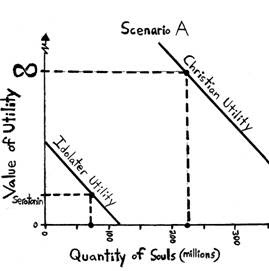
Producing more greenhouse gases to kill off the human race is indeed sound public policy, for the aim of governments is to attain the greatest good for the greatest number. Let us do the utilitarian calculus; out of approximately 293,382,953 souls in the United States of America (let us not strain our own credulity and pretend as if we actually care about souls in other countries), there are approximately 224,437,959 souls who have accepted Jesus Christ as their Lord and Savior, and 68,944,994 Semites, Mahometans, Hindus and various other idolaters who have not. Therefore, if we were able to make Earth uninhabitable tomorrow, there would be 224,437,959 souls who would consequently meet their Maker and enjoy absolute bliss for pure eternity. The other 68,944,994 souls would needless to say endure the throes of Satan's lash for eternal damnation; though that is not to say that their existence would be bereft of any happiness at all, for during their average lifespan of 77.7 years these godless heathens each enjoy the serotonin produced by an average of 7,213 orgasms, 9.08 liters of alcohol and 0.8 grams of cocaine.

If you note the first utility maximization chart below, you will see just how much more happiness will be enjoyed by our 224,437,959 self-described Christian-Americans than our 68,944,994 idolaters; infinitely more happiness - even disregarding the idolaters' eternal damnation. The trump card is, of course, that our Christian brethren will be enjoying eternal bliss - which is infinite - as opposed to a finite amount of orgasms, alcohol and cocaine. Just to show you how powerful this eternal bliss factor is, let us create a hypothetical scenario in which we suppose that all Americans who portend to have accepted Jesus Christ into their lives are not quite sincere and that Billy Graham is the only one who truly has and shall ultimately wind up in Heaven. Even so, the utilitarian product of one soul times infinite is, well, infinite. And that is a lot of utility. Thus, assuming that at the very least the Reverend and some other quantity of saved souls would ascend to Heaven as a result, we must allow them to take up residence there at once by allowing our automobiles and manufacturing plants to toot their horns and spew forth enough greenhouse emissions to destroy the ozone layer and melt the polar ice caps and raise Earth's sea levels high enough so we can stamp out the existence of those living in the wilderness of sin.


Our President George W. Bush surely understands the gravity of this situation and our unique opportunity for our souls' fate to be foreclosed with industrial activity, and that is why he has doggedly fended off the advances of the other seven world powers to impose Soviet-style command-and-control emissions caps. Of course, even though Bush has looked into Tony Blair and Vladimir Putin's eyes and seen the fundamental goodness of their souls, he is too smart to let them know his ulterior motives for refusing to ratify the Kyoto Protocol, because then the Jew-dominated liberal media would find out and they definitely would not be keen on hastening the Apocalypse in which they shall be smitten with not quite fire and brimstone but water of salt. Instead, our God-fearing President tells the G-8 conferees about the how the Lord's invisible hand intervenes in economies and that the best way to "fight" not global warming but "climate change" is to establish a carbon credit market in which our greenhouse gas producers can purchase the right to destroy the ozone layer for around the price of a set of one-sided copies at Kinko's.


We have a problem, however, for though the United States can be thanked for a full 25% of the world's greenhouse gases, 150 governments representing a full 61.6% of the world's total emissions have signed on to the Kyoto Protocol and are now in the process of slowing the process of ozone depletion. Unles these neo-pagan tree-huggers are stopped, we will have to wait even longer for Judgment Day. To do this I call on President Bush to bring the Revered Billy Graham to the next summit of global leaders to tell the story of Isaiah as he did during his first crusade to New York in 1957, where he told the city of sinners tell how Isaiah warned of impending judgment unless there is sincere repentance. Only this time Graham must fundamentally misinterpret the story, for these nations must repent their ratification of the Kyoto Protocol so that we can usher the hour of divine judgment!

Friday, July 11, 2008

The Progressive Case for John McCain

(circa September 2007, when it looked like the GOP was going to nominate either Mitt Romney or Rudy Giuliani and the thought of John McCain sitting in the Oval Office was relatively less conducive to me shitting my pants)

If you have spent more than 30 seconds in my presence, you probably know that I am 1) obsessed with politics, and 2) very, very liberal. This is my third semester as President of the Amherst College Democrats, and I spent last summer working for my Senator Hillary Rodham Clinton. And I believe that John McCain has the potential to make an excellent President.

My initial response to the man is quite inexplicable. At the utterance of his name, I feel like Frank Sinatra’s character in The Manchurian Candidate, as though I have been brainwashed into believing that “John McCain is the kindest, warmest, bravest, most wonderful human being I’ve ever known.” After reading his memoirs about serving as a Navy pilot in Vietnam and spending five years as a prisoner of war, I too am impressed by this man’s acts of courage.

But when it comes to candidates, it is policy and not personality that truly matters. And John McCain is a very conservative Republican. He was first elected as Arizona’s Senator by promising to continue the legacy of his predecessor: Barry Goldwater, the very founder of the modern conservative movement. However, this school of thought is very different from the Christian fundamentalism and crony capitalism which defines the current administration. McCain’s mode of conservatism is predicated on the rule of law, economic prudence, and competent management of the American Empire.

A John McCain presidency should not frighten liberals, for assuming that the makeup of Congress does not change, whoever sits in the Oval Office in 2009 will see bills on their desk written by Democratic committee chairs. If there were to be a government divided with a very progressive Congress and an open-minded Republican President, we can expect a flurry of enormous legislative accomplishments.

The best example is what McCain would do in regards to global warming. He has coauthored legislation to curb greenhouse gas emissions, and if given the opportunity, would use the most powerful office in the world to take on this daunting endeavor. Only the rare individual like John McCain could establish the notion that preserving the polar ice caps is an inherently conservative end and vital for our national security. With the clock ticking towards the point of no return, it might thus be in the global interest for McCain to be our next President.

In the realm of economics, an analogy can be made that John McCain is to George W. Bush as Theodore Roosevelt was to William McKinley. Whereas Bush has ascribed to any policy desired by his campaign financiers, McCain has campaigned to end corporate welfare as we know it. He voted against subsidies to the oil companies and to the pharmaceutical companies. Indeed, McCain’s conception of free markets includes the correction of market failures, having advocated stricter regulation of the auto industry, the accounting industry, the tobacco industry, even the campaign finance industry. Indeed, he is a small-government Republican, but a McCain administration could very well revive the long-dormant spirit of Progressive Republicanism.

John McCain is a social conservative, but he adheres to the authority of binding precedent more than the fatwas of the Reverends Pat Robertson and Jerry Falwell. Particularly after the South Carolina primary in 2000, in which the Bush campaign made an issue out of the color of his daughter’s skin, McCain is openly hostile to the culture warriors of his party whom he has labeled as “agents of intolerance.” McCain is pro-life, but supports federally-financed stem cell research. He opposes same-sex marriage, but he also opposes banning it with a constitutional amendment, which he described “as antithetical in every way to the core philosophy of Republicans.” On illegal immigration, he is one of the primary champions of allowing illegal aliens to become full citizens. Altogether, his positions are sufficiently to the right in order to pass his party’s ideological litmus test, and in some instances he is quite liberal.

Any liberal optimism for John McCain is tempered, however, by his stance on the single most important question which faces the American nation today: the war in Iraq. He does not march in lockstep with the Bush administration, having distanced himself from its treatment of detainees, but McCain is nevertheless accused to be a facilitator of the larger, failing mission. This accusation is well founded, for he still argues that the war can be won with sufficient reinforcements; the so-called McCain Doctrine of escalation.

It seems strange that the former straight-talker would take this occasion to deny perceptible reality, but the about-face signals the dilemma which all Republicans face in 2008. The next presidential election is sure to be all but defined by the war in Iraq, and this enormously unpopular undertaking has lost the backing of all but the most dogmatic members of the Grand Old Party. Anyone who wants to receive the party’s nomination must win over the increasingly-dwindling voters who wish to stay the course, and so every single Republican candidate, McCain included, now has to kowtow to what is but a peripheral element of the general electorate.

My prediction is that once the primaries have been decided, John McCain is going to reestablish himself as the straight-talking centrist reformer who we saw in 2000. If Candidate McCain chooses a likeminded moderate like Rudy Giuliani as his running-mate, the result will be a Republican administration which could implement an agenda with broad-based popular support. And just as only Nixon could go to China, perhaps John McCain can then extricate the United States from Iraq.

There is more at stake in the next election than party and personality, and even this loyal Democrat has respect for the virtues of conservatism. As a young idealist considering a career in public service, in fact, I would be proud to work under the leadership of a President McCain.

Tuesday, July 8, 2008

Brokering Peace in Sri Lanka

(October 2005)

In August 2005, Foreign Minister Lakshmin Kadirgaman was shot in his swimming pool by snipers located in a vacant house next door. His government reasonably suspects the assassins to be members of the Liberation Tigers of Tamil Eelam (LTTE), a rebel group fighting for the independence of the ethnic Tamil minority. Though the type of gun used in the killing was one frequently used by the LTTE, authorities have yet to identify his killers, and thus a firm connection between the murder and the rebel group remains elusive.

Kadirgaman’s assassination took place while I traveled in Sri Lanka as a volunteer with the Tsunami Relief Project, and the streets and airwaves of the entire nation were immediately awash in hagiographical tributes to their revered statesman. Because he was an ethnic Tamil working in a government accused of anti-Tamil prejudice, Kadirgaman carried an aura of dignity which transcended partisanship. He had actively worked to attain international aid for the Sri Lankan civil war from nations around the world, particularly Norway (which is currently facilitating negotiations with the Sri Lankan government and the LTTE rebels) and the United States (which has given billions of dollars in military aid as part of the Global War on Terrorism). Kadirgaman was a great individual, and so as to further his legacy, I spread the story of his country’s plight.

There are two main ethnic-religious groups in Sri Lanka: the predominantly Buddhist Sinhalese, who make up approximately 74% of this country of 19 million, and who live in the developed South; and the predominantly Hindu Tamils, who make up another 18% of the country and live mostly along the Eastern seaboard and in the Northern jungles. Both groups were treated fairly equitably while under the colonial rule of the British viceroyalty, but when the country became the independent republic of Ceylon in 1948, the Sinhalese imposed a barefaced tyranny of the majority. The country now has a vibrant spoils system in which Sinhalese government officials give most public sector jobs to their lighter-skinned brethren, an unofficial policy which has created an obvious socioeconomic disparity in many communities – communities where the steadiest paycheck comes from the police station. Aspiring Sri Lankan politicians have historically made demagogic appeals to the Sinhalese people’s chauvinistic anxieties against the Tamils, and have banned the Tamil language in public schools, universities, and government offices.

This flagrant bias could even be seen in the government’s actions in response to last December’s tsunami; state-financed refugee camps were quickly constructed in Sinhalese South. In the Tamil East, the Kumaratunge administration handed over lands which used to be home to poor fishing villages to private tourism developers, displacing hundreds of thousands from the mostly darker-skinned underclass inland. And now, nine months afterwards, the Sri Lankan government had still done almost nothing to rebuild Tamil communities hit by the tsunami - almost all relief projects there were sponsored by either private charities or foreigners.

The straw that broke the camel’s back and first ignited the Tamil revolt, however, came in 1983 when members of the notoriously corrupt police forces organized violent riots against the Tamil minority in the capitol city of Colombo. Immediately, Tamils across the island nation went to the streets calling for freedom from violent discrimination, and radicals led by current insurgent leader Colonel Villupillai Prabakharan called for an independent Tamil homeland in the North. The sensitivity of the Tamil minority were no stranger to us Tsunami Relief Project volunteers; while we were working in the mixed-ethnicity city of Batticaloa, riots had broken out along the Jaffna peninsula after a Sri Lankan military officer’s rifle discharged at a barbershop and killed his Tamil barber. News of the outrage quickly spread to the Tamils of Batticaloa and violent demonstrations ensued.

For 22 years the LTTE has waged a guerilla war against the Sri Lankan government, and ruthless acts of terrorism are among their favorite tactics; assassination is in fact their preferred method of changing administrations. So as to expel the Indian peacekeeping force from the Tamil regions, Liberation Tigers killed Indian Prime Minister Rajiv Gandhi, and in 1993 the insurgent group assassinated Sri Lankan president Rasinghe Premadasa. Civilians targets have also been hit, such as the Temple of the Tooth which houses what is supposedly a mandible from the jaw of Buddha; this act, if it had successfully destroyed the relic, would have had enormous symbolic consequence, since Sri Lankan regimes since antiquity have carefully guarded the tooth as a source of divine legitimacy.

Nevertheless, the Liberation Tigers of Tamil Eelam are more than just a motley gang of thugs and killers. The LTTE is less like Al Qaeda and more comparable to Hezbollah; they finance their militant activities mostly through taxes from the Tamil population and actually operate what can be called a weakly-functioning civil administration in the territory they control. That is why, though the LTTE is undeniably a terrorist organization and classified as such by the US State Department, it is difficult to lump them into the same category as the religious fundamentalist terrorists on which our FBI, CIA and military have squared their sights.

The LTTE is nonetheless a fringe group primarily limited to the despised and impoverished caste of Untouchables, a group so radical that they impede economic progress so as to maintain the suffering of their constituents, which is then used as a rallying cry for their cause. They are so lacking in willing recruits that they resort to abducting fourteen-year-olds to use as child soldiers. The vast majority of Sri Lankans, Sinhalese and Tamils alike, are weary of this war, which has afflicted thousands of families and costs $700 million a year, out of an annual federal budget of only $4.2 billion. This spending has deprived the economy of funds sorely needed to invest in basic infrastructure; as I was walking along a path of sand and rocks in the war-torn town of Batticaloa, my guide remarked to me, “This is a road. It will never be paved until our civil war ends.”

The truth is that Sri Lanka has so much potential for development and growth that were it not for the Liberation Tigers, it could have possibly been one of the Asian Tigers like nearby India. But such a long-lasting civil war and climate of political instability have frightened off the kind of foreign investors that could create new industries and Western tourists who might otherwise be spending their money there. Peace could very well transform the culture of entrenched poverty which is all-too-familiar for millions.

Since the island’s people so fervently desire peace, in 2001 Lakshmin Kadirgaman and the LTTE rebel leaders settled a cease-fire in what is known as the P-TOMS agreement (“Cease-fire” is an extremely relative term, as shots are routinely exchanged in Batticaloa and kill about one person per day). And while the Norwegian government has since taken the mantle of the international community in an attempt to negotiate a permanent peace treaty, it now seems more elusive without the diplomatic skills of the late Foreign Minister. Nevertheless, if peace is ever to be achieved it will be either through granting the Tamils complete independence or at least a significant degree of autonomy in a federalist scheme. The latter seems much more likely, as neighboring India does not want to kindle the flame of sovereignty among its own Tamil population, and Sinhalese opinion is adamantly against granting independence to a group whom, though they have historically been on the receiving end of Sinhalese oppression, they see as their fellow countrymen.

The world power which could do the most to end the ethnic conflict in Sri Lanka – the United States of America – is painfully uninvolved in the peace process. The only evidence of our country’s involvement I found while taking a break from clearing rubble at a beachfront YMCA now used as a base by Sri Lankan soldiers. I went to hang out with the machine gun-wielding platoon that was napping and playing poker, and the commanding officer proudly showed me their dog’s new puppies in his office. There I caught a newspaper on his desk blaring: “US Ambassador Pledges More Military Aid to Combat Terrorism”.

Simply put, giving block grants of military aid to the Sri Lankan government without any further engagement is only slightly better than doing nothing at all, and does little to further our campaign to weaken organized terrorist groups. The amount of change that we can effect by simply sending an ambassador to the peace negotiations, or by commissioning Condoleeza Rice to condemn the LTTE’s use of child soldiers at a press conference, would be incredible for these people. Though the prospects seems bleak when our current administration is so preoccupied with its own ethnic conflicts in a much more strategically important region of the world.

Even so, our country has other tools with which we can attain a lasting peace in Sri Lanka, namely our unrivaled economic power. The deeply-indebted government is wholly dependent on loans from the World Bank and the International Monetary Fund, which in turn are effectively run by the United States. At the time being we are using this influence over Sri Lanka to make it privatize its banks, deregulate its industries, and institute other policies consistent with orthodox free market ideology – policies which, by the way, led to such a dramatic decrease in the job security of Sinhalese public employees that they vented their rage at the Tamils as scapegoats in the riots of 1983 which precipitated the civil war. But while we are using our influence to make the country more attractive to foreign entrepreneurs, we can also nudge the Sri Lankan economy in a way that services their own desperate needs.

According to the Four Noble Truths adhered to by Sri Lanka’s Buddhist majority, all of life is suffering, suffering has a cause, suffering can be ended, and suffering can only be ended by eliminating its cause. The radicalism which fuels the LTTE rebels is a result of an impoverished population – a population that is fairly cognizant of the ethnic discrimination which has caused them such hardships. We as Americans are in a position to at least dull the edges of this radicalism. While Paul Wolfowitz is privatizing and deregulating the Sri Lankan economy at the head of the World Bank, he can also make loans to the government contingent on their being spent more proportionally among the Sinhalese and Tamil populations, or he could he could push for fair distribution of tsunami relief funds and fair hiring practices. And if he wanted to be truly meddling, Wolfowitz could even encourage the Sri Lankan government to make Tamil another official language.

Any of these options are more than feasible and would not require a cent of American tax dollars. Once the Sri Lankan civil war ends, we too can garner a peace dividend by saving money on military aid and gaining a newly dynamic trading partner. We would also gain the goodwill of a small but grateful nation, a commodity for which our country is in desperate need.

Overreach and Internal Discord: The Future of the G.O.P.

(November 2004)

In the eyes of the Republican Party, the American electorate has given them an unqualified mandate to lead the country on a sharp rightward turn. After all, they emerged from what was deemed the most important election in years with a wider lead in both houses of Congress, a slight majority of statehouses, and a president who even won the popular vote. In the words of the first commander-in-chief with an M.B.A., “I earned capital in the campaign, political capital, and now I intend to spend it”.

What that means is, from now until Bush’s last days as a lame-duck president, do not expect any policy changes lacking the right wing’s blessing – take House Speaker J. Dennis Hastert’s derailing of the 9/11 Commission’s intelligence reforms as Exhibit A. Since the 2004 election validated Karl Rove’s tend-the-base strategy, the captains of industry and evangelical groups expect payback for all their work towards their candidate’s re-election. And they are expecting more than just leftover scraps from the 2000 platform.

“Now comes the revolution”, blogger Richard Viguerie declares, “If you don’t implement a conservative agenda now, when do you?” And by conservative agenda, he and his comrades are not just talking about plugging a hole in progressives’ ambitions for the 21st century. Leaders in the GOP are talking about rolling back the progressive edifices of the 20th century. Income taxes – flattened. Social Security – privatized. In his victory speech, President Bush outlined his very own “vision thing”: an “Ownership Society” in which law-of-the-jungle free market economics is used to solve just about every problem ranging from health care to public education.

My impression is that the Republican Party is lapsing into a state of intoxication, and their drugs of choice are pride and ideology. According to exit polls, the reasons voters offered for giving President Bush another term were that they admired his overt religiosity, traditional values, and dogged rhetoric about fighting terrorism. When it comes to bread-and-butter economic issues, the Republican leadership simply does not have a mandate to carry out the sweeping changes that they promise; in fact, the positions voters preferred on taxes, health care, and Social Security belonged to John Kerry. Just as how Mr. Bush refused to answer reporters’ follow-up questions by invoking “the will of the people” during his post-victory press conference, the GOP is grotesquely misinterpreting whatever mandate to lead that it has earned. It is as though the people have given the Republicans their car keys in order to drive them home safely, but our designated drivers are taking it as an OK to drive to their favorite bar across town. And if those at the wheel are actually going to party as hard as they say they will, at the end of this ride we are going to find ourselves in a ditch.

Unsurprisingly, this agenda is not so palatable among the rank and file. Though the party marched in lockstep through the last election cycle, the Republican-on-Republican literary combat has already begun with Pat Buchanan’s latest book, Where the Right Went Wrong: How Neoconservatives Subverted the Reagan Revolution and Hijacked the Bush Presidency. The charge is that there is an ever-widening gulf between the party’s nascent big government, interventionist wing and the true inheritors of the conservative philosophy. True fiscal conservatives like Senator John McCain loathe the status quo of deficit spending, exploding national debt, and public policy tailored to special corporate interests. True legal conservatives like Senator Arlen Specter do not want domineering judges who remake the law in line with their own political whims. True rugged individualists, like the Cato Institute and the Alaska state legislature, are horrified by the Justice Department’s wanton disregard for civil liberties. But Republican politicians who dare to stray from the official line, such as Senator Specter, are tagged “RINO”s (Republican In Name Only) threatened with having their party’s nomination and committee chairmanships pulled out from under them.

Let us not overlook the overlook the ten-thousand-pound pink elephant which is spawning friction among the caucus: Iraq. If there has ever been an example of neo-conservative overreach, this it, for American troops are dying not to eliminate an explicit threat to national security, but to promote democracy in Fallujah. Republican Congressmen like Doug Bereuter of Nebraska and Ron Paul of Texas are joining the steady drip of dependable party men who can no longer support the war, and rightly so, for it clashes with the principles for which they have dedicated their entire careers.

So what can we anticipate from the Republican Party over the next four years? Barring a Democratic upheaval in the midterm elections, they should be able to achieve pretty much everything they want with ease, but this could very well be more of a curse than a blessing. As Tom DeLay wanted to have the Contract with America broken so that he could remain House Majority Leader while under indictment for criminal charges, his colleagues effortlessly exercised their wherewithal to see it done. That this is what the GOP is spending its “political capital” on, however, cannot possibly benefit the party’s standing in the long run, and conscientious Republicans who abide by their core values of prudence, restraint and personal responsibility are furious. By the time the next presidential primary season rolls around, expect the disciples of Edmund Burke to revolt against the charlatans who have sullied their proud tradition. And if their infighting gets ugly enough, it might just rip apart the Republican coalition.