Showing posts with label global warming. Show all posts

Thursday, March 3, 2011

Zac Mason on Eco Brooklyn and Riverkeeper!

Dear loyal readers,

I have recently been hired by this really awesome green builder/renovator called Eco Brooklyn – which is why I have not been writing a whole lot of extensive blog posts as of late. I have been busy waking up before dawn salvaging construction materials, transporting them to various sites around Brooklyn, Queens and Harlem; digging out a basement, mixing mortar, cement and rammed earth, hauling rocks and bricks and other extremely heavy labors. Commuting to do construction work is kicking my ass; however, I’m learning a whole lot about green tech with hands-on experience. Moreover, it has been discovered that I can also be an asset to this team by blogging extensively about green construction technologies and practices!

Hopefully some of the time I will be able to write about tech matters and local policy, be allowed to use those postings directly on this blog as well. And Riverkeeper is also interested in me doing some blogging for them too… That doesn’t mean that Zacstravaganza is going soft – no sirree – rather, look forward to Zacstravaganza becoming hardcore environmental and straight up New York – from the Croton Watershed and the Hudson River to the NYC sewer system and the Gowanus Canal!

So check out my soapbox on Eco Brooklyn and Riverkeeper’s respective blogs – I will at least be cross-linking all updates over here if not rebroadcasting them verbatim on Zacstravaganza. My first post for the former is on how Eco Brooklyn minimizes its carbon footprint compared to competing New York contractors by using exclusively salvaged cement and other post-consumer construction materials!


Friday, March 13, 2009

Human Sanitation with Feline Inspiration

So I woke up one morning and let my kitten out to pee and set up my solar panel to bask in the rising Sun. Usually I start my days walking down the street greeting everyone in my village and try to get them excited about treating their wells and drinking water. But today I just felt like venting to my kitten.

“James Brown, what’s the point of it all? The people of Sanadougou tell the Peace Corps that they want me to help them with water sanitation, I spend all day teaching people about water-borne disease prevention and they don’t do a damn thing I tell them! Every day I tell people they should drink pump water instead of well water and how they should filter their drinking water with cloth and treat it with bleach and yet they continue to drink worm-infested well water because they say that it tastes better than pump water!!! And I know that they’re not doing anything differently because at night I can smell all the gaseous sulfur from the aggregate diarrhea of everyone in this village! Why do I do this?!?! Why am I here?!?! Why?!?! Why?!?! Why?!?!

James Brown replied, “Get a grip on yo self Madu! You gotta understand! The Bambara people have been living like this for thousands of years! Almost nuthin changes! You been here six months, and you frustrated cuz you ain’t changed nuthin yet? Take a chill pill!!! You gotta learn patience!!!

“You got a point there James. But I don’t understand how people who tell me every day how sick they are and how poor they are can be so resistant to change. It’s just absurd.”

“Put yourself in their position! You’re a Bambara peanut farmer, dig? And some white dude from the suburbs waltzes into your village and tells you you’re doing everything wrong! This honky tells you that diseases come from tiny animals that you’ve never seen! Then he starts tellin’ you that wizards ain’t real! You’d think that punk be talkin' Jive! You'd say ‘screw you, honky!’ You wouldn’t do a damn thing different!”

“But what am I supposed to do? Stop trying to teach people about giardia and amoebas?”

Al – my solar panel – chimed in. “No, Zachary, I would advise that you continue on your current course of action despite its lack of easily measurable achievement. For example, the other day Moustapha told you that he treated his well with liquid bleach like you told him to. I would consider that a success unto itself.”

“C’mon, Al, Moustapha is just one person! There are like 4,427 other people in this village! At this rate they’ll all be treating their drinking water in the year 6224!”

“I would not be so pessimistic, Zachary. When I presided over the first Senate hearings on global warming in 1988 I was received with such skepticism that I was practically laughed out of the committee chamber, for at the time this phenomenon was understood almost exclusively within the academic community. In my 1993 environmental treatise Earth in the Balance I explained the climatological science in relative layman’s terms, and my message reached a substantially larger audience. But it was not until 2006 when I produced and narrated the Oscar-winning documentary An Inconvenient Truth that public opinion was so roused in favor of a national campaign to reduce greenhouse gas emissions, and only now in the year 2009 does it look like public opinion has shifted to such a degree that the cap-and-trade program which I have advocated has a chance of passing both houses of Congress.”

“Al, you lost me. What does global warming have to do with diarrhea?”

“Actually, the two phenomena are not mutually exclusive, for methane actually constitutes one of the most significant biogenic greenhouse gases – and the amount of methane released by the human digestive system actually spikes due to cases of giardiasis and amoebic dysentery. If we could provide potable water supplies to the population of roughly 2 billion persons currently lacking, then that could make a consequential reduction in the annual tonnage of anthropogenic greenhouse gas emissions. However, the point of my analogy between my campaign for sensible climate policy and your campaign for improved water sanitation practices is that you should look into trying new forms of media to broadcast your message to a wider audience. For example, I used cinema and the Internet...”

“No, Al, this has nothing to do with the Internet. The people in my village ooh and ah when I show them how the velcro on my sandals works. Three people in the Mayor’s Office know how to type birth certificates on a typewriter. Just forget about the Internet! If I am going to teach people anything about water sanitation and for them to actually do it themselves it has to be simple enough for a toothless, illiterate peanut farmer to understand. It has to be so simple and so obvious that they can see it for themselves with their own eyes. If it entails concepts that I learned in 9th grade Biology class then it is too complicated.”

“’Scuse me, fellas! I gotta take a pee!”

“You’re excused, James.”

James Brown proceeded to dig a little hole in the sand with his front paws, urinated, and then moved forward and with his back paws pawed sand back on top of his pee hole.

“James, what did you just do?”

“Nuthin! I just got to pee! And when I got to pee I got to dig a hole!”

“I know you dug a hole, but why?”

“I don’t know! I… I… I just got to pee! Every time I got to pee I got to dig a hole! That’s just the way it is!”

Al lectured, “The common house cat covers up its own liquid and solid waste because of its instincts as a carnivorous animal. The scent of feline urine is particularly strong due to its high concentration of urea relative to water and is used among the wild cat population to mark one’s territory; however, potential prey have over millions of generations learned to avoid areas marked by the scent of cat urine. Over time, cats began to realize this as wekk and hence they have likewise developed the instinctive behavior to bury their waste so as to hide the scent.”

“THAT’S IT!!! We need to build a network of rudimentary septic tanks!!! James Brown, you’re the most ingenious talking cat ever!!!”

“Damn straight! They don’t call me the Kitty Cat of Soul for Nuthin!”

So I emulated the ingenious water sanitation infrastructure designed by my kitten and began to build a soak pit. I went out in the back of my nyegen where the wastewater flows out into the garden and plotted out a hole. A soak pit should have a minimum of 1.7 m2 of volume for each person who uses it on an average day, and since I am the only person who lives in the mud mansion of Xanadu that meant that I had to dig a hole roughly 1.2 meters long, 1.2 meters wide, and 1 meter deep. Easy, right?


No. In the midst of dry season – six months since the last rainfall – the dirt is as hard as a rock. Before digging anything I had to take a pickax and smash the ground apart. But even a pickax alone did not do the trick – after smashing the ground for an hour, I would have maybe a couple centimeters of debris to excavate. It was a little easier if I dumped a bucket of water on it at night and came to smash the moistened dirt in the morning, but the water would only moisten about 5 cm below the surface each time. Eventually I was able to sit in my pit and use the ax head to chisel the walls flat. Never was I able to produce enough debris to fill a single shovel – I could only dig this pit with a small garden spade.

The most fascinating aspect of me digging a hole was… that it was so goddamn fascinating. Rumor quickly spread around the village; “Did you hear that Madu is digging a hole?” “Praise be unto Allah! This is the first time since he’s gotten off his fat bobaraba since he got here!” And unless you have been the only white guy living in an African village you’d never believe it, but pretty soon there was a crowd of people gathering around to watch me. Only to a people who enjoy watching shitty Brazilian soap operas dubbed into another Western language they don’t understand could this actually be entertaining. “Holy Goat Meat! Madu is digging a hole! I’ve never seen anything like it!” This actually made my work go significantly slower because every 15 minutes I had to stop and explain what I was doing “Well you see, I’m digging a hole…”

What was actually kind of encouraging is another phenomenon kind of like Tom Sawyer whitewashing Aunt Polly’s fence – if you start a project out in public, other people want to finish it for you. Ten year old kids would point out that in comparison to their fathers’ thick, calloused hands hardened after decades of hard labor in the fields, my hands have the soft and delicate skin of an American who has worked in offices clicking buttons all of his life. “You can’t dig a hole!” “You should sit and rest!” and they would try to take the pickax from my hands and do it for me. After having my manhood called into question by ten year olds, I had to lock my gate so they could only watch from outside.

After two weeks of picking and chiseling downward I eventually I dug my 1.7 m2.

And me digging this hole seems to have done its job. Pretty soon everyone knew that I had a hole in back of my nyegen. Word eventually got around to the dugutigi, so he and his crew of old men came to inspect my hole. They thought that it was so awesome that they wanted one in back of every last nyegen in the village, and I was summoned to the gwa of the elders.

(dum dum DUUUUUUM!!!! To be continued!!!!!!)

Friday, August 15, 2008

Global Warming > Africa's Desertification

If global warming hasn't yet hit home enough for you to cut your personal carbon footprint, install solar panels on your roof and convert your Jeep Wrangler into a grease car, here are a few articles which highlight just how bad greenhouse gas emissions, if unchecked, are going to absolutely annihilate precipitation levels and the water tables of Africa. At this rate, global warming is projected to reduce flows on the Niger River - the lifeblood of Guinea, Mali, Niger, Burkina Faso and Nigeria - by roughly 33 percent. If the Niger River dries up, and the Sahara Desert overtakes the greater part of Mali, even relatively lush agricultural plains like Segou Province are going to soon look like Timbouctou Province - vast expanses of uninhabitable, uninterrupted sand.

http://www.grida.no/climate/IPCC_tar/wg2/384.htm

Mali and the respective nations depending upon the Niger River are doing something about it - and as proof that the World Bank is not the absolute epitome of evil, Robert Zoellick is doing something at least to help conserve the river. http://www.lesafriques.com/en/news/africa/the-silent-call-to-save-the-niger-river.html?Itemid=35?articleid=0084

You can find out pretty much everything there is to know about global warming and the rapid desertification of the African continent here: http://www.thesahara.net/terraform_sahara_desert.htm

If you are an investment banker from Connecticut, droughts might be an unsightly eyesore if your country club can't use their sprinkler to keep the 8th hole pleasing to the eye; if you are a millet farmer in Mali struggling to grow enough grain to feed your eight children, a drought means that soon you will have zero children. I emphasize, the brunt of global warming is going to fall on the backs subsistence pastoralists and herders in the Sahel countries bordering on the Sahara Desert; Mali, Mauritania, Niger, Chad, Burkina Faso and Sudan.

You see, climate change has happened in the past; in fact, it is the reason why the broad northern expanse of Africa is now the Sahara Desert in the first place. Believe it or not, back in the day like in 8000 B.C. what once served as the desert backdrop of Tatooine was lush farmland where humans consumed water freely with crocodiles and hippopatomouses

http://www.nytimes.com/2008/08/15/science/15sahara.html?ref=world

And gradually, due to the kind of organic, completely meterological and unanthrogenic climate change, that lush savannah became the Sahara Desert.

http://www.nytimes.com/2008/05/09/science/09sahara.html?ref=science

Back in 8000 B.C. when people worshipped cats and thought that rains could be augured via the ritual slaughter of goats and less politically desirable people, there was nothing that people could do to avert the dessication of Africa and the expansion of the Sahara. The only change in that cataclysmic shift in human population was the advent of the Pharaohs and the birth of classical Egyptian civilization.

And if we don't reduce our wanton fossil fuel consumption culture dead by at least 80 percent by 2050, all of West Africa up to the Atlantic coast is going to be uninterrupted desert. One day archaeologists are going to go to the house where I live in Diaramana, dig out my dogeared copies of the work of Al Gore, my itty bitty solar panel, and say "It seems as if some humans at least understood that they were shooting themselves in the foot... but they kept on shooting themselves in the foot!" Those future archaeologists will probably be refugees from the erstwhile nation of the Maldives which has since been inundated by the Indian Ocean

But now, decades after the American people demonstrated our capacity to liberate Europe AND Asia, defeat Communism, send men to the Moon and even manufacture Dippin' Dots - the ice cream of the future - it's time to start doing something about global warming. No, signing an online petition and forwarding it to all of your friends is not going to halt the expansion of the Sahara Desert. Calling your Congressman to do something about it is only going to consume more electricity. It's time for all of us First Worlders to get off our fat asses and figure out how to minimize our energy consumption, particularly our fossil fuel energy consumption.

Y'know how I reduced my carbon footprint? For starters, I moved to Mali. Here I am not connected to any electric grid. I get 95 percent of my transportation done by foot or bicycle. Fyi: I have in my possession exactly 4 appliances: my cell phone, camera, iPod and the computer that I use to update this nifty blog. I am living the dream of the Digital Age. And I can get all the energy that I need to power these babies with my little baby Solio panel. Oh wait - I lied... I also have a flashlight which is powered with my hairy hands. And I have gotten used to the stultifying heat - I just deal with it. When I think of my coworkers at a progressive Manhattan office wearing winter jackets to work because the air condition was kept at a crispy 55 degrees, I think that the amount of electricity that people spend on thermostats is absolute insanity.

While people with hundreds of thousands if not millions of dollars in the developed world wait for The Government to do something about retooling America's energy infrastructure (I wouldn't hold my breath) people in Africa are taking the private initiative to increase their standard of living and resist the advancing Sahara Desert. My next-door neighbor in Diaramana is a doctor who makes what would be considered below the poverty line in America, and he has a big solar panel which he uses to power his 21st century luxuries like his cell phone, television and refrigerator. Ladies and gentlemen sitting in your air-conditioned splendor in the States, if you have any disposable income and all, it's time to buy solar paneling for your roof, for your backyard, for your neighbor's roof. Solar panels are beautiful, functionally, symbolically and aesthetically! They make great birthday presents! Buy a solar panel today!

Saturday, July 12, 2008

The Utility Maximization of American Souls - Or, Let's Get on the Express Train to Heaven!

During the summer of 2005, the Reverend Billy Graham came to New York with a pointed message about our current place in history, in particular our proximity to the end of the world; "Jesus Christ said, as the days of Noah were, so shall also the coming of the son of man be. When the situation in the world gets the way it was in Noah's day, you can look up and know that Jesus is close to coming."

Indeed, the world is getting to become more and more like it was in Noah's day, but the evidence which Reverend Graham put forth to back up his belief that "God is warning us" about the End times - the recent disappearance of a teenage girl in Aruba and the suffocation of three boys in the trunk of their parents' car - did not even hit the tip of the ominous iceberg. What he should have said is that with the destruction of the ozone layer, global warming, and the melting of the polar ice caps, the oceans of our planet are soon going to rise to a level unseen since the Flood described in Genesis. In his effort to make his sermon about Noah pertinent to local concerns, Graham could have even cited the Environmental Protection Agency's 2002 study on climate change, which predicts a two to four-foot rise in sea levels around the New York metropolitan area within the century. God must be mightily wrathful about our wickedness as he will be soon be sending our offspring packing as the Atlantic Ocean submerges much of lower Manhattan, Staten Island, and some of the biggest landmarks in Queens, including parts of the Flushing Meadows-Corona Park where Reverend Graham gave his sermon. But what should we Earth-dwellers do in regards to the imminent coming of the Apocalypse? Should we do as these secular scientists and international bureaucrats recommend forestalling the rise in sea-levels and instating mandatory caps on greenhouse gas emissions?

Hell no. Global warming is caused by humans, and humans were created by God to implement His will. Therefore the rise in sea levels and ultimate inundation of New York City and other low-lying cities is all for the best as a part of His divine plan, and to tamper with it would be a transgression of natural law. If anything, what we should do is hasten the global warming process for the betterment of both the worldly inhabitants of our civilization and especially for the ultimate denizens of the kingdom for which Billy Graham is busy securing immigration visas. When you see smokestacks, associate them not with skin cancer but with those harp lessons you have always meant to take up. consider these smokestacks to be not just releasing the products of greenhouse gas machines – think of them as steam engines powering the express train to Heaven!

Think for a moment about the semi-aquatic utopia New York could be under not four feet of salt water, but thirty-four or even forty-four! The discotheques, smut galleries, and other dens of iniquity which line the city's streets shall be totally submerged, leaving little but the spires of the financial district's capitalist cathedrals to see the light of day. Moreover, the cardboard boxes and relatively cheap, low-level apartments which lie under the new, raised sea level shall likewise be inundated, leaving the less affluent, inferior peoples who call them home to drown in a regurgitated puddle of their own sin. In this City there is a direct correlation between an individual's virtue and the number of the floor on which they live, so if we could somehow emit enough greenhouse gases into the atmosphere so that sea levels rise above every tenement building and middle-class hovel, the only living quarters which will be left dry shall be the opulent penthouse apartments which inhabit the most elite echelons of billionaires like Mayor Mike Bloomberg, real estate baron Donald Trump, and real estate heiress Leona Helmsley. And since only morally upright, hard-working individuals such as the aforementioned specimens of the human race can earn or inherit the massive amounts of wealth requisite to pay the rent on these 80th-floor penthouses, the only people left to live in all of New York after this dazzling display of Social Darwinism would surely be the better class of mankind.

Unless, of course, there are certain mutants among these inferior peoples who happen to have gills like Kevin Costner and can survive underneath the Atlantic Ocean, New York City would become as close to an ideal society that we will ever have on Earth after a thorough melting of the polar ice caps. But for those mutants from Flatbush who would escape God's will with their evolutionary advantages - intelligently designed, of course - the jobless and marginally-employed shall be eviscerated and only the true believers in the American free market economy will be left standing. If any such fish-men of the middling classes do indeed exist and manage to survive swimming about in their ground-level apartments, perhaps they can be put to some use and hired to ferry chief executives from their penthouse homes to the office by gondola. A reincarnation of Venetian culture on Wall Street - how splendid!

The weeding out of the lesser masses would nevertheless only be one short-run upshot of radical global warming, ozone layer depletion, and polar ice cap melting. The most worthy achievement which we could get from accelerating the end of the world would not be just the temporary betterment of what is left of worldly society, but the complete annihilation of it. Though we would like to preserve the environment and make life as pleasurable as possible for our future generations of Trumps and Helmsleys and Bloombergs, this concern is but a trifle; for as former Secretary of the Interior James Watt once testified, "I do not know how many future generations we can count on before the Lord returns." You must acknowledge that after the Apocalypse, and not now, is the time which we should really be worrying about. After all, the afterlife, in which the immortal soul is free from the chains of the body and the pollution of the material world, is in every way more important and gratifying than this life which we are now living. For this, true theophiles should rejoice for their death and tremble in anticipation of it! Some may disagree and say that death is a thing to be feared, but these corrupted souls are enjoy pleasures other than the hope of someday eating ambrosia in God's celestial breakfast nook.

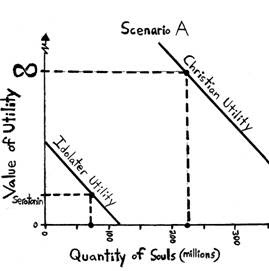
Producing more greenhouse gases to kill off the human race is indeed sound public policy, for the aim of governments is to attain the greatest good for the greatest number. Let us do the utilitarian calculus; out of approximately 293,382,953 souls in the United States of America (let us not strain our own credulity and pretend as if we actually care about souls in other countries), there are approximately 224,437,959 souls who have accepted Jesus Christ as their Lord and Savior, and 68,944,994 Semites, Mahometans, Hindus and various other idolaters who have not. Therefore, if we were able to make Earth uninhabitable tomorrow, there would be 224,437,959 souls who would consequently meet their Maker and enjoy absolute bliss for pure eternity. The other 68,944,994 souls would needless to say endure the throes of Satan's lash for eternal damnation; though that is not to say that their existence would be bereft of any happiness at all, for during their average lifespan of 77.7 years these godless heathens each enjoy the serotonin produced by an average of 7,213 orgasms, 9.08 liters of alcohol and 0.8 grams of cocaine.

If you note the first utility maximization chart below, you will see just how much more happiness will be enjoyed by our 224,437,959 self-described Christian-Americans than our 68,944,994 idolaters; infinitely more happiness - even disregarding the idolaters' eternal damnation. The trump card is, of course, that our Christian brethren will be enjoying eternal bliss - which is infinite - as opposed to a finite amount of orgasms, alcohol and cocaine. Just to show you how powerful this eternal bliss factor is, let us create a hypothetical scenario in which we suppose that all Americans who portend to have accepted Jesus Christ into their lives are not quite sincere and that Billy Graham is the only one who truly has and shall ultimately wind up in Heaven. Even so, the utilitarian product of one soul times infinite is, well, infinite. And that is a lot of utility. Thus, assuming that at the very least the Reverend and some other quantity of saved souls would ascend to Heaven as a result, we must allow them to take up residence there at once by allowing our automobiles and manufacturing plants to toot their horns and spew forth enough greenhouse emissions to destroy the ozone layer and melt the polar ice caps and raise Earth's sea levels high enough so we can stamp out the existence of those living in the wilderness of sin.


Our President George W. Bush surely understands the gravity of this situation and our unique opportunity for our souls' fate to be foreclosed with industrial activity, and that is why he has doggedly fended off the advances of the other seven world powers to impose Soviet-style command-and-control emissions caps. Of course, even though Bush has looked into Tony Blair and Vladimir Putin's eyes and seen the fundamental goodness of their souls, he is too smart to let them know his ulterior motives for refusing to ratify the Kyoto Protocol, because then the Jew-dominated liberal media would find out and they definitely would not be keen on hastening the Apocalypse in which they shall be smitten with not quite fire and brimstone but water of salt. Instead, our God-fearing President tells the G-8 conferees about the how the Lord's invisible hand intervenes in economies and that the best way to "fight" not global warming but "climate change" is to establish a carbon credit market in which our greenhouse gas producers can purchase the right to destroy the ozone layer for around the price of a set of one-sided copies at Kinko's.


We have a problem, however, for though the United States can be thanked for a full 25% of the world's greenhouse gases, 150 governments representing a full 61.6% of the world's total emissions have signed on to the Kyoto Protocol and are now in the process of slowing the process of ozone depletion. Unles these neo-pagan tree-huggers are stopped, we will have to wait even longer for Judgment Day. To do this I call on President Bush to bring the Revered Billy Graham to the next summit of global leaders to tell the story of Isaiah as he did during his first crusade to New York in 1957, where he told the city of sinners tell how Isaiah warned of impending judgment unless there is sincere repentance. Only this time Graham must fundamentally misinterpret the story, for these nations must repent their ratification of the Kyoto Protocol so that we can usher the hour of divine judgment!

Friday, July 11, 2008

Global Warming: A Threat to Human Rights

Global warming caused by human activity is not just a danger to the environment or to endangered species of plants and animals, but it is also a threat to human rights. Indeed, the process of climate change has already begun to alter the environment of human populations and so dramatically reconfiguring their way of life that this trend is leading towards widespread, systematic human rights abuses in a variety of avenues. At this time most of the world’s human population have not yet directly experienced adverse environmental, economic or political changes produced by the planetary rise in temperatures. Though some societies are already suffering unprecedented resource shortages and increases in conflict and violence that individuals are seeing their universally-recognized natural and civil rights being violated, and this disturbing trend is expected to become much worse as global temperatures rise ever more rapidly.

Among the people who are already bearing the brunt of climate change are those whose environment is being heated into oblivion, namely the Inuit of northern Canada, Alaska and Greenland. With only a rise of 5 degrees Fahrenheit over the past 30 years,[i] the waters of the Arctic Ocean have warmed so much that 38,000 square miles of sea ice are lost every year, with sea ice expected to completely disappear by 2040.[ii] As a result polar bears are not the only mammals on the road to extinction[iii] – the thawing of the Arctic is all but devastating populations of humans, namely Inuit society.

Indeed, Inuit culture is all but predicated on the extreme cold, and the northernmost regions of the planet have become so much more temperate that not only is ice and permafrost melting but many Inuit can no longer find enough hard-packed snow to build their traditional igloos.[iv] And such adjustments are more than just a question of style. Arctic snow is thinning to the extent that Inuit are oftentimes unable to run which makes meat harder to come by as hunting traditional game becomes especially difficult.[v] And as ice is becoming thinner than usual, Inuit hunters are falling through and the risk of broken legs and ankles is becoming progressively more common[vi] – a serious threat to the survival of those who find themselves immobile and exposed to the unforgiving elements of Arctic weather.

“These are issues of life and death”, says Inuit activist Sheila Watt-Cloutier, “We go out to hunt on the seas ice to put food on the table. You go to the supermarket.”[vii] This is the basis of the Nobel Prize nominee’s case which she and has brought before the Organization of American States’ Inter-American Commission on Human Rights; that global warming is destroying the traditional Inuit way of life that it is a violation of their basic human rights.

Martin Wagner, the Earthjustice attorney arguing Watt-Cloutier’s case before the OAS, maintained that, “The effects of global warming interfere with the realization of the right of life, physical integrity and security. It is destroying lands and ecosystems to which indigenous cultures throughout the hemisphere are tied. In order to survive, (they) are thus forced to assimilate with other cultures in ways and on a schedule that they have not chosen.”[viii]

stresses the region’s need for sustainable economic development which both provides the Inuit population with sources of income while still minimizing the destruction of the Arctic environment. “A number of Inuit want to live in Western houses and find jobs in the oil or shipping industries, and they have every right to do so,” he explains, “but in addition to promoting economic modernization, governments and corporations must protect the rights of those who want to preserve their traditional lifestyle.”[ix] Economic growth is indeed needed among the Canadian as well as American and Greenlandic Inuit particularly because these populations all suffer extremely high unemployment and poverty rates, not to mention the rampant depression, alcoholism and drug abuse which ensues.[x]

The problematic aspect of much of the Arctic’s current fossil fuel-based industrialization is that so far it has not only capitalized on destructive climate change but has also reinforced it further in an autocatalytic loop. Indeed, the ever more common use of electricity, airplanes and trucks powered by oil and gasoline emits particulate matter into the air, and when it settles the particulate makes ice and snow much darker and conducive to the absorption of solar radiation, which only intensifies the melting process even more.[xi] And though the loss of sea ice is seen by a boon to some – namely the shipping companies that are preparing to make ready use of the Northwest Passage which is expected to completely thaw within the near future,[xii] the frozen environment of the Inuit is even more imperiled. As the Doug Struck writes in The Washington Post, “More ships will bring the risk -- the certainty, some say -- of accidents and black oil spills smeared on the white Arctic.”[xiii]

However, the economic development of the Arctic and the advent of additional prosperity need not destroy the frigid environment which is so crucial to traditional Inuit life. Even without utilizing alternative fuel technologies, Wagner suggests that businesses operating in the region can become more Inuit-friendly by becoming more energy-efficient or by installing scrubbers in the smokestacks of their ships and in the tailpipes of their trucks in order to minimize air pollution.[xiv] Though the effects of global warming are being felt the hardest by the people of the Arctic region, its causes are truly derived by worldwide trends – and so for the human rights of the Inuit to be secure there must be a concerted effort to reduce greenhouse gas emissions by the people of every country on the globe.

In addition to the inhabitants of the coldest environments on Earth, people who live in the climatic antipode are also suffering widespread human rights violations as a result of global warming. Due to shifts in weather patterns the declining precipitation levels of North and Central Africa has led to the rapid expansion of the Sahara Desert. The ways by which human rights are going to suffer as a consequences are not merely subjects for future speculation, for the ramifications on water rights for drinking, sanitation and irrigation purposes are already abysmal.
For example, 40 years ago Lake Chad was the sixth-largest lake in the world, straddling the borders of Chad, Niger, Cameroon and Nigeria and providing ample water supplies to the human population throughout the region. But since global warming caused by human activity has desiccated the region, the lake has shrunk to only one-twentieth of its original size – and the humanitarian consequences have been devastating.[xv] Not only have the vast majority farmers and ranchers who once depended on Lake Chad’s water for their livelihoods given up their lands and emigrated moved to already-overcrowded cities, but those who have kept their farms are in such cutthroat competition for scarce water resources that low-level conflict has broken out for the fertile lands of the former lakebed. Internecine firefights erupted when fishermen from Nigeria followed the retreating shore lines into Cameroon, and violence has been precipitated by farmers over property rights in the bottom of what was once Lake Chad.[xvi]

Following the link between desertification and resource conflict, some observers have concluded that global warming is causally related to one of the world’s worst ongoing violations of human rights, the Sudanese government’s campaign of genocide in Darfur. No less an influential figure than United Nations Secretary General Ban Ki Moon wrote in a Washington Post editorial that “the Darfur conflict began as an ecological crisis, arising at least in part from climate change.”[xvii]
Two decades ago, the rains in southern Sudan began to fail. According to U.N. statistics, average precipitation has declined some 40 percent since the early 1980s. Scientists at first considered this to be an unfortunate quirk of nature. But subsequent investigation found that it coincided with a rise in temperatures of the Indian Ocean, disrupting seasonal monsoons. This suggests that the drying of sub-Saharan Africa derives, to some degree, from man-made global warming.[xviii]
Indeed, there is little doubt that global warming is one of the leading causes of rapid desertification, and particularly the expansion of the Sahara Desert. But Moon’s conclusion that there is causation and not merely correlation between global warming, desertification and the Darfur genocide is significantly more controversial.
It is no accident that the violence in Darfur erupted during the drought. Until then, Arab nomadic herders had lived amicably with settled farmers. A recent Atlantic Monthly article by Stephan Faris describes how black farmers would welcome herders as they crisscrossed the land, grazing their camels and sharing wells. But once the rains stopped, farmers fenced their land for fear it would be ruined by the passing herds. For the first time in memory, there was no longer enough food and water for all. Fight broke out. By 2003, it evolved into the full-fledged tragedy we witness today.[xix]

The Secretary General’s understanding of the genocide’s origins in global warming-induced desertification, however, do not come without controversy. Some critics, most notably Sudan scholar Eric Reeves, argue instead that “decades of severe political and economic marginalization, along with the NIF regime’s politically expedient targeting of the African tribal groups of Darfur, are the real cause of conflict in Darfur.”[xx]
Regardless, many experts fear that the conflicts like that unfolding among farmers and herders in Darfur could be replicated throughout the Middle East and North Africa, because the growing human populations in these regions and their demand for food and water are straining among the most limited water supplies in the world. The average annual rainfall in Darfur has dropped by almost 50 percent over 86 years to 7.48 inches when the conflict began in 2003, while over the past 40 years Darfur’s population has increased sixfold to 6.5 million.[xxi]

Indeed, potable water sources will only become increasingly scarce as rainfall is declining steadily in these areas, and there is the strong possibility that the change in precipitation patterns is related to global warming. “The consciousness of the world on the issue of climate change has to change fast,” said Muawia Shaddad of the Sudan Environment Conservation Society. “Darfur is just an early warning.”[xxii] But as paltry steps are being taken – the Sudanese government has planned a pilot project to spend $10 to construct dams and plant trees, Ismail al-Gizouli of the High Council for Environment and Natural Resources demands, “We need the richer countries to realize desertification is the emergency and help us.”[xxiii]

The expansion of the Sahara Desert is a complicated issue in regards to corporate responsibility, for in addition to global warming there are numerous other artificial causes which contribute to desertification, including overcultivation, overgrazing, and inadequate irrigation.[xxiv] Unlike the shippers poised to take advantage of the thawing Northwest Passage, however, there are no means by which it can be foreseen that any particular corporation might actually reap windfalls from the existence of more uninhabitable, unusable land; so the problem in this case is not necessarily that companies should refrain from capitalizing on environmental degradation which contributes to the violation of human rights, but that in their operations in North and Central Africa they should conduct business with their eye fixed on long-run rather than short-run interests. The most significant measure which business firms could take would be to promote techniques of land and water conservation so that sustainable agricultural methods become more prevalent – benefiting both the companies themselves as well as the individual farmers on the cusp of being overwhelmed by the Sahara sand. But for the international markets for farm goods to shift from the raising of livestock to crops would kill the two proverbial birds with one stone by both reducing water consumption as well as greenhouse gas emissions which contribute to desertification in the grander scale of environmental human rights concerns.

With these civilizational crises already playing out with the modest temperature change that have already been incurred, one can only imagine what humanitarian disasters await as the atmosphere becomes even warmer. With only modest warming of the oceans, hurricanes, cyclones and typhoons are becoming stronger and more destructive, indicating that the rare intense storms which can wreck havoc on densely-populated urban settings like Hurricane Katrina might soon become more and more common.[xxv] And even if global warming is mitigated so that sea levels rise by only a few feet, by bringing shorelines even slightly further inland residential corridors which were once thought to be safe will become susceptible to extreme flooding.[xxvi] And in places where water levels are already a concern, of course, the risk of flooding is only going to become even worse.

If the Antarctic or the Greenland ice sheets were to melt completely – an event which would raise sea levels by 20 feet due to the added volume of additional liquid water in Earth’s oceans. In such a scenario which is indeed projected if the production of greenhouse gas emissions continues to grow at their current rate, entire neighborhoods of New York, London and Tokyo would become submerged, with those high points which could escape permanent engulfment at least vulnerable to extreme flooding.[xxvii] Low-lying cities like New Orleans and Miami would be completely underwater.[xxviii] Granted, this would be a relatively gradual process playing out over the course of many decades, but preempting a failure of imagination, this should nevertheless develop into an unprecedented humanitarian disaster.

The problem of rising sea levels is going to do much more than force people to abandon their coastal homes and villages; a number of low-lying nations will be rendered into uninhabitable. Indeed, even if the Greenland ice sheet were to only partially melt, sea levels will rise so much that countries such as the Maldives – an archipelago of small islands where the highest elevation is only 8 feet, will literally have to be wiped off the map. Though unintentional, the complete and utter destruction of the sine non qua landmass of a nation-state effectively translates into creating a nation in diaspora with no hope of restitution and – depending on how liberally one is willing to interpret the word – tantamount to genocide.

Considering the difficulties that the United States government has faced over the past two years providing for the more than 200,000 persons displaced by Hurricane Katrina,[xxix] it is quite foreseeable that the number of displaced persons in this country alone would completely overwhelm the capacity of our existing social welfare services. The problems which global warming would pose for countries in the industrial West, however, are almost negligible when compared to the results of an additional 20 feet of seawater in the overcrowded cities of the developing world. If the Greenland ice sheet were to melt, it would ultimately turn more than 20 million people from Beijing and the surrounding areas into refugees, 40 million from Shanghai and its environs would have to be evacuated, and 60 million would have to be evacuated from Calcutta and Bangladesh (which are already susceptible to massive flooding even with the Greenland ice sheet in a solid state). The Christian Aid agency likewise predicts that there will be 1 billion people displaced by global warming by the year 2050;[xxx] to say the least, a crisis without even the remotest analogy in the annals of history.

The human rights violations which are projected to be caused by global warming are essentially in two layers, for not only are the people of Florida, Louisiana, China, Bangladesh as well as the entire nations of Vanuatu, Tonga and the Maldives going to be deprived of their ancestral homeland, but the hundreds of millions if not a billion internally-displaced persons and refugees are going to become among the most vulnerable groups to further victimization. In comparison, the United States – which accepts by far more refugees than any other country, has drafted its budget for the Fiscal Year 2008 to accept a maximum of 70,000 refugees in that year.[xxxi]

Even in periods of global economic expansion, exiles can usually be expected to be greeted in their adopted countries by exploitative job markets and xenophobic political climates (look no further than the treatment of illegal immigrants in the United States). In a study issued by the United Kingdom, the socioeconomic destruction produced by climate change is expected to result in a contraction of annual worldwide GDP between 5 and 20 percent,[xxxii] a depression which is all but assured to create environments of vast overcrowding, unemployment and shortages of water and food commodities in which no government is going to be willing to accommodate such a massive influx of refugees. The exact means by which the rights of hundreds of millions of unwanted persons are going to be repressed has of course yet to be determined, but it is all but certain that those displaced by global warming will have a future of war, poverty and outright persecution.

Of course, the best thing which corporations could begin to do now in foresight of this dismal outlook would be to find ways of reducing their carbon footprint; reducing consumption and promoting the conservation of energy, obtaining what energy is necessary to run a profitable business from renewable sources, etc. so that perhaps the process of global warming can be mitigated if not halted altogether. Unfortunately, the business community should take into account that some if not all of the aforementioned consequences of global warming will probably become reality within the 21st century and adopt their operations accordingly so as not to contribute to or take advantage of the human rights violations which will inevitably ensue.

The appropriate response of the political and corporate leadership is best articulated by Maldivean President Maumoon Abdul Gayoom, who might eventually be left without a country to govern if current trends in greenhouse gas emissions continue. “My message is a simple one – take global warming and climate change more seriously. Act now, before it becomes too late to save not only the low-lying islands but the entire planet.”[xxxiii]

[i] Struck, Doug. “Melting Arctic Makes Way for Man.” The Washington Post. 11/12/2006
[ii] Sample, Ian. “Arctic Ice May Lose All its Ice by 2040, Disrupting Global Weather.” The Guardian. 3/16/07
[iii] Eilperin, Juliet. “Study Says Polar Bears Could Face Extinction.” The Washington Post. 12/19/04
[iv] Watt-Cloutier, Sheila. “Global Warming and Human Rights.” Testimony Before the Inter-American Commission on Human Rights. 3/1/2007
[v] Watt-Cloutier, Sheila. “Global Warming and Human Rights.” Testimony Before the Inter-American Commission on Human Rights. 3/1/2007
[vi] Watt-Cloutier, Sheila. “Global Warming and Human Rights.” Testimony Before the Inter-American Commission on Human Rights. 3/1/2007
[vii] Gelbspan, Ross. “Slow Death By Global Warming.” Amnesty Magazine. Summer 2007
[viii] BBC News. “US CO2 Emissions ‘Violate Rights.” http://www.bbcnews.com/ 3/1/2007
[ix] Wagner, Martin. Interview: 8/16/2007
[x] Williams, Sandra. “The Forgotten Inuit Culture.” Suite 201. 2/8/2007. http://poverty.suite101.com/article.cfm/the_forgotten_inuit_culture
[xi] Wagner, Martin. Interview: 8/16/2007
[xii] Krauss, Clifford, Steven Lee Myers, Andrew C. Revkin and Simon Romero. “As Polar Ice Turns to Water, Dreams of Treasure Abound.” The New York Times. 10/10/05
[xiii] Struck, Doug. “Melting Arctic Makes Way for Man.” The Washington Post. 11/12/2006
[xiv] Wagner, Martin. Interview: 8/16/2007
[xv] Gore, Al. An Inconvenient Truth.
[xvi] Gore, Al. An Inconvenient Truth.
[xvii] Moon, Ban Ki. “A Climate Culprit in Darfur.” The Washington Post. 6/16/07
[xviii] Moon, Ban Ki. “A Climate Culprit in Darfur.” The Washington Post. 6/16/07
[xix] Moon, Ban Ki. “A Climate Culprit in Darfur.” The Washington Post. 6/16/07
[xx] Reeves, Eric. “On Ban Ki-moon, Darfur, and Global Warming.” The Guardian. 6/20/2007
[xxi] De Montesquiou, Alfred. “Experts: Darfur Faces Environmental Crisis.” The Associated Press. 6/22/07
[xxii] De Montesquiou, Alfred. “Experts: Darfur Faces Environmental Crisis.” The Associated Press. 6/22/07
[xxiii] De Montesquiou, Alfred. “Experts: Darfur Faces Environmental Crisis.” The Associated Press. 6/22/07
[xxiv] Helldén, Ulf. “Desertification Modification: Is the Desert Encroaching?” Desertification Control Bulletin. 1988
[xxv] Roach, John. “Is Global Warming Making Hurricanes Worse?” National Geographic News. 8/4/05
[xxvi] Natural Resources Defense Council. “The Consequences of Global Warming.” http://www.ndrc.org/ 1/9/06
[xxvii] Randerson, James and Ian Sample. “World’s Sea Levels Rising at Accelerating Rate.” The Guardian. 2/2/07
[xxviii] CBS News. “Miami, New Orleans Face Warming Threat.” http://www.cbsnews.com/ 3/23/06
[xxix] Christie, Les. "Growth states: Arizona overtakes Nevada: Texas adds most people overall; Louisiana population declines nearly 5%." CNN. December 22, 2006.
[xxx] Lyon, Alistair. “Global Warming to Multiply World’s Refugee Burden.” Reuters. 6/18/07
[xxxi] Submitted on Behalf of the President of the United States to the Committees on the Judiciary; United States Senate and United States House of Representatives. “Proposed Refugee Admissions for Fiscal Year 2008.” United States Department of State, United States Department of Homeland Security, United States Department of Health and Human Services.
[xxxii] Eilperin, Juliet. “Warming Called Threat to Global Economy.” The Washington Post. 10/31/06
[xxxiii] Gardner, Simon. “Sea May Swallow Maldives if Global Warming Unchecked.” Reuters. 2/3/07

The Progressive Case for John McCain

(circa September 2007, when it looked like the GOP was going to nominate either Mitt Romney or Rudy Giuliani and the thought of John McCain sitting in the Oval Office was relatively less conducive to me shitting my pants)

If you have spent more than 30 seconds in my presence, you probably know that I am 1) obsessed with politics, and 2) very, very liberal. This is my third semester as President of the Amherst College Democrats, and I spent last summer working for my Senator Hillary Rodham Clinton. And I believe that John McCain has the potential to make an excellent President.

My initial response to the man is quite inexplicable. At the utterance of his name, I feel like Frank Sinatra’s character in The Manchurian Candidate, as though I have been brainwashed into believing that “John McCain is the kindest, warmest, bravest, most wonderful human being I’ve ever known.” After reading his memoirs about serving as a Navy pilot in Vietnam and spending five years as a prisoner of war, I too am impressed by this man’s acts of courage.

But when it comes to candidates, it is policy and not personality that truly matters. And John McCain is a very conservative Republican. He was first elected as Arizona’s Senator by promising to continue the legacy of his predecessor: Barry Goldwater, the very founder of the modern conservative movement. However, this school of thought is very different from the Christian fundamentalism and crony capitalism which defines the current administration. McCain’s mode of conservatism is predicated on the rule of law, economic prudence, and competent management of the American Empire.

A John McCain presidency should not frighten liberals, for assuming that the makeup of Congress does not change, whoever sits in the Oval Office in 2009 will see bills on their desk written by Democratic committee chairs. If there were to be a government divided with a very progressive Congress and an open-minded Republican President, we can expect a flurry of enormous legislative accomplishments.

The best example is what McCain would do in regards to global warming. He has coauthored legislation to curb greenhouse gas emissions, and if given the opportunity, would use the most powerful office in the world to take on this daunting endeavor. Only the rare individual like John McCain could establish the notion that preserving the polar ice caps is an inherently conservative end and vital for our national security. With the clock ticking towards the point of no return, it might thus be in the global interest for McCain to be our next President.

In the realm of economics, an analogy can be made that John McCain is to George W. Bush as Theodore Roosevelt was to William McKinley. Whereas Bush has ascribed to any policy desired by his campaign financiers, McCain has campaigned to end corporate welfare as we know it. He voted against subsidies to the oil companies and to the pharmaceutical companies. Indeed, McCain’s conception of free markets includes the correction of market failures, having advocated stricter regulation of the auto industry, the accounting industry, the tobacco industry, even the campaign finance industry. Indeed, he is a small-government Republican, but a McCain administration could very well revive the long-dormant spirit of Progressive Republicanism.

John McCain is a social conservative, but he adheres to the authority of binding precedent more than the fatwas of the Reverends Pat Robertson and Jerry Falwell. Particularly after the South Carolina primary in 2000, in which the Bush campaign made an issue out of the color of his daughter’s skin, McCain is openly hostile to the culture warriors of his party whom he has labeled as “agents of intolerance.” McCain is pro-life, but supports federally-financed stem cell research. He opposes same-sex marriage, but he also opposes banning it with a constitutional amendment, which he described “as antithetical in every way to the core philosophy of Republicans.” On illegal immigration, he is one of the primary champions of allowing illegal aliens to become full citizens. Altogether, his positions are sufficiently to the right in order to pass his party’s ideological litmus test, and in some instances he is quite liberal.

Any liberal optimism for John McCain is tempered, however, by his stance on the single most important question which faces the American nation today: the war in Iraq. He does not march in lockstep with the Bush administration, having distanced himself from its treatment of detainees, but McCain is nevertheless accused to be a facilitator of the larger, failing mission. This accusation is well founded, for he still argues that the war can be won with sufficient reinforcements; the so-called McCain Doctrine of escalation.

It seems strange that the former straight-talker would take this occasion to deny perceptible reality, but the about-face signals the dilemma which all Republicans face in 2008. The next presidential election is sure to be all but defined by the war in Iraq, and this enormously unpopular undertaking has lost the backing of all but the most dogmatic members of the Grand Old Party. Anyone who wants to receive the party’s nomination must win over the increasingly-dwindling voters who wish to stay the course, and so every single Republican candidate, McCain included, now has to kowtow to what is but a peripheral element of the general electorate.

My prediction is that once the primaries have been decided, John McCain is going to reestablish himself as the straight-talking centrist reformer who we saw in 2000. If Candidate McCain chooses a likeminded moderate like Rudy Giuliani as his running-mate, the result will be a Republican administration which could implement an agenda with broad-based popular support. And just as only Nixon could go to China, perhaps John McCain can then extricate the United States from Iraq.

There is more at stake in the next election than party and personality, and even this loyal Democrat has respect for the virtues of conservatism. As a young idealist considering a career in public service, in fact, I would be proud to work under the leadership of a President McCain.