
There are few things more unpleasant than Malian hot season. At this point in the year the village of Sanadougou is close enough to the Equator that it receives such direct radiation, the Sun beats down with such intensity that I cannot even look outside without my sunglasses on – the reflection from the sand is practically blinding unto itself. During hot season the temperature rarely dips below 100 degrees; often times the thermometer hovers around 110. Here it is just flat, sandy scrub in all directions with no body of water, no topography of any kind; pressure in the air is fairly uniform in all directions, so there is no wind to blow the sweat off your brow. The heat just sits on top of your head and refuses to ever go away. April is more or less dry hot season, so the entire Sahel is kind of like a big unpleasant sauna. But by May the rain clouds are starting to form so it is not only 110 degrees but also as humid as the cavities between the folds inside Rush Limbaugh’s ass crack.
I am not exaggerating when I say that it is a full-time job merely surviving in this climate. Human beings sweat so much that we have to be constantly drinking water simply in order to not die of dehydration. Even the water is hot. I drink about 12 Nalgenes full of hot water a day – and even then I still get massive headaches because I'm dehydrated.
This time of year, people just sit under the shade of their gwa and try their best not to melt. No one has any desire to get off their ass and do anything. Watering a garden would be downright futile. Nobody can do any work, because it’s no matter what they do it's just too……… fucking………hot……………
My Malian neighbors spend their time escaping the Sun's wrath under the gwa brewing pots of boiling hot tea and sugar.
“Madu, you drink tea?”
“NO!!!!! Get that shit
away from me!!!!!”
Hot season
sucks.
And if I thought that hot season couldn’t suck any harder, the night guardian at the clinic across the street from me shot my kitty cat with a colonial-era musket and ate him.
A mere seven days after
the Assassination of James Brown the gardens of Xanadu were graced by a visit with Dr. Dawn – the Peace Corps Medical Officer – on her scheduled annual site visit. She seemed to be concerned for my mental health.
“Zac, you haven’t let go of this cat thing. It’s time for you to move on.”
She was right. There were few worse strategies force coping with the wanton slaughter and consumption of my kitty cat then to wallow at the scene of the crime, especially in this Allah-forsaken weather where one is so busy sweating one’s balls off and struggling to remain alive that it is nearly impossible to experience any semblance of joy.
So I packed my bag and got on a plane to Casablanca!
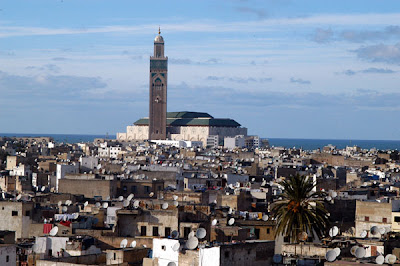
I was supposed to meet my family at the airport – at which time they would have for me a new functional debit card. Though due to a malfunctioning hydraulic system, my family’s flight from JFK was canceled. And of course the Moroccan currency exchangers did not have the slightest interest in trading for Malian francs. So for my first hours on Moroccan soil I was penniless, hungry, and shit out of luck.
But somehow or another my mom got Iberian Airlines to feel an enormous amount of pity and they whisked me to a luxury Casablanca spa and hotel with air-conditioning and a flat-screen TV and a toilet and a bidet and a steam bath and unlimited room service so long as I promised to never badmouth Iberian Airlines all over my blog. And I stand by my vow. When Iberian Airlines’ flights are grounded by hydraulic malfunctions, they treat you like a king.
As this grimy Peace Corps Volunteer has not had a proper shower or bath in almost a year now, I dawdled in this soapy, shampoo steam bath of bliss for at least an hour. When I was done there was a manifest ring of sludge around the bathtub.
And then I stepped outside onto the
asphalt-paved street and walked along the
concrete sidewalk and re-immersed myself into modern cosmopolitan existence. I sat down at the
café with the morning edition of
Le Monde and poured over the
editorials as I sipped a
carafe of red wine and a
cappuccino and ordered a
big hunk of lamb steak, as bloody and rare as the chef will agree to serve it,
smothered in peppercorns. Only current or former Peace Corps Volunteers who have lived in villages of mud and sticks and eaten a steady diet of millet goop could ever understand just how amazing this felt…
Morocco is the most amazing country I have been to on the African continent thusfar(3 out of 54). Unlike Mali or Burkina Faso – which are landlocked agglomerations of various tribes which often have nothing in common besides the fact that they were once governed by the same French colonial magistrate – al-Maghreb is actually a nation-state of 34 million people with a sort of cultural coherence. Yes, in addition to the Arab majority there are distinct minority groups here such as the Berbers, the Gnaoua (black Moroccans) and Jews. However, since this is such a highly tolerant society there has been such intermarriage and exchange among the various subcultures over the years that now most Moroccans speak a patois of Arabic and French with a little Berber. And of course, this culture had their share of influence from the Spanish, the Romans, the Carthaginians, the Phoenicians, and - judging by the indigenous redheads - the occasional Viking raiding party.
What I enjoy about this country so much is that it is hard to pigeonhole into a greater region. In America, one would say that Morocco is in “the Middle East”. My Egyptian Arabic teacher would say that Morocco is in “Africa”. My Malian neighbors would say that Morocco is in “Europe” (it’s halfway to Spain)! All are kind of correct in that since it is located on the African side of the Strait of Gibraltar, and pretty much all maritime traffic in and out of the Mediterranean had to dock in either Tangier or Casablanca to trade for supplies at some point in time, Maghrebee culture is a deliciously cosmopolitan hodgepodge of East, West, North and South. And the result is a culture which mixes the best of all worlds.
The most conspicuous thing about Moroccan culture seems to be that men between the ages of 18 to 100 spend every afternoon at the café sipping mint tea. No women are ever present at the cafés unless of course they are serving the men. I thought this was kind of cool until I was joined for the second leg of my journey with my feminist friend – after that, I came to see the light that
of course, the café is a bastion of misogyny and sexism. Nevertheless, at more gender-neutral establishments one could be treated to a constant smorgasbord of olives, couscous, spicy bean soup and crock pots full of goat and lamb and cumin and turmeric… but you know what? I’m really bad at this Condé Nast culturati fluff – I’ll leave that to
a blogger with a significantly greater estrogen quotient than myself.
This blog isn't about art and dance and cuisine. It's about
manly things like
CONCRETE and
PLUMBING and
SEPTIC TANKS and
SHIT. Yeah, that's right.
So here's my take on Morocco: Morocco is so incredibly awesome, not just because of the olive oil and couscous but because between 65 and 1.8 million years ago the European and African plates collided. The result of this tectonic confrontation were the High Atlas Mountains - which were pushed with enough force to reach heights of 4,000 meters. At this altitude moisture that just happened to be traveling along in the air, minding its own business, got interrupted by these ginormous
mountains and so the moisture condensed and actually formed
clouds - which often saturate to a point that they actually conduct
precipitation. Many peaks of the High Atlas Mountains - such as Toubkal, the very highest mountain in all of North Africa (pictured below)- are so cold and receive so much moisture that that water falls as snow or otherwise freezes into snowcaps last until mid-August.

By the time that I and my parents and my sister went hiking around Toubkal in mid-June there was still a little bit of snow left. If you squint and block out the glare from the Sun you might be able to see some patches out in the distance. Yeah, there they are... Eventually enough solar radiation gets absorbed by those snowcaps that they melt and flow downhill, forming little mountain streams. Those mountain streams serve as the lion's share great of the Berbers' water supply for drinking, cooking, washing and irrigation.

The higher up we went, naturally the less vegetation there was on these mountains. Much of the valley was just full of boulders and scree; Allah did not create many prime plots for farmers or pastoralists in the High Atlas Mountains.
However, back in how many days of yore some Berber shepherds decided to pick up a bunch of heavy rocks and throw them across the mountain streams. Eventually these rocks caught enough sticks and leaves that they formed modest pools - which bit by bit accumulated enough organic matter to create a fertile humus. And grasses grew in the moist soils where they never would have otherwise among the rocks and the shepherds created for themselves prime new places to lead their goats to graze.

In some places the Berbers had gathered so much soil and were able to control the water levels so well that their rock walled-in areas would be fertile - but not flood - and grow figs and cherries and apricots in the alpine terrain.

For thousands of years this rock wall technology was pretty impressive. But then sometime in the 20th century the World Bank came in with some cement bags and fancypants engineers and created permanent, concrete irrigation canals to divert a smaller, more reliable fraction of the mountain streams so as to improve agricultural yields and simultaneously preserve the natural habitats of some of the endangered fauna which call Toubkal National Park their home.
I could totally build something like this... a piece of cake!

Yeah, political science majors from Amherst College know
all about building big concrete-looking canal things...

Check out how the Berbers took a hill on something like a 45-degree angle, built ridges and then with a diversion of this irrigation canal built a cascading, multi-tiered garden plot.

And here they have diverted naturally-flowing mountain stream waters to fill a clothes-washing basin.

And since that water was once in solid form mere hours ago and is probably around 37 degrees Fahrenheit, some Berbers used rubber hoses to divert the canals further, poked holes around one loop of the hose, and created a 100-percent sustainable, gravity-powered refrigerator to chill water and soft drinks for hikers passing by their village.

All of these infinitely awesome water systems are - along with olives, couscous, turmeric and traditional Berber lute music - among the reasons why I am in love with the nation of al-Maghreb and I think I might have to live there for at least some part of my life... or at least become filthy rich and buy a villa in Chefchaouen like Robert Plant.
You might think, "Yeah, and now when you get back to Sanadougou you can build a snow cap > irrigation canal > natural refrigerator system there too! (sigh)...
Unfortunately, the village where I live in Mali is as topographically interesting as
Sarpy County, Nebraska - none of these things could ever happen there.
... So until a major tectonic plate collides with the vast Malian interior, it looks like I'll be concentrating on solid and liquid waste management from now until the Mahdi returns...


