Showing posts with label the Sun. Show all posts

Thursday, February 18, 2010

Perspective


Nouhoume: Madu, what is it like in America?

Madu:
That is a very difficult question to answer… I don’t quite know where to start…

N:
Is there millet in America?

M: Not really. It is so dry here in Mali, so it makes sense for Malians to grow millet. But we have a lot more rain in America, so we can farm a lot of wheat and corn and rice instead.

N: Do you farm peanuts in America?

M: Yes, we have lots of peanuts! Particularly in the American South, there are lots of peanut farmers. In fact, peanuts are such an important staple of the American economy that there was one peanut farmer who went on to become President!


N: Do you have the Moon in America?

M: Um… well, the Moon isn’t in America per se… but we can see the Moon from America, if that’s what I assume you meant.

N: But America is so far away!


M: America is indeed far from Mali – but we can see the Moon in America too, because the Moon is just as far from America as it is from Mali. (grabs a soccer ball for reference) You see, Mali is to the East of America, and the Earth rotates counter-clockwise from the West to the East, so though we are both seeing the same Moon from both countries, in New York we can start to see the Moon about five hours after it can be seen from Mali.

N: What about the stars?


M: We can see most of the same stars in America. But America is further North than Mali, so there are some stars of the Southern sky that you can see here but we can’t in America – and there are some stars in the Northern sky that you can see in America but not in Mali.

Do you see that thing between the stars that’s a different color than all the rest? It looks red.


N: Yes. Why is that star red?

M: It's not a star at all! It's another world revolving around the Sun just like Earth! It is called Mars. After the Moon, it is the closest body to our planet.


N: What about the Sun? The Sun is so much bigger!

M: Yes, the Sun is much much much bigger than Mars, but it is also much farther. If the Sun were as close to Earth as Mars is, then the whole world would be much too hot for us to live!

N: Are there any people there?

M: No, it is much too cold on Mars for any people to live there. And though there is air there, it is not like the air here on Earth - if we were to go to Mars we would not be able to breath... But a few years back America sent some machines to Mars that can drive around and take pictures and study the rocks on the Martian surface. They are still there today.

N: Wowwwwwww...

So Madu, why are all of those stars in a big line there?


M: That, Nouhoume, is what we call "The Milky Way".

You see, there is this force called "gravity" which attracts any two objects in the whole Universe towards each other. Gravity is attracting you to this soccer ball right now, but both you and the soccer ball are so small that you don't move towards each other. But Earth is really, really, really big - and you are so much smaller, and that is why you stay on top of the Earth. Even though the Moon is big too, Earth is a lot bigger, so the Moon is attracted to the Earth. The only thing big enough and close enough to Earth to attract it is the Sun - that is why Earth revolves around the Sun once every 365 days.

Stars work the same way. Gravity pulls stars towards each other if they are big enough and close enough, and when they get really, really close stars will rotate around each other as well! Eventually, millions and millions of stars start revolving around each other and make a big spiral like this (draws a spiral galaxy in the dirt). That is what we call a "galaxy".


Our Sun - our star - is revolving around with other stars in a spiral like this. Our star is on one of the arms of the spiral, which is why we can see so many other stars. When you see all of those stars clumped together in that big, thick line called "The Milky Way", those are just more stars in the same arm of the spiral that ours is on.

Most of the stars that we can see are in our own galaxy, but there are billions and billions of other stars in their own galaxies. We can see some of them, but it is very difficult because they are so far away.


N: Wowwwwwww.....

Madu, can you see all of these things in America too?

M: Yes, America and Mali are both on Earth, you see, so like I explained most of the things in the night sky that you can see here we can see in America too - but not all of them.

N: Madu, I have another question.

M: Shoot.


N: Do you have fire in America?

M: Yes.


Friday, December 11, 2009

Emancipated from the Smoky Kitchen by the Power of the Sun

This scene might look like just another day in the life of a Malian housewife. But in fact, this is far from a portrait of mundane drudgery - rather, this scene captures the quiet struggle of women's empowerment and feminist revolution.


You see, something is missing from this picture - were it to capture the quotidian labors of the average Malian woman. Deborah Dao cooks her family three square meals a day - a responsibility which in this economy requires nearly constant preparation and cooking. Most women spend all day pounding millet, mixing the batter, chopping firewod and fanning the flames to cook their family's toh, but here there is no burning hearth, no fire, no smoke.

On a closer look, you can see that Deborah is cooking with a solar oven - a wonderful appliance made by local carpenters with their own wood and just a few imported materials which harnesses solar radiation to collect heat energy.


If Deborah prepares her family's lunch early in the morning and places it in her solar oven, by noon it's ready to eat. And she is free of the tedious labor of fanning the flames for hours at a time.


Now that she no longer has to spend all morning in the smoky kitchen inhaling the noxious fumes and tars of wood smoke, Deborah can occupy her time with various cottage industries. She makes shea butter, soap, liquid soap and incense to sell at market and earn money for herself and her children. On this day, she is sewing garments for her neighbors; a Westerner might think that Deborah is still relegated to traditional "women's work", but here in Mali, most women are too busy fanning the flames of the hearth to engage in much income-generating activity - most taylors are men. Deborah, on the other hand, is the only female taylor in the entire Commune of Sanadougou.


Friday, June 26, 2009

On a Marrakesh Express


There are few things more unpleasant than Malian hot season. At this point in the year the village of Sanadougou is close enough to the Equator that it receives such direct radiation, the Sun beats down with such intensity that I cannot even look outside without my sunglasses on – the reflection from the sand is practically blinding unto itself. During hot season the temperature rarely dips below 100 degrees; often times the thermometer hovers around 110. Here it is just flat, sandy scrub in all directions with no body of water, no topography of any kind; pressure in the air is fairly uniform in all directions, so there is no wind to blow the sweat off your brow. The heat just sits on top of your head and refuses to ever go away. April is more or less dry hot season, so the entire Sahel is kind of like a big unpleasant sauna. But by May the rain clouds are starting to form so it is not only 110 degrees but also as humid as the cavities between the folds inside Rush Limbaugh’s ass crack.

I am not exaggerating when I say that it is a full-time job merely surviving in this climate. Human beings sweat so much that we have to be constantly drinking water simply in order to not die of dehydration. Even the water is hot. I drink about 12 Nalgenes full of hot water a day – and even then I still get massive headaches because I'm dehydrated.

This time of year, people just sit under the shade of their gwa and try their best not to melt. No one has any desire to get off their ass and do anything. Watering a garden would be downright futile. Nobody can do any work, because it’s no matter what they do it's just too……… fucking………hot……………

My Malian neighbors spend their time escaping the Sun's wrath under the gwa brewing pots of boiling hot tea and sugar.

“Madu, you drink tea?”

“NO!!!!! Get that shit away from me!!!!!”

Hot season sucks.

And if I thought that hot season couldn’t suck any harder, the night guardian at the clinic across the street from me shot my kitty cat with a colonial-era musket and ate him.

A mere seven days after the Assassination of James Brown the gardens of Xanadu were graced by a visit with Dr. Dawn – the Peace Corps Medical Officer – on her scheduled annual site visit. She seemed to be concerned for my mental health.

“Zac, you haven’t let go of this cat thing. It’s time for you to move on.”

She was right. There were few worse strategies force coping with the wanton slaughter and consumption of my kitty cat then to wallow at the scene of the crime, especially in this Allah-forsaken weather where one is so busy sweating one’s balls off and struggling to remain alive that it is nearly impossible to experience any semblance of joy.

So I packed my bag and got on a plane to Casablanca!
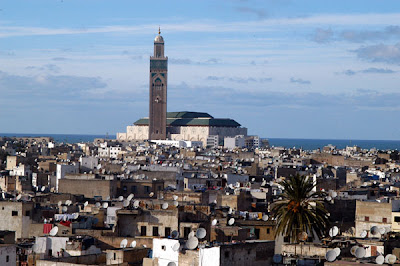


I was supposed to meet my family at the airport – at which time they would have for me a new functional debit card. Though due to a malfunctioning hydraulic system, my family’s flight from JFK was canceled. And of course the Moroccan currency exchangers did not have the slightest interest in trading for Malian francs. So for my first hours on Moroccan soil I was penniless, hungry, and shit out of luck.

But somehow or another my mom got Iberian Airlines to feel an enormous amount of pity and they whisked me to a luxury Casablanca spa and hotel with air-conditioning and a flat-screen TV and a toilet and a bidet and a steam bath and unlimited room service so long as I promised to never badmouth Iberian Airlines all over my blog. And I stand by my vow. When Iberian Airlines’ flights are grounded by hydraulic malfunctions, they treat you like a king.

As this grimy Peace Corps Volunteer has not had a proper shower or bath in almost a year now, I dawdled in this soapy, shampoo steam bath of bliss for at least an hour. When I was done there was a manifest ring of sludge around the bathtub.

And then I stepped outside onto the asphalt-paved street and walked along the concrete sidewalk and re-immersed myself into modern cosmopolitan existence. I sat down at the café with the morning edition of Le Monde and poured over the editorials as I sipped a carafe of red wine and a cappuccino and ordered a big hunk of lamb steak, as bloody and rare as the chef will agree to serve it, smothered in peppercorns. Only current or former Peace Corps Volunteers who have lived in villages of mud and sticks and eaten a steady diet of millet goop could ever understand just how amazing this felt…

Morocco is the most amazing country I have been to on the African continent thusfar(3 out of 54). Unlike Mali or Burkina Faso – which are landlocked agglomerations of various tribes which often have nothing in common besides the fact that they were once governed by the same French colonial magistrate – al-Maghreb is actually a nation-state of 34 million people with a sort of cultural coherence. Yes, in addition to the Arab majority there are distinct minority groups here such as the Berbers, the Gnaoua (black Moroccans) and Jews. However, since this is such a highly tolerant society there has been such intermarriage and exchange among the various subcultures over the years that now most Moroccans speak a patois of Arabic and French with a little Berber. And of course, this culture had their share of influence from the Spanish, the Romans, the Carthaginians, the Phoenicians, and - judging by the indigenous redheads - the occasional Viking raiding party.

What I enjoy about this country so much is that it is hard to pigeonhole into a greater region. In America, one would say that Morocco is in “the Middle East”. My Egyptian Arabic teacher would say that Morocco is in “Africa”. My Malian neighbors would say that Morocco is in “Europe” (it’s halfway to Spain)! All are kind of correct in that since it is located on the African side of the Strait of Gibraltar, and pretty much all maritime traffic in and out of the Mediterranean had to dock in either Tangier or Casablanca to trade for supplies at some point in time, Maghrebee culture is a deliciously cosmopolitan hodgepodge of East, West, North and South. And the result is a culture which mixes the best of all worlds.

The most conspicuous thing about Moroccan culture seems to be that men between the ages of 18 to 100 spend every afternoon at the café sipping mint tea. No women are ever present at the cafés unless of course they are serving the men. I thought this was kind of cool until I was joined for the second leg of my journey with my feminist friend – after that, I came to see the light that of course, the café is a bastion of misogyny and sexism. Nevertheless, at more gender-neutral establishments one could be treated to a constant smorgasbord of olives, couscous, spicy bean soup and crock pots full of goat and lamb and cumin and turmeric… but you know what? I’m really bad at this Condé Nast culturati fluff – I’ll leave that to a blogger with a significantly greater estrogen quotient than myself.

This blog isn't about art and dance and cuisine. It's about manly things like CONCRETE and PLUMBING and SEPTIC TANKS and SHIT. Yeah, that's right.

So here's my take on Morocco: Morocco is so incredibly awesome, not just because of the olive oil and couscous but because between 65 and 1.8 million years ago the European and African plates collided. The result of this tectonic confrontation were the High Atlas Mountains - which were pushed with enough force to reach heights of 4,000 meters. At this altitude moisture that just happened to be traveling along in the air, minding its own business, got interrupted by these ginormous mountains and so the moisture condensed and actually formed clouds - which often saturate to a point that they actually conduct precipitation. Many peaks of the High Atlas Mountains - such as Toubkal, the very highest mountain in all of North Africa (pictured below)- are so cold and receive so much moisture that that water falls as snow or otherwise freezes into snowcaps last until mid-August.


By the time that I and my parents and my sister went hiking around Toubkal in mid-June there was still a little bit of snow left. If you squint and block out the glare from the Sun you might be able to see some patches out in the distance. Yeah, there they are... Eventually enough solar radiation gets absorbed by those snowcaps that they melt and flow downhill, forming little mountain streams. Those mountain streams serve as the lion's share great of the Berbers' water supply for drinking, cooking, washing and irrigation.


The higher up we went, naturally the less vegetation there was on these mountains. Much of the valley was just full of boulders and scree; Allah did not create many prime plots for farmers or pastoralists in the High Atlas Mountains.

However, back in how many days of yore some Berber shepherds decided to pick up a bunch of heavy rocks and throw them across the mountain streams. Eventually these rocks caught enough sticks and leaves that they formed modest pools - which bit by bit accumulated enough organic matter to create a fertile humus. And grasses grew in the moist soils where they never would have otherwise among the rocks and the shepherds created for themselves prime new places to lead their goats to graze.


In some places the Berbers had gathered so much soil and were able to control the water levels so well that their rock walled-in areas would be fertile - but not flood - and grow figs and cherries and apricots in the alpine terrain.


For thousands of years this rock wall technology was pretty impressive. But then sometime in the 20th century the World Bank came in with some cement bags and fancypants engineers and created permanent, concrete irrigation canals to divert a smaller, more reliable fraction of the mountain streams so as to improve agricultural yields and simultaneously preserve the natural habitats of some of the endangered fauna which call Toubkal National Park their home.

I could totally build something like this... a piece of cake!


Yeah, political science majors from Amherst College know all about building big concrete-looking canal things...


Check out how the Berbers took a hill on something like a 45-degree angle, built ridges and then with a diversion of this irrigation canal built a cascading, multi-tiered garden plot.


And here they have diverted naturally-flowing mountain stream waters to fill a clothes-washing basin.


And since that water was once in solid form mere hours ago and is probably around 37 degrees Fahrenheit, some Berbers used rubber hoses to divert the canals further, poked holes around one loop of the hose, and created a 100-percent sustainable, gravity-powered refrigerator to chill water and soft drinks for hikers passing by their village.


All of these infinitely awesome water systems are - along with olives, couscous, turmeric and traditional Berber lute music - among the reasons why I am in love with the nation of al-Maghreb and I think I might have to live there for at least some part of my life... or at least become filthy rich and buy a villa in Chefchaouen like Robert Plant.

You might think, "Yeah, and now when you get back to Sanadougou you can build a snow cap > irrigation canal > natural refrigerator system there too! (sigh)...

Unfortunately, the village where I live in Mali is as topographically interesting as Sarpy County, Nebraska - none of these things could ever happen there.

... So until a major tectonic plate collides with the vast Malian interior, it looks like I'll be concentrating on solid and liquid waste management from now until the Mahdi returns...


Saturday, May 2, 2009

Crisis in the Garden of Xanadu

Despite my earnest efforts to teach my neighbors how to treat their drinking water and to build improved latrines and soak pits, I have come to realize that my current lifestyle practices have an overall detrimental effect on Sanadougou's water supply.

It seems to me that when the Christian NGO set up shop in Sanadougou twenty years ago, they had a bit too much faith in Western technology – a conceit which I unfortunately inherited. Around the same time that they were building their residential quarters they also brought in engineers to put together a solar-powered groundwater pump and water tower to bring potable drinking water to robinets located in three locations throughout the town. At first the NGO personnel planned on placing one of those robinets directly inside the chain-link fence of their concession. I thank Jesus that the NGO apparently realized how completely awful the symbolism would have been of having a private supply of running potable water in a village where most people drink from parasite-laden wells; they ended up placing the robinet 50 meters outside the fence where it would be accessible to the public – technically.

Groundwater pumping can be fairly dubious in many environments, but it is not very harmful to the equilibrium of the water table when the quantity of water pumped is dwarfed by the annual recharge. In this Sahelian climate where the soils are supersaturated again every rainy season, the human impact on the water table by a single solar pump used for limited human consumption is quite negligible. Even if every single person in this village were to use the solar pump/robinet system to access uncontaminated groundwater for their personal drinking and cooking needs, any minor disruptions of natural water table levels are easily justified by the health benefits of reducing the transmission of giardia, dysentery, cholera, guinea worm, round worm and ring worm. In this society where the first two water-borne illnesses constitute a significant fraction of the infant and child mortality rates, it is no exaggeration to say that the value of groundwater resources as a source of potable drinking water can be measured in lives.

So after a decade of building schoolhouses and a kindergarten and a health clinic and a library and a playground in Sanadougou, the Christian NGO decided that they wanted to grow a garden. To Westerners who think of gardening as a weekend hobby, I don’t think that they understood just how much labor is required to irrigate even a small garden in a pre-industrialized Malian village. Most gardens in Sanadougou are really small – a seasonal okra patch, maybe a banana tree or two – because someone has to water that garden every single day with water pulled from well bags. Water is surprisingly heavy, and to repeat the motion of drawing well bag after well bag is remarkably strenuous and time-consuming. There are some larger gardens of perennial crops, and watering each one of those gardens with well bags is enough labor to constitute one person’s full-time job from September until the rains return in June.

So when the Christian NGO decided to build a garden in their concession, they planted 5 papaya trees, 5 guava trees, 5 banana trees, 4 lemon trees and an orange tree which remain to this day. To maintain moist, fertile soil around these trees requires approximately 1600 liters of water a day – to do this manually would require 80 large buckets, 40 trips to the well and back every 24 hours. I’ve tried watering this garden by hand many a times – But the NGO decided that they could avoid the hassle altogether and buy two plastic hoses to water their garden from the conveniently-located solar pump/robinet system. To Westerners who have lived all of their lives in developed countries where clean water is in such abundance that its perfectly ordinary to spend hundreds of dollars on mechanized sprinklers to irrigate their grass lawns with water that has been treated for human consumption, they probably did not think twice about irrigating this enormous fruit garden in Sanadougou with running water.

And like most Western do-gooders who come to Africa, after ten years the NGO had finished construction on all the buildings they intended to build and decided that their work here was now done. And like most Western do-gooders, they gave their residence and the garden and all the tools which came with it to the village of Sanadougou – because giving presents is the most effortless and instantly-gratifying mode of “aid”. And they gave the keys to a local fellow named Moussa so that he could water their score of fruit trees until the next resident came to live in the house, and in exchange for watering the trees in the meantime Moussa could take all of the fruit and also plant his own little annual plots of okra, beans and peppers.

As much as the NGO extension agents must have thought giving a massive fruit garden to a simple Malian peasant farmer to water with a plastic hose was a perfectly benevolent act of generosity, ten years after the fact it is pretty clear that was an enormous mistake. Plastic hose is a completely inappropriate technology to introduce to this society and in this climate, especially without providing any instruction or means to conduct proper maintenance. Polyethylene degrades over time, and this process is greatly accelerated when plastic is left exposed under the unforgiving African sun. Furthermore, in between the robinet and the garden was a dirt road, and for ten years Moussa left the hose to be crossed by tens of dozens of motorcycles and donkey carts each day. Battered by a medley of heat, dryness and acute pressure, to no one’s surprise this hose would spring leaks in the exact place where it was run over by donkey cart wheels.


Moussa had some pretty clever solutions to the leaky hose problem. Whenever a new hole would spring up, he would tie it closed with pieces of spare motorcycle tires; when these holes became so egregious that not even rubber could tie them up shut he would take a knife and cut off the offending section, cut off a piece of good hose from the end, and splice the two together with more moto-rubber. The new holes would always appear in the same place in the middle road where donkey carts rang over it, but Moussa kept on slicing and splicing and tying the hose together in such a way that the hose was migrating about itself. By the time that I arrived, this process had been going on for a decade and no more than 80 centimeters of this 70-meter hose remained intact. It was a veritable Frankenhose which got the job done adequately enough – but there were so many leaks that for every 3 liters of water which made it to the guava trees at least 1 liter would leak onto the dirt road. I don’t think it ever occurred to Moussa that if he hadn't left the hose in the middle of the road for 10 years then maybe it wouldn’t be such a piece of shit.


And when the village of Sanadougou applied for a Peace Corps Volunteer they offered the former NGO residence to be their house, so when I arrived last September this house and the garden became mine. When I arrived I took up the daily garden watering duties, and there was this plastic hose in the concession leading from the robinet and so I watered the orange, lemon, papaya, guava and banana trees with approximately 1600 liters of running water a day – not to mention the hundreds of liters of leakage onto the road - and to be honest I didn’t give it much thought either, for I’ve never watered a garden any other way. It’s not like I had a choice either – for there was no well in the concession, the robinet was the source proximate enough to get the job done. All I had to do was flip a switch and hang around in the garden every afternoon (the only time that sufficient water pressure would ever have accumulated from the solar pump to get water flowing), and as I waited for the hose to fill each tree’s individual furrow I could busy myself weeding furrows, pruning trees, annihilating termite nests or other small tasks.

Though eventually it dawned on me that something was wrong when went around the village doing my drinking water treatment lessons and everyone I talked to – even in the neighborhoods proximate to the robinet taps – told me that they always drank turbid, wormy well water. It’s not that they didn’t want to get potable water from the robinets – whenever women went to the fetch drinking water from the robinets they were always cut off. Part of this problem could very well be attributed to the fact that the solar pump is misused (women often use the fence around the solar array to dry their laundry), but a much more likely reason why the robinets were cut off was because I and the prior occupants of my house had been exhausting the very limited supply of potable, filtered groundwater during the entire ten years of this solar pump/robinet system’s existence.

By the time I finally put two and two together I felt like the world’s biggest douchebag. Here I am supposed to be helping the people in Sanadougou improve the quality of their drinking water, and every day I’m taking 2,000 liters of the best water in town and using it to water my papaya trees. That's enough potable drinking water for 40 adults to use for their daily drinking and cooking needs. What’s worse, each time I water the garden with this Franken-hose I’m taking another 500 liters of potable drinking water to water a big mud puddle in the street. I had to put an end to this.

I tried cutting this garden off of potable robinet water cold turkey. I talked to the doctor Diaraman next door and he said that I could water the garden with water from his well. So for about a week I would walk to his well with a pair of buckets and fill them with well bags and walk them to the garden, go back and do the same ad infinitum. Like I said, manually irrigating a garden is a pain in the ass. The degree of the pain in the ass of this chore could be expressed by the mathematical expression: (2.5 well bags to fill a bucket) x (4 buckets of water for each fruit tree) x (each bucket has to be carried 100 meters from the well to the tree) x [(5 papaya trees) + (5 guava trees) + (5 banana trees) + (4 lemon trees) + (1 orange tree)]. For a week I did next to nothing from the moment I woke up until the moment I went to sleep but pull well bags and haul buckets of water for this garden, and even then my efforts were so inadequate that all the trees started to wilt. The whole stint I could not help but think of how much of a waste of my time and taxpayer money this was, and after a week of manually irrigating 20 water-intensive fruit trees I threw in the towel.

Neither the public robinet and the Franken-hose nor my neighbor’s well was a satisfactory source of water. Towards the end of my experiment in manual irrigation I seriously considered taking my machete to every last tree in this garden and giving my jatigi a few months worth of firewood. The Raskolnikov in me thought that chopping down these fruit trees would put 2000 liters of robinet water back on the grid for people to drink, I would save hours each day that I could otherwise spend building nyegens and altogether benefit the general will of all society. I really considered doing it. However, as much as the lure of creative destruction appealed to me I realized that in a subsistence agriculturalist society where children are dying of malnutrition and people break their backs just to feed their families with millet goop and leaf sauce – and where most people are content drinking muddy well water anyway, it would be absolutely incomprehensible why anyone would take a machete to an enviable grove of papayas, guavas, bananas, lemons and oranges. No one would understand the boon for public health, and I would go down in Sanadougou history as the white guy who destroyed a perfectly good garden.

Faced with this dilemma, for the time being I have no choice but to continue watering the garden from the robinet. But if I am going to be misusing valuable resources, I might as well be misusing less valuable resources. So I dug a half-meter trench across the road, laid 25 meters of plastic pipe, added plastic elbows to each end and covered all but the ends up again with mud. At the moment I’m on my back from Bamako having just bought 100 meters of new rubber hose, so once I get back to site I can thread the rubber hose underground through the pipe and it will never be run over by motorcycles and donkey carts. And I am going to cover the rest with mud, sand and mulch so that it is protected from the elements and will not degrade. So for $100 worth of rubber hose and plastic piping and a week’s worth of labor I can water this garden with only 1440 liters of potable drinking water a day as opposed to 2,000 – a 28 percent decrease in the total misuse of this precious commodity. I also bought a good deal of small, clear, ultra-cheap siphon hose so that I can burn some holes with hot pins and make a drip irrigation system to lace throughout all the trees – if this works and I cover it all with more mulch to reduce evaporation, I can make my execrable misallocation of potable drinking water tremendously more efficient in terms of time and application.

This is a good start – but still quite a long way from weaning my garden from potable drinking water. To feel content on this modest achievement would be like my mom who traded her Ford Explorer for a Toyota Prius and now goes around thinking that by driving a hybrid she is saving the world from global warming – every time she drives her fuel-efficient car she’s certainly emitting less carbon dioxide than otherwise and that is certainly commendable, but she’s still burning petroleum and emitting greenhouse gases into the atmosphere. I will not rest until I can water my fruit trees with zero liters of water from the solar pump/robinet system.

I needed a well. This was kind of a spur-of-the-moment decision. This is the peak of hot season when the water table is at its absolute low point and thus the one window of opportunity I have for well-digging; though for insurance reasons Peace Corps Washington prohibits Volunteers from descending into wells without an appropriate helmet and safety equipment which I do not have. So I could either wait until all the paperwork went through to apply for well construction safety equipment and the climate aligned once again – which would be next year’s hot season – or I could pay someone else to do it now. So I rounded up Sanadougou’s best well-diggers and paid them the going rate – $80 – for an 8 meter well. It was kind of embarrassing being the Peace Corps Volunteer here to dig wells and not being able to so much as step foot inside the well, but I made up for my injured manhood by spending a week serving these nice men a constant supply of filtered, treated water and tea and sugar.

So now I have the equipment to lead a new rubber hose from the robinet underground to what will soon be a working drip irrigation system which will require no more work than a flick of a switch to water all of my papayas and bananas, two lemons and one guava tree - and I will also have a hole in the ground which I can use to water the rest of the guavas, lemons and the orange tree with buckets of well water. Once I have all of this set up by the end of the week I should be able to effortlessly irrigate the front row of trees with only 1040 liters of potable drinking water a day, and I can water all of the guavas, lemons and the orange tree in the back with only 28 buckets of water a day. Compared to a week prior, this garden will be consuming 48 percent less water from the solar pump/robinet system – but this irrigation overhaul will not be complete until those 1040 liters of potable drinking water which my papayas, bananas and lemons are consuming can be drunk by human beings.

The first thing I need to do is to do some top-well construction and build a concrete platform so that I can install a metal door so that I can pull water from the well when I need to and I don’t have to worry about James or Snoop chasing after lizards during the night and falling down to their watery demise. And I’m going to have to find some large, sturdy tree trunks or invest in some sort of finer material so that I can hand a pulley and reduce the workload in pulling well bag after well bag. Donné donné…

What I want to eventually do is to build a cistern with a storage capacity of 2,000 liters. I am going to build a platform fairly close to the well so that I can build the cistern at least 50 centimeters above ground, and the cistern itself is not going to be all that much different from the mud granaries which everyone in this town has in their concession – only my water granary is going to be built with concrete and lined with cement. And then I can buy a foot-powered Nafasoro pump so that I can put one hose down the well, the other in the cistern so that I can fill the cistern with well water. And by this point, I can attach the drip irrigation hosing to the cistern, and with an hour’s worth of pumping the foot pedals each day – which is kind of like working out on a stair machine – I can fill the cistern, turn a handle, and the garden will be watered with the force of gravity.

Once I have constructed the top-well platform, the cistern, and rigged it all together with a Nafasoro pump and drip irrigation hosing I will be able to water this magnificent garden of papayas, guavas, bananas, lemons and oranges exclusively with murky well water, and every molecule of filtered, potable drinking water in the solar pump/robinet system will be available for human consumption. And most importantly, my butt is going to look awesome.

Thursday, January 8, 2009

Let There be Light unto Xanadu!

When I signed up for this gig, at first I was kind of apprehensive about housing because most Malians live in mud huts that collapse every rainy season. But my mud hut is awesome! A nice Christian NGO which once operated in Sanadougou built this structure for their employees, and so I have a bedroom, a kitchen, a mud room, a walk-in closet, and a completely empty room reserved for silent meditation. It is the perfect place for me to slowly lose my marbles over the next two years.

For the first time in my life, I think I should thank Jesus.

Just as Jesus gave me a home, he also gave me a tropical fruit and vegetable garden. As I gradually integrate into this community of subsistence agriculture I am learning to take care of my own plot of millet, corn, beans, okra, sweet potatoes, hot peppers, oranges, bananas, papayas and guavas which the Son of God gave me as a house-warming present. It is my own little plot of organic paradise. God has bestowed unto me water and firmament which brings forth grass and herb yielding seed after his kind, and the tree yielding fruit, whose seed was in itself, after his kind. And it is good.


Nevertheless, my homeboy upstairs was quite erratic when it came to bringing forth light. Between the hours of 10:00 in the morning and 2:00 in the afternoon the blistering African Sun is so strong that even the Malians do not dare leave the shade of their gwa – which is an overhang made out of sticks and millet stalks and palm fronds. I presume as punishment for all of those things I said about Him not existing and all back in my bar mitzvah sermon, God has punished me by leaving my yard completely bereft of shade. So I told God to go screw Himself and I built my own gwa and I tied a hammock underneath so I can hide from the noonday sun and read the works of Nietzsche just to spite the vindictive son of a bitch.


Just as He is overly generous with the Sun’s rays when they are needed least, God is rather stingy about letting there be light when I most need it – like when I wake up in the middle of the night and realize there’s a chameleon crawling on my mattress. I was able to go for months without direct current, and I have a headlamp so it’s not so bad. But the second time my semi-naked self woke up to a chameleon which somehow got inside of my mosquito net and had to catch it under my sheets in pitch blackness I decided that enough is enough. I want electricity.

One problem: the rural Malian village of Sanadougou is not yet connected to anything resembling a power grid. Many people have televisions to watch the god-awful Brazilian soap opera which dominates all cultural life between 7:00 and 7:30 P.M., and there is an interesting system going on here where people power their televisions with car batteries. There are a total of 3 cars in a village of 4,428 persons, but everyone seems to have a car battery.

So I went to the market and bought my own car battery, some wires, alligator clips and with the help of my friend who happens to moonlight as an electrician I set up a functioning circuit for a fluorescent light bulb. And I had light to read at night for about a week. And then my battery died. I was told there were two means readily available in town to recharge it:

Option 1: I could pay someone a day’s worth of food money to rev up their gasoline generator. I ruled out this option because I am earnestly trying to divorce myself from the fossil fuel economy which is a primary cause of America’s stagnation, funding terrorism, causing the aquatic genocide of the coral atoll nations of Kiribati and the Maldives, and driving the polar bear to extinction. Also, I would prefer to eat for a day.

Option 2: I could become a member of the church which has a solar array on the roof to power their loudspeakers with which they let the congregants charge their batteries on off-days. This option is completely renewable and environmentally friendly, so I actually considered it. But as grateful as I am to Jesus for my tropical fruit garden, Hell is going to freeze over before Zac Mason becomes a member of a church.

In so many words, I was told that if I wanted to charge my car battery, I would have to accept either Jesus or Petroleum into my life. Though as much as I want electricity, I do not value a charged battery more than my spiritual independence.

This was on the back of my mind one noon as I was sitting under my millet stalk gwa perusing through the Book of Exodus and reading about the Hebrews’ construction of the Pyramids to satisfy the vanity of a single earthly man. As I pondered Pharaoh’s enslavement of my people to labor in the sweltering Sun, I remembered that even though the Egyptian potentates thought themselves to be gods among men, even they believed that there was one deity in their pantheon supreme above all: Ra, the god of the Sun. I thought that maybe if I want to take ten steps forward to spiritual freedom, maybe I have to take a step back to Bronze Age polytheism. And that is how I decided to become a Sun worshipper.

So I went to the hardware store in the big city and bought my own 50-watt photovoltaic solar panel. Never before have I possessed an electrical appliance of such spiritual and political import. Before I had a little Solio which is fine for things you might bring on an extended camping trip like a cell phone, an iPod, a GPS locator. But this 50-watt solar panel is the real thing; I can use it to charge batteries, to power up fluorescent light bulbs, to power my computer – I could even blast a fan if I so desired. There isn’t a single comfort of the Electric Age that I could realistically want that I can’t power with my solar panel. In honor of my favorite advocate of renewable energy, I call him “Al”.


Now one of the first things that this born-again heliotheist does every morning is place my buddy Al in front of the powerful, direct radiation of the early morning Sun. I kneel before Ra in supplication of his dominion over my electrical consumption and also photosynthesis for Jesus’ papaya patch. And as I go about the day I adjust its angle ever so slightly to compensate for the rotation of the Earth. O Ra, bless me with sustenance! O powerful Ra, bestow unto me energy!

The next time a chameleon finds its way into my sleeping place, I can flick a switch and say “Let there be Light!” and squash it much easier. What is more, not one penny of my money ever has to line the palaces of the House of Saud ever again.

Back in the U.S.A., so-called “realistic” businesspeople tend to pooh-pooh the potential of solar energy as a silly gimmick and that the best we can hope for change in the energy market is find more oil in America. Such “realistic” individuals also told me that instead of joining the Peace Corps I should get a real job for a serious company like Lehman Brothers. Just to prove all of those naysayers wrong, from now on I am going to avoid at all costs charging my car battery, my light bulbs, my computer, my iPod or any other appliance with even a single electron released from the breakdown of fossil fuels. Even this blog is now powered with solar energy. From this point in time until the year Infinite I shall derive my electrical sustenance from the daily supplication of the Sun god Ra.

Mahmoud Ahmadinejad can suck on my photovoltaic generator.