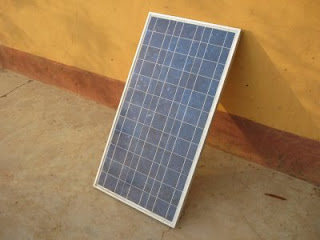
Saturday, April 24, 2010

Banking on Defeat

Let’s say that an enterprising Malian farmer named Amadou invested his best field, his strongest work ox, that ox’s richest fertilizer, 1,000 francs worth of seeds, 5,000 worth of pesticides and two months of his family’s labor towards the cultivation of cotton. Let’s say that this year Amadou’s cotton crop was quite successful and he was able to sell 100 kilograms of raw cotton to the local textile mill representative, netting him the sum total of 20,000 CFA. Amadou was smart and collected all of the cotton seeds, his tools are all in good shape, and his work ox looks healthy enough to work the cotton fields next year – he has no need to put any revenues back into the operation costs of his cotton business. His 20,000 CFA of revenues this year translates into pure profits. And let’s say that Amadou is really, really responsible and he wants to save all of his money so that he can have something to fall back in case of an emergency, and he hopes to one day buy a millet-grinding machine to give his family another source of income.

The unfortunate fact of the matter is that Amadou the farmer doesn’t have any good places to put his money. What looks like the safest option might be to stuff his cash in a tin can and to hide it behind the loose brick in his one-room mud hut. So Amadou hides his 20,000 francs behind the loose brick in his hut and resolves to not touch it unless he needs to pay for medical bills. But maybe a few weeks later, Amadou’s shady younger brother Mamadou sneaks inside Amadou’s hut, and since he knows the hiding space he pulls out the brick, opens the can and steals 5,000 to buy cigarettes and whiskey. And over the next few months a termite colony invades the mud bricks in Amadou’s hut, the termites find the cavity comprising his hiding spot, and happily munch away at the remainder of the paper bills. When Amadou has to send his wife to the clinic months later, he opens up his secret stash and all he has to show for his cotton harvest is a rusty can of termite poop.

What’s really tragic is that in countries like Mali, there really aren’t any better options for Amadou to manage his savings. At least if he puts his money in a tin can behind a brick in his hut, there’s only a chance that his savings will be stolen or destroyed. If he were to employ any of the other options available, that would be all but guaranteed.

If Amadou were interested in a more aggressive, growth-oriented investment strategy, he could do what most Malian men do and put his money on the horses. Yes, even though there are no race tracks in Mali, the inevitable has occurred and a group of exploitative parasites that calls itself PMU found a way to enable this largely illiterate, innumerate culture to bet on horse-racing in France. All they had to do was set up booths in every major city and hire local agents to distribute pamphlets and collect wagers in the villages, and most importantly to spread the word that people could win big money. I've been told by numerous investors in the horse market that "There is a man around here who won so much money from the horses that now he'll never have to work again!" - none of these investors know who this man is or where he lives, but they insist that he exists. So now every week when PMU distributes the next lineup of horses, the barely-numerate men of the village sit together and closely examine the odds as though they were stock quotes in The Wall Street Journal.

Since he bets on the horses every week, I asked an inveterate gambler named Alexandre – a poor subsistence farmer with 3 wives and 19 children – how much he’s actually won this year.

“This one time, my horse came in first place and I won 1,000 francs!”

“… Yes, but how much have you bet on all the other horses that didn’t win?”

“This year, I have put 8,400 francs on the horses.”

“…So you lost 7,400 francs.”

“But I won 1,000 francs!”

Given the performance of more reputable investment houses like Goldman Sachs as of late, one could argue that college-educated American investors are managing their money no more prudently than PMU’s illiterate, innumerate clients. The greatest difference between Goldman Sachs and PMU is that wagering with the more respectable American investment house carries much less risk, for if the value of Chrysler stock plummets then its shareholders only lose wealth if they sell their stock at that lower value and they can always wait it out until Chrysler stock rises again – but if Amadou puts his money on “Silver Bullet” and his horse comes in 7th place, then his money is unambiguously lost. Furthermore, there is hardly anyone in America who wagers on the stock market who doesn’t also have money sitting in the bank, accumulating interest at a slow and steady rate.

So why don’t Malians put their savings in a bank account? There are even banks in rural towns like Sanadougou – which has a two-room Kafo Jiginew office open on market every sixth day. Kafo Jiginew is a real bank in which men and women can open accounts, make deposits, take out withdrawals and even apply for small loans. But the money put in an account at Kafo Jiginew does not accumulate interest. In fact, this bank charges each holder of an account 5,000 francs (~ $10) every quarter. So if Amadou were to open up an account at Kafo Jiginew and deposit the 20,000 worth of profits from his cotton harvest, he better withdraw it all within a few months because by this time next year the bank will have deducted it all. That is why rural Malian villagers do not ever put their savings in a bank, and if they do have an account in a formal bank, it is simply for the purpose of taking out loans and repaying their debts.

Banking is only slightly better in the cities, where people can choose from opening an account at either Kafo Jiginew or la Banque de Developpement du Mali, la Banque Nationale de Developpement Agricole, EcoBank or Bank of Africa. Though urban banking is quite different, for people’s livelihoods tend to be based less on good production than on selling goods and services; with less people who need to buy new seeds and tools every planting season, urban banks rely less on lending to make a profitable business. Generally, the only people who have accounts at the urban banks are functionnaires who get paid via monthly, directly-deposited salaries; police officers, teachers, doctors, NGO personnel, those in management positions at textile mills, etc. And since there is more communications infrastructure in the cities, urban banks offer a wider range of services, most importantly in that they have access to computers and the Internet which allow clients to wire transfers to family-members in other cities and receive remittances from family-members abroad.

Urban banks are also more expensive; they charge 10,000 francs just to open an account, and another 1,500 francs just to keep the account open every month. Like Amadou’s money at Kafo Jiginew, the funds that I leave untouched in my BNDA account accrue no interest. Even in the supposedly more sophisticated cities, banking is a losing endeavor. In truth, these banks truly function less like banks in the Western sense of the term and more like those establishments where illegal immigrants go to cash checks and wire remittances via Western Union – they charge predatory fees for minimal services which a real bank would offer for free, and the only reason why people keep throwing money at these institutions is that they have nowhere else to go. Since they exercise a monopoly over the money market¸ these so-called banks do not even have to conduct the development-oriented lending which they were originally commissioned to do in order to remain profitable enterprises – they are making a killing by providing services that can be done just as efficiently by an ATM.

A fundamental departure from Kafo Jiginew is that some urban banks allow holders of a checking account to open up une caisse d’épargne; a savings account. At BDM, so long as an account-holder can put away 50,000 francs (~$100) into a separate savings account which they cannot touch for a year, they can earn 15 percent interest. So if Pascal the teacher can put away the exact minimum for a savings account, after a year he can accrue an extra 7,500 francs (~$15) and feel like a big winner. Compared to prevailing interest rates in American banks, this might sound too good to be true – because it is.

You see, no one can hold une caisse d’épargne for a year without also having a checking account, and though the savings account might have accrued 7,500 francs, over that same amount of time BDM will have charged Pascal 18,000 francs simply for keeping a checking account open. The effective benefit to Pascal of opening up a savings account is that instead of losing 18,000 CFA in convenience charges, he only loses 10,500 CFA. In fact, Pascal would have to be able to put 120,000 CFA (~$240) away in une caisse d’épargne for a whole year just in order to accrue enough interest so that his participation in the banking sector can break even. Therefore, in this country where per capita income hovers around 200,000 CFA (~$400), the mere act of holding a bank account can only serve as a profitable endeavor for the wealthy elite. And still, the despots of General Traoré’s kleptomaniac regime decided that it would be in their interest to tuck their pillaging away in Swiss banks…

As much as individual adults are responsible for their own fiscal solvency, it is hard to blame individuals for being bankrupt in this country where the banks are not facilitating sound money management. The banks in Mali as they now stand provide only disincentives for the rural peasantry, the urban poor and the middle class to save their money, and even if they can’t do math they understand that keep cashing around the house will make it liable to getting lost, destroyed or stolen – so they feel compelled to spend it as quickly as possible on fancy clothing and electronics they can’t afford, and before you know it they’re broke.

And as perverse as it is, the worse the people are at managing their money, the better it is for the bank’s short-term profits. In failing to offer better financial products, the banks are keeping the standard of this living in this country stuck in abject misery, because without savings people cannot pay for their children’s school fees and without savings they cannot pay their medical bills – unless of course they pay with borrowed money. And since the banks do not allow private individuals to collect interest in savings accounts, the only way for enterprising individuals to start or expand a business is by taking out loans and going into debt to – of course – those very same banks.

The fact that we in the developed West can so easily save our money, accumulate capital and invest it as we choose is what drives our relatively-thriving market economies. Conversely, the Malian banks’ collective failure to offer bona fide savings accounts to the middle class, the urban poor and the vast rural peasantry is more than just a burden on those individual consumers – it is one of the reasons why the economy of Mali is suffering from one of the weakest growth rates of any country in the world. Especially when you consider that Kafo Jiginew, la Banque Nationale de Developpement Agricole, la Banque de Developpement du Mali were established for the explicit purpose of offering financial services to stimulate the agricultural sector, the fact that these banks are actually discouraging small-scale farmers from saving is decidedly backwards.

Until Malian banks offer savings accounts that appreciate interest greater than the cost of merely keeping a bank account open, or until they eliminate outright their service fees which now make banking such a losing operation, individual Malians are never going to have any reason to save their money, capital will remain painfully scarce, and entrepreneurs will continue to be shut out from the investment they need to make this economy grow. Until they start offering modern financial products and reform the way they do business in a way that encourages private savings, the Malian banking system will continue to retard this country’s economic development.


Thursday, April 22, 2010

The Number Five

There are so many deficiencies in human capital which make it difficult for the Malian economy to function that one might be tempted to cast the blame on economic illiteracy. Very few people here understand that profits = revenues – costs because the Bambara language has not evolved different words for money to express those three distinct concepts. Quite often rural shops fail because the butigitigis purchase their wares in the cities and then resell those wares to their customers in village for the same exact prices – with every sale, they actually lose money. Most vendors don’t even bother to keep ledger books; they just eyeball how much money is flowing through their business in relative terms; “a little”, “a lot”, “enough”.

But economic illiteracy is only the tip of the iceberg; it has not been uncommon for merchants to hand me incorrect change – not because they are necessarily trying to cheat me, but because they simply cannot handle the math. Most owners of big shops in this country are able to invest 500 francs in a small calculator, and most are so uncomfortable doing subtraction in their heads that they whip out their machini every time they make a transaction – but that doesn’t mean that they know which buttons to push. The deficiencies in Malian human capital run even prior to arithmetic.

I myself never really understood how devastating ignorance can be on the local economy until I sat down one day in market to talking with a Malian vegetable-seller named Ma about the prices of the goods she sells at market. As we were discussing all of these numbers Ma stopped her own thought in mid-sentence, smiled radiantly and hunched over to trace her index finger into the dirt:


“One, two, three, four, five, six!”

And that is how I was introduced to the concept of “innumeracy”: the inability to read or write numbers. Innumeracy is a phenomenon causally related and integrally tied to illiteracy, of course, but it comes across to the numerate observer as incredibly more astonishing. In a society completely bereft of novels and plays or anything application of the written word more complicated than the labels on tea boxes, being unable to read does not seem to be all that much of a handicap. But numbers are an intrinsic part of material existence prior to their utterance by humans, and for an adult member of society to be unable to recognize or portray the visual representations of these numbers in any system at all means that they cannot possibly comprehend a base-ten system, that they can at best comprehend mathematical concepts as complex as the amount of digits they have on their two hands.

The sorry fact of the matter is that the Malian monetary economy is predicated on society’s inability to recognize and identify the numbers printed on their own currency. Back in the days of colonialism and the first two and half decades after independence, Malians conducted business with the sou – the smallest denomination of which was a 1 sou piece. But in 1984 the Republic of Mali joined the Economic Community of West African States and adopted the CFA as their new currency, and since this new currency had already depreciated in value from rampant inflation the smallest denomination in circulation at the time was a 5 CFA piece. Those who could actually read those numbers and speak a little French referred to the money with the proper French terms for each denomination: “cinq francs”, “dix francs”, “vingt-cinq francs”, “cinqant francs”, etc.

But very few Malians could make sense of the squiggles representing those concepts on their coins and bills, and even fewer could speak French. Though the different denominations of this new currency were easily distinguishable by size and color, the vast majority of the Malian population could make no sense of the “5”, “10”, “25”, “50”, “100”, “250” and “500” engraved on their coins, and they especially couldn’t decipher the “1,000”, “2,000”, “5,000” and “10,000” printed on their bills – that is, if an innumerate person could ever get their hands on a paper bill to begin with. So they referred to their new ECOWAS currency with the same names as the sou; since the 5 CFA coin was the smallest denomination like the 1 sou piece, innumerate Malians referred to it as the Bambara word for “one”, the 10 CFA coin as “two”, the 25 CFA as “five”, the 50 CFA as “ten”, etc. There were a lot of people who could in fact read those numbers, but if they read them correctly they couldn’t do business with the innumerate.

Moreover, this is a culture that regularly bows to the lowest common denominator - no matter how absurd. The older generations who came of age during colonialism were disproportionately more likely to be unschooled and innumerate, and Malian society is largely structured upon youth’s deference to elders; in this country, if Grandpa has no teeth, then no one can eat solid foods for dinner so as to not hurt his feelings. So just as the House of Habsburg purposefully mispronounced every “s” as a “th” to humor the grotesquely underbitten, dreadfully lisping King Carlos II, the entire population of Mali established the practice of misidentifying their currency to accommodate those who do not recognize that the numeral 5 stands for the number five.

As though Malian shop-owners don’t already have enough problems staying in the black without any accounting or arithmetic, there is a unique problem which besets those who are in fact numerate; the spoken terms used to identify prices are five times smaller than when those prices are written down – thereby making every transaction at least five times more confusing than necessary. If a shop-owner does know math and he knows that a customer’s order is 9,750 francs, he has to ask his customer for “one thousand, six five hundreds and sixty” no matter how nonsensical that is.

Even I have a really hard time converting between numeric prices and Malian illiterate prices, accepting the cognitive dissonance between seeing one value of numbers on budgets and currency but referring to it as something else. Let’s say I’m haggling over cement prices and the market price for 83 sacks at 7,100 francs a sack and the vendor’s starting price should be 589,300 francs, but I don’t have any scratch paper on me so I have to figure out in my head, what’s 589,300 divided by 5?... well, 100,000… then… what’s 89,000 divided by 5?... um… 16,000… plus 1,800… then 60… so 100,000 plus 16,000 plus 1,800 plus 606 equals… 117,860…

“The price for this should be '117,860', but since I’m buying so much cement here how ‘bout you cut me a break and cut it down to '100,000'?”

“ '100,000' is too low. '107,225'.”

'107,225' ... what’s that in real numbers?... multiply by 5… 500,00… plus 35,000…”

And even I have to give up and take out the calculator application on my phone and translate every numeric price into an illiterate price, and even though I and the cement seller can actually do relatively advanced math the negotiations take so long that we get confused as to what the other is trying to say and we completely lose track of each other’s offers because the only common language we share requires that we manhandle our numbers out of deference to all of those who don’t know what to make of the numeral 5. This is why – as much as I hate speaking to people in French in this country – Bambara and all of Mali’s other tribal tongues are wholly inadequate and the language of the former colonial power is in fact necessary for dealing in transactions more complicated than a few thousands francs.

If you can imagine how difficult handling money in this country is for people like me who can in fact do math, now try to imagine how much harder it is for the masses who need to use their fingers to count to ten…

It is pretty hard to find statistics quantifying the population of the innumerate – maybe that makes a lot of sense, actually – but if slightly more than 70 percent of all Malians are absolutely illiterate, and identifying individual numbers is significantly easier than sounding out combinations of letters into words, then the innumerate population must number at least a few million persons out of a total population of 13 million. But seriously, when is the average millet farmer eking out a hand-to-mouth existence going to interact with any amount of currency so complex that it cannot be adequately expressed with the illiterate numeral system? The fact of the matter is that most people living in countries like Mali are still living in a pre-modern subsistence level agricultural economy in which they farm the coarse grains that they eat, they eat the coarse grains that they farm, and there usually isn’t enough to feed the whole family to begin with. Unlike cash crop farmers, it is fairly rare that subsistence farmers can produce any sort of surplus that can be traded for currency, the whole question of money is a relatively minor aspect of their overall business plan.

And so long as they are illiterate and innumerate, Malians are extremely vulnerable to exploitation by the better-educated urban elite. There probably isn’t very much exploitation present when two rural peasants trade between themselves, like when Amadou the farmer goes to his village market and sells handfuls of tomatoes or onions to his neighbors. Though exploitation is certainly present if Amadou farms cotton on a third of his fields and sells it all to the representative from the nearest big city textile mill. Mills like CMDT and Comatex enjoy perfect monopsony over their respective local cotton markets, so they can still collect supplies of raw cotton year after year by paying the farmers only 200 CFA for a kilogram of cotton. A typical small-scale farmer will sell about 100 kilos after an extremely successful harvest – so for that year, they will take home a monetary revenue of 20,000 CFA (roughly $40). To an innumerate farmer who does all of his counting on his fingers, all of those zeros equate to a completely incomprehensible sum of currency – he will consider himself such a wealthy waritigi that he will spend without abandon.

But in reality, the innumerate farmer is getting royally screwed. The only reason why the textile mills can pay below market value for their raw materials is that no one else in town is buying – the peasants can either take the below-market value offer from CMDT or get nothing. Maybe the executive leadership of the textile companies knows about this disparity, but Amadou the farmer has no means of tracking global commodity prices, he doesn’t even know that he is being exploited. He understands so little about the value of money that he thinks that he is coming out on top, so the next year he is going to whittle down his acreage designated for cereal crops so he can grow even more cotton.

What exactly is Amadou the farmer going to do with the 40,000 francs he earned from selling cotton this year? Perhaps he will invest it in a new plough, another donkey, some better hoes and shovels. Perhaps he will hide it under the loose brick behind his bed in case of emergencies. But most likely, he is going to blow it all on tea, sugar, cigarettes, warm Coca Cola, millet beer and prostitutes. If he hasn’t already, there’s a good chance that he will spend 20,000 francs on a cell phone which he will use can play Tetris and the snake game – he will have to pay more for credit if he wants to actually make any calls. Amadou will spend hardly anything on better food, clothing or medicine for his family; taking care of the children’s day-to-day needs is generally considered the complete responsibility of the women of the family. There’s a good argument that such profligate spending could be reformed if women had more say over family decision-making or if men knew enough about science that they appropriately valued modern medicine– but there’s an even better argument that money would be spent more wisely in this country if people actually understood its value.

And while Amadou the farmer has blown all of his cotton money on toys and candy, the cotton he planted last year has mined all of the nutrients from the soil and put nothing back in, so the third of his fields used for cotton production have become too barren for food production in the long run. Amadou might have money, and he might have even more of it if he expands his cotton acreage the next planting season, but if this trend continues he will eventually be forced to purchase his food – and the 200 francs earned for each kilo of cotton will by no means suffice to compensate for the lost food production. So even though Amadou made what looked like a lot of money this year, the nutrition and health of his family will suffer from the paltry stores in his granary. If Amadou was duped into planting too much cash crops in proportion to food crops he will have to sell off some of his cows or donkeys, maybe even take out a loan at an usurious rate of interest in order to feed his family until the next harvest.

Maybe the typical Malian farmer could avoid such hardships if they could buy better fertilizers, high yield seeds and machine tools. Maybe they could be better off if they actually knew how to manage their finances. But neither can become a reality so long as the typical Malian farmer does not comprehend that the numeral 5 stands for the number five.


Saturday, April 10, 2010

Frambara

I believe that it is impossible for any reality to exist so miraculous that it can authoritatively prove the existence of God. However, the fact that the United States government assigned me to live and work in Mali because of my background in French is so absurd, in fact, that it ipse facto proves that if there is a God, He must have a sadistic sense of humor.

You see, the general rule among Peace Corps Assignment Officers is that if an applicant has any knowledge of the French language, they get sent to Africa, anyone who can speak Spanish goes to Latin America, and that one linguistics major who wrote her thesis on Kyrgyz poetry gets sent to Kyrgyzstan. This rule generally makes a lot of sense, for it efficiently utilizes Volunteers pre-existing skills and places them in communities where they can most readily integrate. And when PC Washington was going through my application way back when, they were apparently very impressed by the fact that I took 6 years of French back in junior high and high school – so much, in fact, that they decided that I should be assigned to a country in Francophone Africa.

The fact that I do know French has been more of a liability than an asset here in Mali. When people like me arrive with a solid background in French in this officially Francophone country, we wrongly assume that we can communicate with the locals and that they will understand what we are saying. I am one of those pretentious assholes who spends his free time reading Camus and Baudrillard in the original, so when I first came here and bank tellers told me that they too spoke French and I reflexively told them what to do with my money in the conditional pluperfect subjunctive tense, time and time again I would become enervated when they mangled my instructions. Presuming that people here actually speak French only leads to situations in which the Francophones get frustrated, the locals feel lorded over, and everyone loses.

Even in Africa where each and every tribe has developed their own language which they have been speaking for thousands of years, there are some African countries which have wholeheartedly embraced the language of their former colonial masters. In Ghana where there are 47 traditional tongues, the government is promoting English as the single national language in order to mitigate tribal identification and shore up national identity. Some former French colonies like Senegal and Benin have also forged such a post-tribal national culture that parents raise their children to converse exclusively in the official, formerly colonial language. And such profound cultural shifts don’t just happen with a presidential proclamation; the reason why English is the common vernacular in Ghana and French is so prevalent in Senegal and Benin is that the governments of these countries have spent the past half century investing in the education of their citizens, particularly in literacy and language instruction.

Senegal and Benin are exceptions in that they truly are Francophone countries. In the bulk of the former French colonies like Guinea, Côte d’Ivoire and Mali, there is an elite class of government officials, soldiers, gendarmes and teachers who use French for the workplace. And there is an even smaller minority of persons who do not work in government but can command the French language because they were born to such immense wealth to have attended private lycées. Though after decades of gross government neglect of the public welfare, the vast majority of adults have never received even a cursory elementary education, more than 70 percent of the population is absolutely illiterate, and they definitely do not speak more than a few token words outside of their local tribal tongue.

… But if asked, they will tell you that they do in fact speak Tubabukan ¬– the “language of the white people”. Of course, there is no such thing – the Tubabukan spoken here is a patois hybrid of French and Bambara we call “Frambara”; the nonsense that Malians who have never interacted with foreigners mislead each other into thinking is truly the “language of the white people”; usually, it is only Bambara laced with a few French nouns, maybe "est-ce que", "le voila", or - my favorite - "peut-etty". And likewise, most Malians are taught that if you see a Tubab, the proper thing to do is to address them in “their own language”:

“Bozu le Blanc!”

Here, the colloquial “Ça va?” – “how goes it?” – has transformed into functional equivalent of “Bozu”. People will shout “Sava! Sava!” and they think that they are greeting me. It is also common for Malians to greet Tubabs “Sava! Sava sava byen!” – which must have originated in the dialogue of an introductory French textbook “Ça va?”/ “Ça va bien!” and has now regressed into a greeting uttered by one single person. Thus it is thought that "Bozu sava sava biyen" is how we white people say hello.

The most entertaining phenomenon is how Frambara has taken certain phrases and so warped their meaning that they induce cringes in anyone with a rudimentary understanding of their etymological origins. For example, in Mali it is perfectly customary for people to come up to me at 8:00 in the morning and greet “Bo swa, Monsieur!”

Soir means ‘evening’. You cannot greet anyone ‘Bon soir!’ until the sun is setting.”

“No, when you see a white person you are supposed to greet them ‘Bo swa’.”

“That… doesn’t make any sense.”

“That’s what we do in our country.”

“… As I said…”

Other times I am greeted “Bo swa, Madame!” When this happens I like to think that these kids must have learned this phrase in the context of a female teacher, which must mean that at one point in their short lives they have in fact sat in a classroom. But there are other Tubabukan bastardizations that suggest more nefarious settings.

Children in the cities greet me with a bastardization of French with a mission: “Bozu cadeau? Sava sava cadeau?” When I am confronted with such obscenity, it is apparent that some asshole taught this kid that if they see a white person, all they have to do is say these magic words and the white person will smile and give them a lollipop. But when you’ve been living here for an extended amount of time and have been petitioned for a cadeau every single day by kids and adults alike who think of white people as arcade machines which will give you a toy if only you toggle the joystick and push their buttons the right way, these childlike Frambara-isms quickly become downright dehumanizing.

The absolute worst bastardization of French is when I’m in the city and I’m approached by one of the barefoot, tomato can-toting beggar children and they blurt out, “Tubabu! Do mwa cinq mille francs!” Initially, such an utterance impresses me in that it is in fact a complete sentence – a lot more than can be said of 95 percent of the "French" spoken here. However, in every such situation it is fairly obvious that if I were to reply “Préferez-vous un billet de cinq mille francs ou cinq billets d’une mille francs?” or even “Tu t’appelles comment?” the kid would have no idea what I’m saying. These kids are never going to be taught proper French greetings, introductions, how to ask for directions or the weather. “Do mwa cinq mille francs!” constitutes the entirety of that garabout’s French, because their “Quranic teacher” only instructs their cash cows in that one saying to finance their sedentary lifestyles. Accordingly, the marabouts instill the despicable misunderstanding that the language of Senghor, Césaire and Fanon is the language of humble supplication to white people.

The logic of a Malian greeting white people in Tubabukan is inherently racist – not necessarily a vicious ideology of racial supremacy, but at least the belief that all persons of a similar skin tone are indifferentiable. Of course, if a given Malian is walking down the street and they see person with pale skin, to the Malian it makes sense to greet this stranger in Tubabukan when 70 percent of all of the melanin-deficient they will ever interact with are in fact French, Belgian, Quebeçois or Luxembourgian. But there are also a lot of Americans, Germans, Spaniards and Italians who come here speaking no French at all, and according to Malian logic they too are greeted “Bozu! Sava sava byen!” because Tubabukan is “the language of the white people” – all of them. The term Tubabu refers to Aryans, Slavs, Arabs, Persians, Latinos, and all non-African persons alike. Even when Japanese or Korean tourists trek through Dogon Country with their brand new video cameras, they too are greeted by the locals “Bozu! Sava bonbon!” When Malians address each and every white person with what they think is “our own language”, it only demonstrates how profoundly unaware they are of the outside world and the crudeness of their racialism.

Even when the adult population addresses made in grammatically correct, polite French along the lines of “Excusez-moi, monsieur, est-ce que tu es perdu?” or “Je vends du pain du qualité superieur!” it strikes me as patronizing and just as innocently racist. When people speak to me in French, it means they assume that I am a lazy NGO worker or gold miner who is only here to interact with government ministers and rarely leaves the hermetically-sealed, self-contained expatriate biodome – or even worse: a tourist.

So when anyone in this country ever speaks to me in French, I instinctively reply in Bambara – and after a few lines of dialogue in which the Bambara is speaking broken Tubabukan and the Tubabu is speaking fluent Bamanankan the former eventually realizes the folly of their efforts and switches gears into their own language. Now that I’m starting to pick up Miniankakan – the really, really local language which only has any use in the tiny homeland of the Minianka subgroup of the Bambara tribe, around my home base I can show off how dedicated I am to integration with an even greater effect. The response is universally effusive, for these people have spent their entire lives thinking that they have to learn the language of their former colonial masters if they ever want to do business with the West – with much detriment to their collective self-esteem. Thus when an Occidental comes to live amongst an isolated culture and takes the time to learn to speak to them in their own obscure tongues, the symbolism is lost on no one.

When people ask me why I do not speak to them in French like all the other Tubabs do, I point out the ideological chasm between my country and the Old World powers:

Americainw Mali la kono be Mali kanw kalan tiyenna barisa folofolo Angleterre tun be an mara i na fo jonw ye, ni an ye keleke fo an ye an yere ka jamana mine. I be se ka fo ka an te fe ka jamanw were mara.

“Americans in Mali take the time to learn Malian tongues largely because of our own history of exploitation by the British and our War for Independence… You could say that our own experience has left a particular distaste for colonialism.”


Sunday, March 28, 2010

Trench Peacefare

This one trick pony has expanded his repertoire. As loyal readers should know, the people of Mali suffer from completely unnecessarily high rates of giardia, dysentery and explosive diarrhea because the raw sewage from their “traditional latrines” flows out into the streets and the entire population is exposed to the dangerous pathogens which cause these illnesses and continue the positive feedback loop by making their way into other people’s mouths. Sewage is both a danger to public health and also a necessary byproduct of human life itself, and so this blog’s eponymous hero is busy spending the prime years of his youth and your tax dollars building modern latrines equipped with concrete floors and soak pits: a rudimentary septic tank technology appropriate for cultures in this harsh Sahelian climate with few financial resources and building materials.


In the flat center of Sanadougou where I live, the water table lies almost perfectly uniformly between 7.5 meters below ground level at the peak of hot season and 4 meters below ground level after the groundwater has been recharged by 4 months of rainy season. In the center of Sanadougou where about 3,800 of the 4,400 permanent residents live, development-minded villagers have been digging soak pits 1 meter deep and varying in diameter (usually about 1 to 1.5 meters) depending on the number of people in their households and the volume of wastewater generated by their respective nyegens. Since the pathogens originating in wastewater can usually seep up to half a meter through hard-packed soil and sedimentary rock, the water table should never come closer than 2.5 meters to the sewage generated by these modern latrines and thus the groundwater consumed through wells and pumps should be adequately protected from direct contamination by human fecal matter.

However, even within the demarcated borders of Sanadougou there are some places where the soak pit is an inappropriate technology. Namely, there is an outlying neighborhood called Filablena which is significantly lower in elevation than the rest of the town and sits around a couple of large seasonal ponds. Here the water table varies between 5 meters below ground level at the peak of rainy season and 1.5 meters below ground level after rainy season.


The wells here are so shallow, and with less rock they are cut into nothing but soft soil which is much more permeable and conducive to groundwater flows. The pressure in a well is somewhat less than within the soil, so the water levels of wells are slightly higher than the water table; in Filablena during rainy season, the well water surface is only slightly less than a meter below ground level.


If we built 1 meter deep soak pits here like we have in the rest of Sanadougou, soak pits would in fact exacerbate the water sanitation problem by directly polluting the groundwater with raw sewage. That contaminated groundwater would then eventually make its way to people’s wells from which they get the bulk of their drinking water. The absolute worst-case scenario would be that contaminated water makes its way into the seasonal ponds and – though it probably wouldn’t be as obvious as the ones which form behind "traditional latrines" – render them into gigantic seasonal cesspools.

In Filablena we are just beginning to introduce a specialized technology: the infiltration trench. An infiltration trench serves the same function as a soak pit in that it contains the wastewater emitted from “traditional latrines” underground so that it cannot serve as a fertile breeding environment for filth flies and mosquitoes and cockroaches and a vector for all sorts of disease. It has to be able to store roughly the same volume of wastewater as a soak pit, but in an environment where the water table is prohibitively high an infiltration trench must be dug at a much smaller depth. In truth, the volume of a soak pit is only really important so long as it briefly stores wastewater before in seeps into the surrounding soil and rock; what is much more important is the surface area which determines the rate of discharge into the ground where it is safe and isolated from human water and food supplies. Where there has not been a lot of room to maneuver, we have solved this problem by simply reducing the depth of our soak pits and increasing the diameter accordingly.

Infiltration trenches take that ideal of minimal depth and maximum surface area even further. First I found a group of Filablenakaw interested in rebuilding their nyegens, measured their dimensions and assigned them lengths of plastic piping between 4 and 6 meters in length. Then we took an afternoon and pierced holes in them; we took a dozen large nails and placed their ends in the fire until they became red hot, and with protective work gloves we held pliers to hold the hot nails and melted lines of holes down the length of the pipes. With these hole-ridden pipes, wastewater should flow out over a more evenly distributed area and facilitate more rapid and less concentrated wastewater seepage into the soil.


Instead of small circular pits, Filablenakaw have been digging 4- to 6-meter long trenches which begin about 20 centimeters and eventually expand to a maximum depth of no more than 50 centimeters. We fill them in with rocks in such a way that the plastic pipe is on a gradual incline downwards and wastewater flows all the way down. Then we fill them with more rocks to keep the pipe stable, and cover the end of the pipe with a large flat rock to protect it from closing up.


Eventually we’re going to cover the trenches all up with plastic sheeting and cover them with the dirt that was dug up in the first place so that the sewage is contained underground, people and animals can walk over them without falling in, and every year or so homeowners can open up their infiltration trenches to inspect them and clean them as necessary.

However, there are some negative aspects of this process which make the construction of an infiltration trench an unattractive option. The biggest down point of this technology is that burning holes in the plastic pipes produces noxious fumes and is fairly harmful to anyone who isn’t wearing a respirator – I covered my face with soaking wet handkerchiefs while doing this work, and even then I came down with really bad headaches. Infiltration trenches also require more than 6 times as much plastic piping and sheeting than your average soak pit – but the plastic materials are so cheap compared to the cement that goes into the nyegens that the cost of an infiltration trench cannot be prohibitively expensive to anyone who is building or revamping an entire nyegen. Nevertheless, in communities sitting atop extremely high water tables, infiltration trenches are the most practical, cost-effective technology available for sound wastewater management. It is unlikely that we will be able to completely sanitize Filablena's latrines with such infiltration trenches, but my hope is that the few models which we are building will serve as an example for the entire community to one day safely contain their waste underground and away from the rest of the water supply - insh'allah.


Monday, March 15, 2010

This is Why UNICEF and NGOs Should Stop Giving People Free Mosquito Nets


Madu Bigmeat: What are you doing?

Gajuma: I am cutting up a mosquito net.

M: I can see that. But why?

G: I am making rope.

M: You can make rope out of old rice bags, you can make rope out of cotton or grass or even old rope. Why - of all things - are you making rope out of a precious mosquito net?

G: This mosquito net was free.

M: Do you have another mosquito net?

G: No.

M: Are you going to buy another mosquito net?

G: Of course not! The doctor gives them to pregnant women for free!

M: Is your wife pregnant?

G: Of course not! She is 70 years old! She is too old to have another child.

M: Then you're never going to get another free mosquito net! Why on Earth are you destoying this one?!?!?!

G: It doesn't matter - my sons have wives. And soon they will have more children. And the doctor will give them another mosquito net.

M: Yeah, that new mosquito net - if they ever get it - would be for the mother and her infant child to protect themselves from malaria. No doctor is ever going to give you a new mosquito net!

G: Yes, but when my sons' daughters get new mosquito nets, they will give them to me because I am an old man.

M: And are you going to sleep under them?

G: No, I will use them to make more rope.


Floccing Shit


Madu Bigmeat: So things are going fairly well with my newest round of latrines and soak pits… But I dunno, James Brown II… should I be focusing the whole time on wastewater management? Should I return to teaching people how to treat their well water?

James Brown IV: Sorry man, I think you’ve got us cats confused!!! I’m the fourth James Brown you’ve had hanging round this gwa!

Madu: James Brown IV?!?!?! Damn, son. I’ve been going through you cats so fast that I’ve lost track.

James Brown IV: Whatchoo talkin’ bout, Madu?

Snoop Dogg: I think you should break him the bad news, being his master and all.

Madu: You see, James Brown IV, due to the low content of vitamins and minerals in a diet of millet goop and peanut oil, the townsfolk of Sanadougou are suffering from acute malnutrition – especially the children. One of the most important things which Malians are lacking from their diet in sufficient quantities is protein. And so, James Brown IV, it is quite common for my malnourished neighbors to hunt other people’s cats when they wander around at night– hence the suffix after your last name.

James Brown IV: But… but… why?!?! Why would anyone want to eat a cute little kitten like me? There’s hardly any meat on these bones!!!

Madu: You’re right, but the fact that there is meat on those bones – and not enough of it on the bones of all the children here in Mali. That’s why you’re inevitably going to get eaten.

James Brown IV:
Inevitably?!?!?!

Mdu: Yeah, the fact of the matter is that all animals raised in this society – whether they be cows, goats, chickens, dogs or cats – are eventually destined for the food bowl. It’s been hard, but I’ve come to terms with this. And I’ve come to accept that both of you will also one day be eaten by my malnourished neighbors… though in the meantime, I’m going to give you all the tender love and care that I can.

Snoop: That’s the truth, fo’ sure!

James Brown IV: If only it didn’t have to be like this!!! If only!!!

BrzzzzzzzzZZZZZZZZZZZZZZZZZAAAAAAAAAAPPPPPPPP!!!!!!!!!!!


Al Gore: There is in fact logic to that assertion, for it in indeed possible to address the root cause of this pet-eating behavior amongst the local populace.

Madu: Al Gore!!!! What in tarnation are you doing here?!?!?! There is no way that your academic brainpower can solve this problem.

Al: Your claim is lacking in foundation, for there exist sound methods of improving the nutritional content of the typical Malian diet and therefore obviating the demand for feline and canine proteins.

Madu: Shove it up your converter box, Al. There simply isn’t enough water to grow any food here in substantial quantities beyond millet and peanuts. And if anyone gets their hands on any money, they’re going to blow it on tea and sugar and toys. Unless you’ve got a solution that requires no water and no money, then it’s not going to fly.

Al: There are in fact a multitude of species of plants edible to humans and possessing a plethora of nutritious elements which can be grown in environments with little to no water. For example, one such species, among the most promising of crops to be disseminated for the objective of improving nutrition in the developing world, is the Moringa oleifera – a tree native to the foothills of the Indian Himalayas commonly known as the “moringa”.


For millennia Indians have eaten the pods of the Moringa – which they call “saragwa” and is consumed fried and in sanbars and curries. In addition, the moringa leaves can be cooked like spinach and are even more nutritious, containing significant amounts of Vitamin A, Vitamin C, protein, calcium, iron, phosphorus and potassium. If each Malian child were to drink a serving of moringa leaves crushed into powder and stirred with water into a beverage – perhaps with a little sugar or lemon for taste – it would be the nutritional equivalent to eating an orange, a carrot, a banana and drinking a glass of milk.

James Brown IV: So you’re saying that if these kids eat these leaves, they’ll have their protein and won’t want to eat my cute little self?

Al: Well, there is no certainty that Moringa oleifera alone can serve as a causal factor in such a momentous behavioral change; however, if this species could be cultivated to such an extent that the present nutritional deficiencies in Malian culture were abated then it is reasonable to surmise that the demand for feline protein would reduce significantly.

Snoop: And dogs?

Al: Yes, improved nutrition would probably reduce the demand for canine protein as well.

Snoop: Y’know, I think this solar panel pinhead over here’s got some sense in him. Everyone here eats their toh with baobab leaves in the sauce – adding moringa leaves wouldn’t be such a big change in their habits!

Madu:
Okay, so this tree’s nutritious – I get it. But why should people farm these trees to eat the little leaves and pods when they could grow oranges and bananas and carrots instead?

Al: Unlike all of the crops which you just mentioned, moringa is a relatively easy and cheap crop to cultivate. After sugarcane, oranges, bananas and carrots are amongst the most water-intensive crops that are grown in this country – and in addition to intensive irrigation during the dry months and even during rainy season, they require much intensive fertilization and maintenance. Oranges and especially bananas do not start bear fruit until many years have passed since planting.


Alternatively, moringa requires little to no irrigation to be a productive crop. Of course, irrigation is linked to extremely high rates of growth and the bearing of pods and leaves, but Moringa will sprout pods and leaves even with no precipitation or irrigation. If it receives no moisture at all for extremely lengthy periods of time it will shed its leaves and go dormant, feigning the appearance of death, but in fact it will remain alive to blossom upon the receipt of the next rainfall.

Madu: Is that it?

Al: No, Moringa oleifera also serves additional benefits to most that lie adjacent to it – with the notable exception of corn. Moringa is a nitrogen-fixing legume – which means that it fosters cultures of bacteria on and around its roots which take nitrogen and convert it into ammonia, enriching the nutritional content of the soil and thereby improving the yields of adjacent and/or subsequent garden crops.

Madu: Alright, fine. Now that’s it with the benefits of moringa – right?

Al: Your assumption is erroneous, for Moringa oleifera can also serve to assist in the treatment of water for drinking purposes and even in wastewater treatment, because the seeds of the plant contain a cation which is polarized and can therefore assist in flocculation.

Snoop: Fuck you too, man.

Al: You see, if particles of polluting matter are suspended in a solution, it is often because they are of the same usually negative charge and hence do not aggregate together – or rather, they do not “floc”. But certain polarized substances can catalyze these colloids to floc into the noun form – a floc – and accumulate sufficient weight to sink down to the bottom.


Moringa seeds contain so many of these aforementioned cations that if they are crushed into a fine powder with a mortar and pestle, they can serve as practical flocculants for use even in a non-monetary economy or those where commercial flocculants such as aluminum chloride or polyaluminum sulfate are otherwise unavailable on the market.


Madu:
So what you’re saying is, if there’s little bitty poo particles in someone’s well, if you add moringa seeds then they’re going to form big pieces of poo and settle on the bottom of the well? How is moving the poo from the top of the well to the bottom of the well going to make it more sanitary?

Al:
Even if the entire body of water is not potable, since the vast majority off well water is taken from the top of the well, or if someone fills a cup from the top of the water jug it is almost certainly from the top of the water jug, the process of flocculation per se will reduce the total quantity of fecal particles consumed by that individual.

Madu: So I should just quit it with the chlorine treatment and just start filling my water filter with moringa seed powder?

Al: If you possess the means, it would be advisable to do both, for flocculation in fact expedites chlorination and renders it more effective overall. Sodium hypochlorite – bleach – purifies water only by killing and removing pathogens such as bacteria and amoebas; however, it is limited by the overall mass of pollutants suspended in the body of water at hand. If each particle of sodium hypochlorite can kill and remove exactly one unicellular pathogen, and if the number of bleach particles is greater than or equal to them number of pathogens, then chlorination is an adequate method of water purification. However, if the number of pathogens exceeds that of bleach particles, then the population of pathogens can be lessened but not annihilated and can even grow resistant over time. Flocculation increases the efficacy of chlorination by floccing the pathogens together into a lesser number of larger, heavier particles.


Madu: So this moringa tree thing, all I have to do is plant the seed, maybe I should water it a little if I’d like but I don’t really have to, and the tree that grows out of it improves nutrition, it improves the yields of all of the other plants in its garden, and it can even make drinking water treatment more effective. Is there anything that this tree cannot do?

Al: To my knowledge, it remains unable to encourage Malians to wash their hands before eating and sharing their fecal matter through the common food bowl.


Friday, February 26, 2010

Solar Pump Repair and Maintenance Project


In 1998 the World Vision NGO financed the installation of a solar pump system in the town of Sanadougou. The aim of this project was very straightforward; in this growing market town of more than 4,000 people where the bulk of the population regularly suffers from giardia, dysentery and worms inadvertently contracted by drinking from unsanitary wells, public health could be drastically improved with access to potable drinking water. World Vision hired Bamako contractors to build a groundwater pump, and two water storage towers to be powered by an array of solar panels. The contractors built a pump-serviced livestock-watering trough in the adjacent vicinity of the complex as well as 7 tap posts strategically-located throughout the town; altogether, there are 17 taps – 3 of the posts have room for 3 individual taps while the 4 other posts have only 2 taps. As promising as this system might have been at the onset, the entire system is now essentially useless due to lack of maintenance and necessary repairs. In response to these pressing needs, the Sanadougou Water Committee has petitioned their Peace Corps Volunteer to help them institute a plan to repair and reorganize the entire system.

The solar panels, the pump and storage towers are perfectly fine, but the entire system as a whole is seriously malfunctioning due to breakages at the livestock watering trough and in a way-station in the metal pipe connecting the water pump to the taps in the Filablena neighborhood. These parts cannot be shut off and flow at the maximum rate at all times.


The ever-flowing watering trough and broken way-station overload the capacity of the entire system, directly exhausting the supply of potable drinking water and often leaving the taps dry. Even when there is water left for human consumption the water pressure is significantly diminished, which allows for rust to develop and diminish water quality. Furthermore, the perpetually-flowing components create vast puddles of standing water which serve as a fertile environment for mosquito breeding. Note that the picture above was taken during dry season on a day when most of the overflow had evaporated in the 105-degrees Fahrenheit heat – during cold and wet season, the puddle of overflow from the livestock-watering trough expands almost all the way to the leafless tree in the center-left of the photograph.

The Water Committee has analyzed these broken parts and they have given them to local plumbers to try to weld them back together, but the plumbers have returned to say that these parts are beyond repair; Peace Corps Assistant Water and Sanitation APCD Adama Bagayoko has analyzed these parts as well and independently concluded that the only course of action is to purchase entirely new components. I apologize that I am unable to find the English translations, but specifically, the parts we need are (in French): une ventousse, un compteur, une vanne, un raccord union, une coude MF, un reducteur, une vanne p26, le clapet vapere. We plan on buying these broken parts from the Bamako suppliers SETRA, and we will hire the local welder Smeila Fané to reassemble the malfunctioning parts and weld them onto the rest of the solar pump system. To our understanding, there is no evidence of malfeasance or negligence for the broken parts – this is merely repair which should be expected in such a large system after 12 years of running and is now long overdue.

However, even if we were to replace the broken components at the livestock-watering trough and the way-station, this solar pump system would still be operating well below capacity and with little benefit for public health; only 3 out of 17 taps are currently operational. The problem with the taps is that they are simply too easy to break; children are used to pumping water with the vertical pump handles with such strenuous work that they have to jump up and down to obtain water, and though the horizontal handles to the tap system can be opened with the flick of a wrist, this is a point which apparently has not been conveyed as children have broken all of the tap handles.


Though the direct cause of this problem was of course the children themselves, this result was inevitable when World Vision built this system with the flimsiest, most fragile handles available. And since these little pieces of metal are now gone, the entire solar pump system is now effectively useless, completely wasting the charitable donations of well-minded humanitarians to the tune of about a million dollars. Well, to be fair, it wasn't a total waste - now for a million dollars the cows of Sanadougou could drink better-quality water than their human masters.


Since the townsfolk of Sanadougou cannot access the potable drinking water provided by the solar water pump, they resort to unsanitary, uncovered wells for their supply of drinking water. These traditional wells – which are really little more than holes in the ground – are home to vibrant populations of worms, snails, amoebas, giardia cysts, and in some cases even frogs and fish. In some locations – particularly during rainy season – these unimproved wells are directly polluted with wastewater and contaminated with human fecal matter. The fact that the people must fall back on such substandard water sources is the prime reason why giardia and dysentery are endemic in this community, and why diarrhea is after malaria the most common preventable cause of infant and child mortality.

Of the 3 taps that are functional, they are functional only because certain individuals have put in their own money to buy their own private taps with locks; one being the tap shared by the Peace Corps Volunteer, the doctor and kindergarten teachers, and the other two are adjacent to mechanic shops where they are used to clean motorcycles with potable drinking water. What differentiates the sites of these taps and the other are the functioning ones are used exclusively by a small number of relatively wealthy people who are both willing to spend money on clean water and also confident that their resources will be used almost exclusively by themselves with few (if any) free-riders. Asides from the tap managed by the Volunteer, the two other functioning taps provide little public health benefits to the population as this potable drinking water is used almost exclusively for cleaning motorcycles. As regrettable as this situation might be, it aptly demonstrates the universality of a saying from the American West, that “water flows uphill towards money”; as the rest of the community pays nothing, they are unable to obtain potable drinking water even from the tap system installed next to their homes at great cost.

When World Vision built the solar pump > tap system a decade ago, the NGO agreed to finance the totality of the initial startup costs only because the Mayor agreed that the citizens of Sanadougou would pay for maintenance and operating costs on a pay-as-you-go basis. However, such payments never happened since the taps were free for all to use and break anonymously; and since no one at le Bureau de la Mairie or the Water Committee could possibly know who was and who was not drawing water from the taps, they could not change anyone; without any accrual of maintenance costs, the system of course degraded into oblivion.

With this history in mind, the Sanadougou Water Committee unanimously resolved to 1) replace the broken taps and 2) begin a payment program so that the Committee will be able to garner revenue to finance inevitable maintenance and repairs in the future. The Committee decided that they cannot do only one of these things, they must do both at the same time. And in this way they will capitalize on the opportunity granted them by the need for repairing the solar pump system to fundamentally overhaul its use under the guidance of the Water Committee.

First of all, we need to get new taps that cannot break so easily. After children broke the last tap next to my house I bought a new tap with a hole through the handle so that it can be locked by the user. By limiting the access to this tap to the holder of the three keys, only I, the doctor and the kindergarten teachers next to me could get access to potable water. However, the doctor and kindergarten teachers were really bad about locking the tap after using it. And even when it was locked, children would come to the tap and try to open it – though they could not access water, they could break the handle in trying. After six months, even this tap deteriorated to the point that it could no longer be used.


A month ago I bought another new tap which can only be opened with a key – though unlike the previous model, the key goes directly into the head itself and there is no external handle at all. In other words, there is really no external part on this tap that can be broken by children. What is more, there is only one key to each tap – which means that responsibility unambiguously falls on him or her to maintain it and that they cannot pass the buck to someone else. This model seems promising enough to serve as a model for refurbishing the remaining 14 taps which are currently useless because their handles have been broken off.


Having showed this new tap to the Water Committee, we agreed that we must pair the repairs of the broken livestock-watering trough and way-station with the replacement of all the broken taps with new lockable taps with keys to ensure that the human population can have a sustainable supply of potable drinking water. As my homologue Sidiki Sogoba jokes, “Otherwise, we would spend a lot of money to help only the cows.” And this is the crux for our plan to reorganize the solar pump > tap system. Part of Sanadougou’s community contribution will be to purchase 17 new lockable taps at 3,000 CFA a piece, and these are going to be paid for neighborhood by neighborhood. Likewise, since each tap comes with exactly one key, the Water Committee is going to decentralize the daily operation and maintenance of each tap neighborhood by neighborhood.

Under our plan, each individual tap will be the responsible of exactly one person to whom the Water Committee and village chief – in consultation with the neighborhood – will assign the sole key. For example, the tap post in the neighborhood of Jigila has room for two taps, so we will assign the key to one to the butigitigi whose shop is directly adjacent to the tap post and the other key to a woman next door. Since water collection is primarily the duty of women in Malian culture, we are going to emphasize the assignment of keys to women whenever possible. Very rarely do men ever draw water, so only in circumstances such as this where there is a man who can in fact be counted on to always be next to the tap will we assign keys to men. The Committee agreed that the key criteria in assigning keys should be individuals’ proximity of their home to the tap, reliability of being at that location at any given time, maturity, ability, responsibility, trustworthiness, and of course their interest in volunteering for such a duty. We also agreed that persons of great importance in this community e.g. the chief of the village, the Mayor, the imam and the pastor should expressly not be assigned keys, for their other duties would make them unreliable to be in the vicinity of the tap at all times.

The kletigi – “holder of a key” – would be a position of great responsibility and great power. They have to be willing to open the water tap for all people at all times, to make sure that children to not play with the taps, and to moreover keep a record of who draws water from that tap and how much. Ultimately, the crux of the position of kletigi will be to collect money from every person in the neighborhood who draws water from that tap. The Water Committee agrees unanimously that we have to establish some sort of a payment system to pay for the maintenance and operational costs of the entire solar pump > tap system so that the next time that a pipe leaks or a tap needs replacement, the Committee will have money on hand to pay for any necessary repairs. In so many words, the Sanadougou Water Committee understands that potable drinking water is a valuable commodity that cannot be procured for free, and thus they have taken it unto themselves to transform this useless, broken-down NGO “cadeau” into a functioning utility that bends to the laws of market economics and finance its maintenance and operating costs through user fees.

The Water Committee still needs to work out how exactly they are going to conduct the payment program. There is one camp in the Committee that argues that people should pay a small price i.e. 5 or 10 CFA for every bucket of water so that payment is perfectly conditional to use; another camp in the Committee argues that such a scheme would be impractical to implement and so water tap subscribers should pay a flat monthly rate. The eventual payment policy will probably allow for users to pay for water either by the bucket or by a flat monthly rate. One area of agreement is that on every market day the Committee should assign one kletigi to man the taps next to the market so that they can draw water and collect money from all of the market vendors and customers who would otherwise consume water as free-riders. Each individual kletigi would be responsible for keeping accounts of how much money they collected from each individual and to forward those user fees to the Treasurer of the Water Committee. Another issue that has yet to be decided is whether the kletigi’s should receive any compensation for their work, for the Committee acknowledges that their duties can be an inconvenience, and I voiced wariness that any individual kletigi might pocket user fees which are meant to pay for maintenance and repairs.

One could pose the question of moral hazard in this situation; e.g. “The NGO built this solar pump system on the premise that the village would provide maintenance indefinitely thereafter – why should a foreign development agency pay for the maintenance costs that the villagers agreed to pay themselves?” I can commiserate with this argument; however, it is overlooking a number of important facts: 1) the Mayor's Office which made this original agreement and the Water Committee that wants to revamp the solar pump system are completely separate entities; 2) the World Vision NGO originally built this entire system with easily-breakable taps completely inappropriate for public infrastructure in an African village; 3) the NGO completely dropped the ball in organizing a payment system; 4) the village has never had any experience repairing or maintaining a running water system before. Not to be paternalistic, but the NGO must have had unreasonably great expectations that the Mayor’s Office could be able to effectively manage this complex system without any background experience and without any guidance, training or even suggestions. From my own experience, I can say that World Vision made an enormous mistake by entrusting this responsibility to the Mayor's Office and not the independent Water Committee, because in a rural village it is the traditional, informal government that actually wields all substantial power over public infrastructure - and the Mayor is really just a figurehead who gets paid to be everybody's friend. And le Bureau de la Mairie in question frankly has no genuine interest in managing the public drinking water system. As the Committee explained to me, it was precisely in the Mayor's best interest to just yes the NGO about instituting a payment system and do nothing once they packed up and left, because whereas presiding over a giant new cadeau and not asking anything of anybody is a boon to re-election (even if it evenually falls apart without maintenance), asking the people to pay for public services with user fees or taxes is decidedly not in the best interest of any self-interested public office-holder. Yes, eventually the Water Committee and le Bureau de la Mairie have to be able to eventually manage this system entirely by themselves – but in the meantime, now that one of the two groups has put forward a proposal to get serious about organizing these waterworks and fix what is broken, I think that it is perfectly reasonable to match their own repairs with $483.72 to rebuild a functioning system requisite for sound management.

Altogether, this project will allow the Sanadougou Water Committee to take the long-neglected solar pump system and overhaul it into a functioning water utility, re-organizing it with respect to market forces to benefit the public good. It will respond to the Committee’s desire to repair and reorganize the waterworks by raising funds through the Peace Corps Partnership to pay for new parts for the broken livestock-watering trough and way-station. The Committee will pay for the transportation of the materials from Bamako to the village of Sanadougou, they will hire a local plumber to assemble the parts and a local blacksmith to weld the necessary pieces together. They Committee will also raise money from the villagers to purchase new, lockable heads for the 14 broken taps. And the Committee will follow up by instituting a payment system – probably monthly for certain subscribers, daily for all others, so that they can gain the necessary revenues to pay for maintenance and operating costs in the future. Even after the initial repairs are complete, we will spend the rest of my service working to strengthen the Committee’s accounting and budgeting skills. And if this works out, the Sanadougou Water Committee should be able to build the capacity to effectively manage the solar pump and tap system indefinitely without any need for further foreign intervention.

If you are interested in making a financial contribution to repair and maintain the people of Sanadougou's drinking water infrastructure, click here. This project should be on the Peace Corps Partnership website within a few weeks.


Friday, February 19, 2010

Dongiliw Chaman Chaman Chaman

My mind has for so long been mired in the muck of Malian culture that it is sometimes difficult to transcend cognition to more beautiful and lofty matters such as religion, literature, fashion and sculpture. My writing has become so accustomed to dredging the worst of the worst of this culture that I almost feel that any words of praise and adulation might come across as… well, less than sincere. I truly hope that that is not the case, for though I am perpetually surrounded by poverty and ignorance and disease and malnutrition and shit and piss and garbage and general human misery, there in fact is joy in this society. As poor as their standard of living might be, Malians take their celebrating much more seriously than we do in America; maybe it is because they actually know what true suffering is, maybe it is because life expectancy is so short and death is such an ubiquitous element of existence that people understand that they have to make their short lives worth living while they still have the chance. And that is why if there is anything worth genuine praise in Malian culture, it is the vibrant tradition of song and dance.

Though before I get ahead of myself, out of bad habit I must first dwell on that which is truly awful about music in Mali. And there is quite a lot.

To begin, the very medium of music is quite archaic. In America, we have all but converted the products of the musical recording industry to purely digital form; everybody relies so exclusively on their iTunes and iPod that we have even made the compact disc – the reification of digital music into a tangible thing – obsolete. In Mali, people are still listening to cassette tapes.


In some ways, cassette tapes are an appropriate technology because there is so much sand and dust flowing through the air during dry season and people listen to their music almost exclusively outdoors that a CD collection would inevitably get scratched into oblivion – cassettes are more durable in this climate. They are also a lot cheaper. And a lot of recording companies based out of Accra, Abidjan and Dakar understand their consumer base and continue to manufacture the recordings of local artists in cassette form. This feels so very retro to me, for I can’t even remember listening to a cassette, I haven’t even owned anything that would play a cassette for the past 10 years. The last time I ever bought a cassette was in 1997, the summer after my last year of elementary school when I plopped down my weekly allowance for a single of Puff Daddy’s tribute to the slain Notorious B.I.G., "I'll Be Missing You".

If you can remember that far back, during the penultimate years of the 20th century CDs had so dominated music sales that cassette tapes were already on their way out; no new cars were being assembled with tape decks, no one but broke 5th-graders were willing to buy such inferior products that couldn’t jump tracks and had to be rewound after listening, anachronistically-titled “record stores” had accumulated so much of this unwanted inventory that they couldn’t sell it at any price.

So naturally, like all of the unsellable surplus American corn and wheat and clothing, all of those cassette tapes somehow made it to Mali. And it’s like someone dropped and shattered a magical Tamagotchi and so the entire country was cursed to be forever stuck in the year 1997. When the teenagers of Sanadougou decide to hold a dance party at the bane-of-my-life dongeyuro the World Vision NGO built across the street from my house, I could almost swear that I’ve unraveled the very fabric of the space-time continuum and found myself at my 6th-grade dance at the John Jay Middle School cafeteria at 4:00 in the afternoon in 1997. Current hits in Sanadougou include “Quit Playing Games With My Heart” by the Backstreet Boys, “You Make Me Wanna” from the new teen-heartthrob Usher, Mariah Carey’s “Honey”, R. Kelly’s “I Believe I Can Fly” from the Space Jam soundtrack, and of course, the song for which you needed to find your own Jack or Rose to awkwardy slow-dance to: Celine Dion’s anthemic “My Heart Will Go On”.

I thought that maybe the locals understood this phenomenon when I waltzed in on a bunch of men sitting around and drinking tea to “A Candle in the Wind”.

“So, I guess you guys are still bummed about Princess Diana – what with everything she did for Africa and all… right?”

“… Who?”

“Oh… I guess not…”

What makes it all the more horrendous is that Malians only listen to a certain genre of cassettes from the 1996-1997 era. If you remember, there were some pretty groundbreaking cassettes coming out around that time from Sublime, Foo Fighters, Radiohead, Ben Folds Five – but no, no cassette mogul would ever imagine selling such a decidedly non-bootylicious album like OK Computer to the decidedly booty-philic Malian people. When Malians listen to music, they want to put on something they can bump and grind and catch a nice piece of bobaraba to – like Los Del Rio.

A couple of months ago the doctor next-door to me decided to splurge on a big, 7th-hand stereo complete with radio and tape deck, and no tape deck would be complete without a cassette to play upon it – so Dr. Dembele decided to buy his family a stereo and a cassette single of the Macarena. To my knowledge, Los Del Rio was a strictly ad hoc act, so the B-side was of course the Christmas remix of the Macarena. And the Dembele’s next door blared their sole cassette single on repeat for the next five days straight.

To understand just how bizarre this was from my perspective, the only conceivable reason why anyone would listen to such a horrendous track would be so that they could re-enact the equally-horrendous line-dance of the same name. But Dr. Dembele’s wife is a pampered, well, a doctor’s wife who never has to do a day of physical labor for the rest of her life – they have a servant girl who draws all the water and does all the cooking and cleaning. So Mrs. Dembele is a very rotund woman of about 500 pounds whom after 18 months of living next door I cannot recall a single instance that I have seen her standing up. And they have a 28-year-old daughter who also does not cook, does not clean – which in this country means she’s an unmarriageable old maid – and weighs in at a slightly lesser 380 pounds or so. And these two portly women just sit on their stools all day drinking milk and fanning themselves – and blasting the Macarena over and over and over and over and over again. Of course, they are never doing the Macarena - for that would require standing up. To my good fortune, however, the actually tape within a cassette degrades after 14 years, so by the morning of the fifth day it was revolving at about 6 times the normal speed like Alvin & the Chipmunks singing the Macarena – until eventually the darn thing finally snapped beyond repair, Hamd’allah.

Malians with any sort of money available tend to splurge on more modern technologies – I specifically do not refer to those Malians who can afford modern technologies, but those who have the mathematically necessary sum of money to their person. As I often rant, it is perfectly common for a Malian man who would never shell out 2,500 CFA to buy a mosquito net for his 16 malnourished, barefoot children to go to the city for a dry season to find money and blow 500,000 (more than twice the average annual income) on an iPhone. An iPhone is not used for making calls or looking up stock quotes – Malian men blow all of the money that they have to their name for these devices so they can watch bootylicious pornography and the crassest of hip hop music videos; Akon is a favorite because he is Senegalese and legally polygamous, while American rappers Jay-Z, Nelly, Lil Wayne and “Cinquant Cent” not far behind. It makes perfect sense that this hyper-macho culture where men are men and women are chattel property is still drawn to those songs with the very most misogynist rhymes; for example, men in my town are really into the DMX hit “What These Bitches Want”:

Aiyyo!! Dog, I meet bitches, discrete bitches
Street bitches, slash, Cocoa Puff sweet bitches
Make you wanna eat bitches, but not me
Y'all niggaz eat off the plate all you want but not D
I fuck with these hoes from a distance
The instant they start to catch feelings
I start to stealin they shit
then I'm out just like a thief in the night
I sink my teeth in to bite
You thinkin life, I'm thinkin more like - whassup tonight?
Come on ma, you know I got a wife
and even though that pussy tight I'm not gon' jeapordize my life
So what is it you want from a nigga?
I gave you, you gave me - BITCH, I blazed you, you blazed me
Nothin more, nothin less, but you at my door
willin to confess that it's the best you ever tested
Better than all the rest, I'm like - Aight girlfriend, hold up
I gave you, what you gave me Boo, a nut"


Of course, no one in this town knows enough English to make sense of these lyrics – I can only surmise that the sheer chauvinism and misogyny of tracks like are just so overwhelming that they can transcend all language barriers and make male listeners of all cultures feel that their penis is nine feet longer by Tralfamadorian telekinetic brain wave communication. How else can one make sense of the popularity of English lyrical recordings with little to no musical content whatsoever in decidedly non-Anglophone Africa?


This influx of American rappers is completely understandable in this rapidly globalizing hip hop culture, but it is kind of funny how much of a following more teeny-bopper acts like Lil Bow Wow and Usher have among grown adults. This phenomenon is not confined to strictly African-American teeny-boppers; many-a-time I have stifled laughter as I witnessed big, macho Crip wannabes at the bus station grooving to a Hannah Montana music video. Or this one time I was in a café in Ouagadougou and at the next table over was a guy dressed like an American “gangsta” - part South Central gang member, part Prohibition-era bootlegger with a fedora hat, saddle shoes and spats, rolling like a mean badass. This macho gangsta hustla hunched over his beer to hypnotized by his iPhone production of S Club 7. Of course, this only testifies to the isolation and gross lack of education in this culture, for only to the completely illiterate and ignorant can Disney Channel fare be considered such a fascinating spectacle of moving shapes and colors – but the sad truth of social injustice does not in any way detract from the humor of grown adult men being enthralled with bubblegum manufactured for the exclusive consumption of 10-year-old girls… from 1997.

What is so difficult for me to comprehend is that - belying the fact that younger crowds prefer sleazy American hip hop and cheesy Radio Disney pop - Mali does in fact have a long and proud musical tradition. When I say this, I do not mean that I cannot understand that Mali can produce good music; in fact, I mean quite the opposite - traditional Malian music is so good that I cannot for the life of me understand why anyone would prefer Lil Bow Wow and Aaron Carter.

The Bambara, Minianka, Malinke, Dogon, Senaful, Songraï, etc. never developed their own tongues as written languages, so for the millennia before Arab and French expansion the histories of West African kings and nobles were recounted exclusively through the oral tradition of the griot. A griot is a musical storyteller who recounted history through song, and what differentiates a true griot from any mere singer is that to be a griot one must be descended from a caste of griots – kind of like how Woody Guthrie transmitted his canon of songs chronicling the struggles of the American people to his son Arlo Guthrie who then transmitted them to his own son Krishna Guthrie, ad infinitum… Accompanied with a djembé drum, a lute, xylophone or a goni – this primordial stringed instrument with 6 strings though no frets – the oral history of the griot is really the basis of Malian music. What began as mere oral historiography evolved donné donné into what would eventually be known as the Malian blues.


The Malian blues is exactly what it sounds like; it is composed of tales of the pain of daily life – illness, death, drought and famine, unrequited love, jilted lovers, etc. Like the Bambara language itself, the lyrics to Malian blues are usually painfully literal – imagine if Robert Johnson were a subsistence farmer living off of a drought-plauged patch of sandy soil. And a lot of it is quite decent. However, I am really frustrated by goni-derived Malian blues. There is a butigitigi in town who plays the goni and he always invites me bring my guitar and jam with him – but it is sometimes tiring always playing in the same one key because my accompaniment is limited to repetitive permutations of the same 6 notes. Malian blues started getting really good when gonis developed frets and became guitars as we now know them. And that is why music critics credit the Malian blues tradition as a direct progenitor of the African-American blues – and by extension, soul, funk, rock and roll and its infinite derivative genres.

If you want to hear some classic Malian blues, I would suggest downloading anything by the late Ali Farka Touré – who is considered the godfather of the guitar-driven line of this genre. Touré was a Songraï from the small village of Niafunké in Timbouctou province who started with the goni but eventually started playing a modern guitar mixing the traditional style of the griots with what a listener like you should recognize as the blues; as Martin Scorsese describes his sound in a recent documentary, when listening to Touré one can hear “the DNA of the blues”. Ali Farka Touré garnered the moniker as the “John Lee Hooker of Africa”, and was truly the first Malian musician to develop a sense of crossover appeal with Western audiences, even winning Grammy awards in the World Music category. In 1994 Touré collaborated with American roots guitarist Ry Cooder on a duet album Talking Timbuktu and with African-American blues singer Corey Harris in 2002’s Mississippi to Mali. Anyone interested in Malian blues must start with a survey of Ali Farka Touré’s solo and duet albums.

If you like what you hear in Ali Farka’s blues, the next logical step would be to check out the works of his son 29-year-old son Vieux Farka Touré. Vieux Farka Touré is no nepotistic hack like Lisa Marie Presley; I would compare him more to a Ziggy or Damian Marley who does a fairly decent job of continuing the sound of his legendary father – especially because some of his more upbeat tracks are distinguishably influenced by reggae. And Vieux is already making inroads with American audiences – he recently played a tour of U.S. college campuses, even made it onto the Bonnaroo 2009 lineup.

Other, more traditional griot-like Malian bluesmen include Afel Bocoum, Habib Koité and Toumani Diabeté. I am told that the latter played a duet set at the last Bonnaroo with the innovative classical banjoist Béla Fleck - if anyone can help me track down a bootleg of this set, I would greatly appreciate it.

Though he is sometimes lumped in the same category as the aforementioned artists, I would like to set Salif Keïta apart. First of all, his biography is all the more fascinating; Salif Keïta is the direct descendent of the founder of the Mali Empire, Sundiata Keïta - thereby making him royalty. However, this young prince was born an albino - making him not only royalty but a social outcast in this superstitious culture that sees the pigmentally-challenged as sources of bad luck and macabre fetishry. So Salif Keïta - turned out by his royal family, violated the traditional Malian caste system and became a singer - a profession designated solely for the lower caste which exists but to record the Keïtas' history. After directly rebuking the existing social order, Salif Keïta's choice has been clearly vindicated by the people as he has taken the Malian blues, electrified it, added a backup band and produces a stage show that is unequivocally glam rock. If Ali Farka Touré is the "John Lee Hooker of Africa", then Keïta's unique sound and stage presence makes him more like the African David Bowie.


Perhaps the most universally-appealing crossover act from Mali would be the married couple Amadou et Mariam. They met at Mali's Institute for the Young Blind where the bonded over a common interest in music - decades later, they are performing their fusion of Malian blues, soul, reggae and funk playing at Bonnaroo, Coachella and Lollapalooza and becoming perhaps the most commercially successful act to ever hail from this country. Rolling Stone recently pegged Amadou et Mariam's Dimanche à Bamako at #90 of their top 100 albums of the past decade - albeit, not a Grammy like père Farka Touré, but for a blind man and a blind woman from Mali that is quite an achievement. Even if you haven't the slightest interest in traditional Malian blues, you will probably enjoy the spaghetti and butter of this country's musical fare.

As the role of the griot has been almost exclusively held by men, very few women have burst out onto this specific genre of Malian blues per se. Though a number of female singers such as Nahawa Doumbia and Oumou Sangaré have gained popularity playing more modern pop acts. I'm somewhat indifferent to their music, but I really admire Sangaré's social activism and outspokenness on women's rights - and a number of her songs directly protests topical oppression in the form of polygamy and genital mutilation.

I feel that I owe a shout-out to the Gaoan Songraï guitarist Baba Salah, because I was totally blown away by his psychedelic Slash-like shredding at le Festival de la Niger. However, I would hold out on buying any of his recordings. Salah has two, and this awed fanboy made the mistake of blowing two weeks of food money on them. Apparently Baba Salah is taking the analogy of Mali's very own Cheap Trick - an act that puts on an astounding stage show, but records albums so tame, watered-down and saccharine bland that they are absolutely unlistenable. Until he puts out a concert bootleg, I would wait to see him shred in the flesh.

And last but not least, I must extol the killer Tamashek group Tinariwen. If there is one group in this country that I would recommend spending your unemployment insurance check on at at the iTunes music store, it is this troup of self-described "poet guitarists and soul rebels from the southern Sahara Desert". The only reason I didn't put them on the top of the list of Malian musicians to hear is that, well, the members of Tinariwen would be loathe to hear anyone refer to them as "Malian". They are Tamashek rebels who think of their nomadic people as a state unto itself, the Bambara-dominated state in Bamako as alien a regime as the French colonialists, and yearn to estabish an "Islamic Republic of Azawad" out of the Sahara frontiers of Mali, Mauritania, Niger, Algeria and Libya. Their collective biography is just as captivating as their music. Ringleader Ibrahim Ag Alhabib originally hailed from a small village in the Tamashek northern frontier, but when the Malian Army clamped down on the Tuareg uprising in 1963, executing Alhabib's father and destroying almost the entirety of his family herd, young Alhabib began a multidecade exodus from refugee camps, nomad trains across the Sahara, training with formal militant insurrectionists and even the Libyan Army. But Ibrahim Ag Alhabib preferred to use a more peaceful weapon of revolution - making his own guitars from scraps and bicycle break wires and gradually accumulating a troupe of like-minded freedom fighters. Today, the group known as Tinariwen travels the Sahara heartland and the world singing of Tamashek nationalist consciousness, a life of exile and exodus, freedom, homesickness and all but calling for the militant secession of the historical Tamashek homeland. Get your hands on the albums Imidiwan, Aman Iman and Amassakoul as soon as possible.

And if its still in stock, the cassette single of the Christmas Macarena remix.